
Modern aviation has compressed the world in ways that previous generations could not have imagined — connecting cities on opposite ends of the earth with a single nonstop flight. Ultra-long-haul travel, once considered physically and technically impossible, is now a commercial reality powered by next-generation aircraft like the Airbus A350-900ULR and Boeing 787-9 Dreamliner.
Today’s longest flights cover distances exceeding 15,000 kilometres, keeping passengers airborne for over 18 hours without a single stop. These routes are not just engineering feats — they represent the aviation industry’s response to the growing demand for direct connectivity between major global business and leisure hubs. The future promises even longer routes, with Qantas’s Project Sunrise planning Sydney–London and Sydney–New York nonstop flights that will shatter all current records by 2027.
| Rank | Route | Airline | Distance | Flight Time | Aircraft |
| 1 | New York JFK – Singapore | Singapore Airlines | 15,349 km | ~18h 27min | A350-900ULR |
| 2 | Newark EWR – Singapore | Singapore Airlines | 15,344 km | ~18h 45min | A350-900ULR |
| 3 | Auckland – Doha | Qatar Airways | 14,535 km | ~16h 34min | A350-1000 |
| 4 | New York JFK – Auckland | Air New Zealand/Qantas | 14,207 km | ~16h 52min | Boeing 787-9 |
| 5 | Auckland – Dubai | Emirates | 14,200 km | ~16h 41min | Airbus A380 |
| 6 | Perth – London Heathrow | Qantas | 14,498 km | ~17h 45min | Boeing 787-9 |
| 7 | Sydney – Dallas/Fort Worth | Qantas | 13,804 km | ~17h 25min | Airbus A380 |
| 8 | Johannesburg – Atlanta | Delta Air Lines | 13,582 km | ~16h 55min | Boeing 767 |
| 9 | Abu Dhabi – Los Angeles | Etihad Airways | 13,502 km | ~16h 45min | Boeing 787-9 |
| 10 | Hong Kong – Washington DC | Cathay Pacific | 13,121 km | ~16h 20min | Airbus A350 |
1. New York JFK – Singapore (15,349 km) — Singapore Airlines
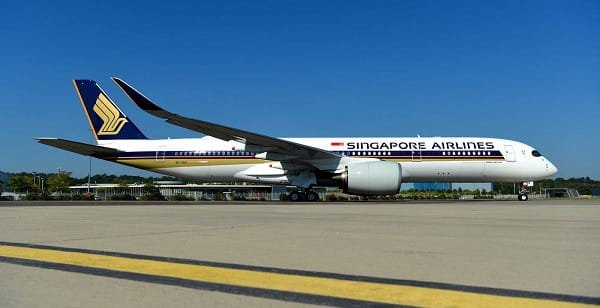
Singapore Airlines’ SQ23/SQ24 flight between New York’s JFK airport and Singapore Changi is the world’s longest commercial flight — covering an extraordinary 15,349 kilometres and keeping passengers airborne for approximately 18 hours and 27 minutes. This route has held the world’s longest flight title since November 2020 and shows no sign of being displaced until Qantas launches its Project Sunrise flights in 2027.
The flight is made possible by the Airbus A350-900ULR (Ultra Long Range) — a specially configured variant of the A350 with enlarged fuel tanks, raked wingtips, and a higher maximum takeoff weight that gives it the range to cover over 18,000 kilometres in a single fuel load. Singapore Airlines operates the route in a premium two-class configuration (Business Class and Premium Economy only) because the economics of carrying heavy fuel loads make fully economy-configured cabins commercially unviable on such extreme distances. Interestingly, the outbound and inbound routes often differ — the eastbound flight to New York frequently uses the Pacific jet stream for assistance, while the westbound return to Singapore often takes the polar route depending on conditions.
2. Newark EWR – Singapore (15,344 km) — Singapore Airlines
Just 5 kilometres shorter than its JFK counterpart, Singapore Airlines’ SQ21/SQ22 connecting Newark Liberty International Airport to Singapore Changi is the world’s second longest flight at 15,344 kilometres. The route was originally the world’s longest nonstop commercial flight when Singapore Airlines operated it between 2004 and 2013 using Airbus A340-500 aircraft, before fuel costs forced its suspension. It was revived in 2018 using the far more efficient A350-900ULR and has operated continuously since.
Newark serves as an important alternative departure point for travellers in the New York metropolitan area who find it more accessible than JFK, particularly those connecting from New Jersey and northern Manhattan. With a flight time of approximately 17 hours 58 minutes eastbound and 18 hours 45 minutes westbound — the directional difference reflecting the assistance or resistance of prevailing winds — this route consistently ranks among the most physically demanding journeys in commercial aviation.
3. Auckland – Doha (14,535 km) — Qatar Airways
Qatar Airways’ QR920/QR921 service between Auckland, New Zealand and Doha, Qatar covers 14,535 kilometres and takes approximately 16 hours 34 minutes — one of the few routes outside the Singapore Airlines duopoly to appear consistently at the top of the world’s longest flights list. The route was originally launched in 2017 using the Boeing 777-200LR and briefly held the world’s longest flight title before Singapore Airlines’ Newark service was reinstated in 2018.
The Auckland–Doha route is strategically important to Qatar Airways as it anchors the airline’s Southern Hemisphere network — providing New Zealand passengers with a direct gateway to Doha’s extraordinarily well-connected hub, from which connections to over 160 destinations in Europe, Africa, and Asia are available. The route currently operates using the Boeing 777-200LR following Qatar’s decision in 2025 to switch back from the A350-1000 — a choice reflecting the 777-200LR’s legendary combination of exceptional range and high payload capacity that makes it commercially superior on this specific routing.
4. New York JFK – Auckland (14,207 km) — Air New Zealand / Qantas
The 14,207-kilometre route between New York’s JFK and Auckland is notable for being operated by two separate airlines — Air New Zealand and Qantas — making it one of the very few ultra-long-haul routes with dual carrier competition. Air New Zealand launched the service in 2022 using Boeing 787-9 Dreamliners, with Qantas joining the route in 2023. The flight takes approximately 16 hours 52 minutes on the NZ1 service.
Air New Zealand has used this route as a testing ground for cabin innovations targeting ultra-long-haul comfort — the airline’s Economy Skycouch converts standard economy seats into a flat surface for sleeping, while the upcoming Skynest sleeping pods (launching in 2026) will provide dedicated economy-class sleeping berths specifically designed for overnight ultra-long-haul passengers. The JFK–Auckland route passes over the Pacific Ocean and offers some of the most dramatic inflight scenery for those seated at windows.
5. Auckland – Dubai (14,200 km) — Emirates
Emirates’ Auckland–Dubai service on the Airbus A380-800 covers 14,200 kilometres in approximately 16 hours 41 minutes — the world’s longest commercial flight operated by the iconic double-decker superjumbo. The route holds the specific distinction of being the longest A380 flight in the world, a record Emirates maintains with considerable pride given the aircraft’s capacity and the operational challenge of sustaining such a long sector commercially.
The A380’s sheer passenger capacity — carrying hundreds of travellers simultaneously — gives this route commercial viability that smaller aircraft on similar distances cannot match. Emirates’ onboard product for this marathon journey includes private first-class suites, an onboard lounge, and the carrier’s renowned Business Class flat-bed seats — all designed specifically for the demands of passengers spending over 16 hours in the air.
6. Perth – London Heathrow (14,498 km) — Qantas
Qantas made aviation history in March 2018 by launching the world’s first nonstop commercial flight between Australia and the United Kingdom — the Perth to London Heathrow service covering approximately 14,498 kilometres in around 17 hours 45 minutes. Operated using the Boeing 787-9 Dreamliner, the route was a landmark achievement for Qantas and for Australian aviation connectivity, eliminating a layover requirement that had defined Australia–UK travel for decades.
The route’s significance extends beyond mere distance — it represents Qantas’s phased approach toward Project Sunrise, the airline’s ambitious plan to eventually connect Sydney and Melbourne directly to London and New York. Perth serves as the Australian endpoint specifically because its western location reduces the total distance enough for the current generation of aircraft to manage the sector without additional fuel stops.
7. Sydney – Dallas/Fort Worth (13,804 km) — Qantas
Qantas’s Sydney to Dallas/Fort Worth service covers 13,804 kilometres using the Airbus A380 — the airline’s flagship transpacific route and one of the longest commercial services operated by the world’s largest passenger aircraft. Flight time averages approximately 17 hours 25 minutes depending on wind conditions across the Pacific.
This route is part of Qantas’s transpacific joint venture with American Airlines, combining both airlines’ networks to create a comprehensive Australia–North America connectivity programme. Dallas/Fort Worth’s central US location makes it an ideal hub for connecting Australian passengers onward to destinations across the eastern, central, and southern United States.
8. Johannesburg – Atlanta (13,582 km) — Delta Air Lines
Delta Air Lines’ Johannesburg OR Tambo to Atlanta Hartsfield-Jackson service spans 13,582 kilometres — the longest route operated by a US carrier connecting North America to Sub-Saharan Africa. Flight time averages approximately 16 hours 55 minutes.
The route holds economic significance beyond its impressive distance — it connects South Africa’s financial capital directly to Atlanta, Delta’s largest hub, enabling seamless connections across Delta’s extensive North American network for business travellers between the two continents. The service operates on Boeing 767 aircraft, representing one of the longest commercial routes for this aircraft type.
9. Abu Dhabi – Los Angeles (13,502 km) — Etihad Airways
Etihad Airways’ Abu Dhabi to Los Angeles service covering 13,502 kilometres is one of the Middle East’s longest transpacific routes, connecting the UAE’s capital directly to the US West Coast in approximately 16 hours 45 minutes. The route operates using the Boeing 787-9 Dreamliner and serves the significant business and leisure travel market between the Gulf region and southern California.
Etihad has continued expanding its US network, with new nonstop services to additional American cities planned for 2026 — reflecting the Gulf carriers’ sustained commitment to capturing long-haul premium traffic flows between their Middle Eastern hubs and North America’s major cities.
10. Hong Kong – Washington DC (13,121 km) — Cathay Pacific
Cathay Pacific’s Hong Kong to Washington Dulles International Airport service covers 13,121 kilometres in approximately 16 hours 20 minutes — the southernmost major US capital directly connected to one of Asia’s premier aviation hubs. The route uses Airbus A350-1000 aircraft and has gained additional strategic importance following routing changes necessitated by avoidance of certain airspace over Russia and Central Asia since 2022.
The Hong Kong–Washington route serves significant government, diplomatic, and business travel demand between the US capital and Hong Kong, alongside connecting passengers moving between the US East Coast and Cathay’s extensive Asian network via Hong Kong.
Frequently Asked Questions (FAQs)
Q: Which is the longest flight in the world?
A: Singapore Airlines’ JFK–Singapore route at 15,349 km, taking approximately 18 hours 27 minutes, is the world’s longest commercial nonstop flight.
Q: Which aircraft is used for the world’s longest flights?
A: The Airbus A350-900ULR (Ultra Long Range) is the primary aircraft for the world’s longest routes, operated by Singapore Airlines. The Boeing 787-9 Dreamliner and Airbus A380 are also used on other extreme long-haul routes.
Q: What will be the longest flight ever when Qantas Project Sunrise launches?
A: Qantas’s Project Sunrise Sydney–London route at approximately 17,000–18,000 km and 20+ hours will become the world’s longest commercial flight when it launches, expected in 2027.
Q: How do passengers manage on flights over 17 hours?
A: Airlines use cabin design innovations, optimised lighting to reduce jet lag, high-humidity cabin environments, specially designed menus, and enhanced seat comfort including flat-bed Business Class and premium economy products to make ultra-long-haul travel manageable.

Brandon is the cheif editor and writer at WorldUnfolds.com. With a passion for storytelling and a keen editorial eye, he crafts engaging content that captivates and enlightens readers worldwide.