Tunnels represent some of engineering’s most ambitious and technically demanding achievements — boring through mountains, under oceans, and deep beneath cities to create pathways that would be impossible or impossibly slow on the surface. From ancient Roman aqueduct tunnels to today’s laser-guided tunnel boring machines that chew through kilometres of rock per month, humanity has been perfecting the art of underground passage for thousands of years.
The world’s longest tunnels today serve a range of purposes — water delivery, railway transport, and road travel — with each category maintaining its own length records. Whether delivering drinking water to New York City through 137 kilometres of bedrock or connecting the UK and France beneath the English Channel, these tunnels represent the full scope of underground engineering at its most extraordinary scale.
| Rank | Tunnel | Country | Length | Type | Year |
| 1 | Delaware Aqueduct | USA | 137 km | Water | 1945 |
| 2 | Päijänne Water Tunnel | Finland | 120 km | Water | 1982 |
| 3 | Gotthard Base Tunnel | Switzerland | 57.1 km | Railway | 2016 |
| 4 | Seikan Tunnel | Japan | 53.9 km | Railway | 1988 |
| 5 | Channel Tunnel (Eurotunnel) | UK/France | 50.5 km | Railway | 1994 |
| 6 | Yulhyeon Tunnel | South Korea | 50.3 km | Railway | 2016 |
| 7 | Songshan Lake Tunnel | China | 38.82 km | Railway | 2023 |
| 8 | Lötschberg Base Tunnel | Switzerland | 34.6 km | Railway | 2007 |
| 9 | Lærdal Tunnel | Norway | 24.51 km | Road | 2000 |
| 10 | Yamate Tunnel | Japan | 18.2 km | Road | 2015 |
1. Delaware Aqueduct — 137 km (USA)
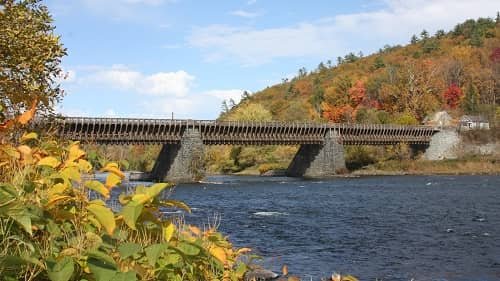
The Delaware Aqueduct in New York State is the world’s longest tunnel by a substantial margin — 137 kilometres of continuous underground waterway bored through the bedrock of the Hudson Valley between 1937 and 1945. This is not a transport tunnel but an engineering marvel of water infrastructure — delivering approximately 50% of New York City’s daily drinking water supply (roughly 1 billion gallons per day) from reservoirs in the Catskill Mountains to distribution points in southern Westchester County.
The aqueduct was constructed as part of New York City’s ambitious Delaware Water Supply System — the largest municipal water supply project ever undertaken in the United States at the time. The tunnel’s 4-metre diameter bore travels at depths of up to 300 metres through hard granite and gneiss bedrock, following a route designed to use natural gravity flow rather than pumping wherever possible. The Delaware Aqueduct currently holds the distinction of being the world’s longest tunnel in any category, outlasting all subsequent transport tunnels by a comfortable margin. A significant $1 billion repair project to address leakage issues identified in the early 2000s is currently underway, with completion expected in 2027.
2. Päijänne Water Tunnel — 120 km (Finland)
Finland’s Päijänne Water Tunnel is the world’s second longest tunnel at 120 kilometres — another water infrastructure tunnel rather than a transport structure, delivering raw freshwater from Lake Päijänne in central Finland to the water treatment facilities serving the Helsinki metropolitan area. Construction took a decade from 1972 to 1982, requiring excavation entirely through Finland’s ancient, extremely hard Precambrian bedrock.
The tunnel ensures water security for over 1.3 million people in the Greater Helsinki region — one of the world’s most reliable and highest-quality municipal water supply systems. The Päijänne tunnel’s diameter is large enough to accommodate truck passage, and the tunnel creates a natural gravity-fed flow from Lake Päijänne to Helsinki at depths ranging from 30 to 100 metres in bedrock. Finland’s reputation for exceptionally clean drinking water is in no small part a consequence of this remarkable underground infrastructure project.
3. Gotthard Base Tunnel — 57.1 km (Switzerland)
The Gotthard Base Tunnel in Switzerland is the world’s longest and deepest railway tunnel — 57.1 kilometres of twin-bore tunnel bored through the heart of the Swiss Alps between Erstfeld in the north and Bodio in the south. The tunnel took 17 years to construct (1999–2016) and cost approximately 11 billion Swiss francs — one of the most expensive infrastructure projects ever completed in Europe. It was opened with considerable ceremony in June 2016, with European leaders in attendance and a uniquely Swiss celebration featuring yodelling and alpine horns.
The tunnel sits up to 2,300 metres below the Alpine peaks above it and required excavation through extraordinarily complex geological conditions including unstable rock, extreme heat (temperatures in the tunnel during construction reached 46°C), and massive groundwater pressure. Trains pass through the completed tunnel in approximately 20 minutes at speeds up to 250 km/h — reducing Zurich to Milan travel time by nearly an hour and providing a critical freight corridor between northern and southern Europe through the New Rail Link through the Alps project. The tunnel contains 3,200 kilometres of copper cable laid during construction — enough to reach across much of the European continent.
4. Seikan Tunnel — 53.9 km (Japan)
Japan’s Seikan Tunnel is the world’s longest undersea railway tunnel and the longest tunnel with a significant undersea section — 53.9 kilometres connecting the Japanese islands of Honshu and Hokkaido beneath the Tsugaru Strait. Construction began in 1971 and was completed in 1988 after an extraordinarily difficult 17-year construction period that included a catastrophic 1976 flood that nearly abandoned the project entirely.
The tunnel descends to 240 metres below sea level — its lowest point — making it the deepest undersea tunnel in the world by depth below sea level. The Seikan Tunnel’s construction required the invention of new drilling and waterproofing techniques that subsequently influenced tunnel engineering worldwide. Two underwater stations — Tappi-Kaitei and Yoshioka-Kaitei — are located within the tunnel below the seabed, though these are no longer used for regular passenger service. The tunnel remains essential for Japan’s north–south rail connectivity, though the Hokkaido Shinkansen now uses it for high-speed services.
5. Channel Tunnel — 50.5 km (UK / France)
The Channel Tunnel — popularly known as the Eurotunnel — is the world’s longest undersea railway tunnel by undersea length, with 39 kilometres of its 50.5-kilometre total length passing beneath the English Channel. It connects Folkestone in England to Coquelles near Calais in France, and when it opened in 1994 after six years of construction at a cost of approximately £14.7 billion, it fulfilled a centuries-old dream of a fixed crossing between Britain and the European mainland.
The tunnel actually consists of three parallel bores — two rail tunnels and a central service tunnel — which collectively represent one of the largest undersea civil engineering projects ever undertaken. Eurostar passenger trains connect London St. Pancras to Paris Gare du Nord in approximately 2 hours 16 minutes through the tunnel, while Eurotunnel Le Shuttle carries cars, trucks, and motorcycles on a drive-on/drive-off shuttle service. The Channel Tunnel reduced travel time between London and Paris more dramatically than any transport innovation since the introduction of air travel, reshaping European travel patterns fundamentally.
6. Yulhyeon Tunnel — 50.3 km (South Korea)
South Korea’s Yulhyeon Tunnel at 50.3 kilometres is the fourth longest railway tunnel in the world and the longest in South Korea — forming the primary underground section of the Suseo High-Speed Railway connecting Suseo in Seoul to Pyeongtaek to the south. Opened in December 2016 after more than five years of construction, the double-track tunnel is designed for maximum speeds of 300 km/h with an average operating speed of approximately 240 km/h.
The tunnel was constructed using the New Austrian Tunnelling Method — a technique that uses the surrounding rock’s own load-bearing capacity rather than rigid pre-formed linings, making it particularly suitable for the complex geological conditions of Gyeonggi Province’s urban environment. The Yulhyeon Tunnel demonstrates how modern long railway tunnels are increasingly driven by urban needs rather than mountain geography — this tunnel exists primarily to pass beneath Seoul’s densely built suburban environment rather than to cross a geographical obstacle.
7. Songshan Lake Tunnel — 38.82 km (China)
China’s Songshan Lake Tunnel stretches 38.82 kilometres through Guangdong Province’s rapidly growing industrial and urban corridor between Jiao Station and Changping East Station on the Dongguan–Huizhou Intercity Railway. Completed in 2023, it is the longest national railway tunnel in mainland China and contains six underground stations — a feature that distinguishes it from most long tunnels that are simply point-to-point connections with no intermediate stops.
The presence of six subterranean stations transforms the Songshan Lake Tunnel from a simple underground bypass into an integrated urban rail system that serves multiple communities along its 38-kilometre route. Trains operate at up to 200 km/h through the tunnel, with 31 pairs of daily services navigating the six stations and the connecting surface sections of the broader intercity railway network.
8. Lötschberg Base Tunnel — 34.6 km (Switzerland)
Switzerland’s Lötschberg Base Tunnel at 34.6 kilometres is the third longest railway tunnel in Europe and a critical component of Switzerland’s north–south freight and passenger rail network through the Bernese Alps. The tunnel was opened in 2007 and forms part of the same New Rail Link through the Alps programme as the Gotthard Base Tunnel, together providing Switzerland with two parallel deep-base tunnel corridors through the Alps for European rail freight and passenger traffic.
The Lötschberg was opened initially with only one of its two bores fully equipped for train operation — a phased approach that reduced costs while the traffic demand built to justify the full dual-track capacity. Expansion work underway through 2026 is adding double-track sections progressively to increase capacity. The tunnel reduced travel time between Bern and Milan significantly when it opened and handles a substantial proportion of Switzerland’s vital north-south goods transit traffic.
9. Lærdal Tunnel — 24.51 km (Norway)
Norway’s Lærdal Tunnel is the world’s longest road tunnel at 24.51 kilometres — connecting the towns of Lærdal and Aurland in western Norway through the mountains that would otherwise make the route between Oslo and Bergen treacherous or impassable during winter. Construction began in 1995 and was completed in 2000 at a cost of over 1 billion Norwegian kroner.
The tunnel was designed with particular attention to the psychological challenge of driving 24 kilometres underground — the world’s first long road tunnel to incorporate deliberate atmospheric design features specifically to prevent driver drowsiness and disorientation. Three large caverns have been carved out of the rock at intervals along the tunnel’s length — illuminated with blue and yellow lighting to create the impression of dawn light — providing motorists with a psychological sense of reaching a waypoint rather than being in an endless featureless bore. The design has been widely studied and replicated in subsequent long road tunnels worldwide.
10. Yamate Tunnel — 18.2 km (Japan)
Japan’s Yamate Tunnel in Tokyo at 18.2 kilometres is the world’s second longest road tunnel and the longest urban road tunnel — forming a critical section of the Tokyo Metropolitan Expressway Central Circular Route that passes beneath the Japanese capital’s densely built inner districts. Completed in stages between 2007 and 2015, the full tunnel finally opened in March 2015.
The Yamate Tunnel solves one of urban engineering’s most challenging problems — providing high-capacity highway access through an existing mega-city without the land acquisition costs or community disruption that surface motorways in such densely built environments would cause. The tunnel runs beneath Tokyo’s densely populated Shinjuku and Shibuya wards, connecting the city’s outer ring roads without surface impact. Its construction required some of the most advanced tunnel engineering techniques ever applied to an urban road project, including simultaneous boring from multiple points to manage the extraordinary complexity of Tokyo’s underground environment.
Frequently Asked Questions (FAQs)
Q: What is the longest tunnel in the world?
A: The Delaware Aqueduct in New York State at 137 kilometres is the world’s longest tunnel overall. Among railway tunnels, Switzerland’s Gotthard Base Tunnel at 57.1 km is the longest.
Q: Which is the world’s longest undersea tunnel?
A: The Seikan Tunnel in Japan at 53.9 kilometres is the longest undersea tunnel, though the Channel Tunnel has the longest continuous undersea section at 39 kilometres.
Q: What is the world’s longest road tunnel?
A: Norway’s Lærdal Tunnel at 24.51 kilometres is the world’s longest road tunnel, connecting Lærdal and Aurland through the mountains of western Norway.
Q: Which country has the most long tunnels?
A: Switzerland and China have the highest concentration of long railway tunnels, while Norway leads in long road tunnels due to its fjord-filled geography requiring underground connections.
Q: How long did it take to build the Gotthard Base Tunnel?
A: The Gotthard Base Tunnel took 17 years to build (1999–2016) and cost approximately 11 billion Swiss francs — one of the most expensive infrastructure projects in European history.

Brandon is the cheif editor and writer at WorldUnfolds.com. With a passion for storytelling and a keen editorial eye, he crafts engaging content that captivates and enlightens readers worldwide.