Train travel at its greatest scale is not merely transportation — it is a journey through entire continents, time zones, and civilisations. The world’s longest train routes span thousands of kilometres across Russia’s vast Siberian wilderness, China’s diverse interior landscapes, and the wide open prairies of Canada and Australia, offering experiences that no other mode of transport can replicate.
Unlike flights that compress distance into hours of altitude, long train routes reveal the earth’s actual scale — passing through eight time zones, crossing the Ural Mountains, skirting the shores of Lake Baikal, or traversing the endless Nullarbor Plain. These routes are not just about reaching a destination but about the journey itself — one of travel’s most profound pleasures.
| Rank | Route | Country | Distance | Duration | Stops |
| 1 | Moscow – Vladivostok (Trans-Siberian) | Russia | 9,289 km | ~7 days | 87+ |
| 2 | Moscow – Beijing (Trans-Mongolian) | Russia/Mongolia/China | 7,622 km | ~6 days | Multiple |
| 3 | Moscow – Beijing (Trans-Manchurian) | Russia/China | 8,961 km | ~6 days | Multiple |
| 4 | Toronto – Vancouver (The Canadian) | Canada | 4,466 km | ~3.5 days | 66 |
| 5 | Shanghai – Lhasa | China | 4,373 km | ~2.5 days | Multiple |
| 6 | Sydney – Perth (Indian Pacific) | Australia | 4,352 km | ~3 days | Multiple |
| 7 | Dibrugarh – Kanyakumari (Vivek Express) | India | 4,234 km | ~4 days | 57 |
| 8 | Chicago – San Francisco (California Zephyr) | USA | 3,924 km | ~3 days | Multiple |
| 9 | Beijing – Guangzhou | China | 3,706 km | ~2 days | Multiple |
| 10 | Adelaide – Darwin (The Ghan) | Australia | 2,979 km | ~2 days | 3 |
1. Trans-Siberian Railway — Moscow to Vladivostok (9,289 km)
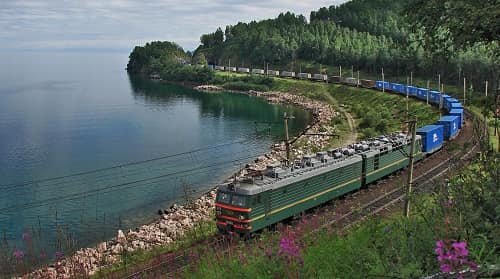
The Trans-Siberian Railway is the world’s longest train route by a considerable margin — 9,289 kilometres of continuous track stretching from Moscow’s Yaroslavsky Station to the Pacific port city of Vladivostok in Russia’s Far East. The journey takes approximately 7 days and crosses 8 time zones — the equivalent of crossing from the Atlantic coast of Europe all the way to the Pacific Ocean of Asia on a single railway line. Construction began in 1891 under Tsar Nicholas II and took 25 years to complete across some of the world’s most inhospitable terrain.
The journey passes through some of Russia’s most iconic landscapes — the Ural Mountains that mark the geographical boundary between Europe and Asia, the birch forests and endless steppes of Siberia, and the magnificent shores of Lake Baikal — the world’s deepest lake and largest freshwater reservoir by volume. The train makes approximately 87 stops across cities including Yekaterinburg, Novosibirsk, Irkutsk, and Khabarovsk. Passengers can choose between the budget-friendly platzkart (open-plan dormitory carriage), the more comfortable kupé (four-berth compartments), or the premium spalny vagon (two-berth sleeper compartments). The Trans-Siberian is not just the world’s longest railway — it is one of earth’s greatest travel experiences.
2. Trans-Mongolian Railway — Moscow to Beijing (7,622 km)
The Trans-Mongolian Railway connecting Moscow to Beijing is the world’s second longest international train route at 7,622 kilometres — a six-day journey that crosses four distinct countries (Russia, Mongolia, Kazakhstan, and China) and passes through some of Central Asia’s most dramatic scenery. The route branches off the main Trans-Siberian line at Ulan-Ude in Siberia, heading south through the Mongolian capital Ulaanbaatar before crossing into China via the Gobi Desert and continuing to Beijing.
The journey’s most spectacular section is the crossing of Mongolia — vast open steppe, dramatic mountain ranges, and the extraordinary emptiness of the Gobi Desert create a visual experience entirely unlike anywhere else on the Trans-Siberian corridor. Passengers transit through Ulaanbaatar, offering a brief window into Mongolia’s rapidly modernising capital that still maintains deep connections to its nomadic heritage. The train requires a wheel-gauge change at the Russian-Mongolian and Mongolian-Chinese borders, as the track width changes between countries.
3. Trans-Manchurian Railway — Moscow to Beijing via Manchuria (8,961 km)
The Trans-Manchurian route offers an alternative Moscow–Beijing connection at 8,961 kilometres — longer than the Trans-Mongolian route because it bypasses Mongolia entirely, instead crossing into China through Manchuria at the Russian border town of Zabaikalsk. The journey takes approximately 6 days and passes through the frozen Siberian city of Harbin in northeastern China before heading southwest to Beijing.
The primary practical advantage of the Trans-Manchurian over the Trans-Mongolian is that it does not require a Mongolian visa — making it the preferred option for travellers who want to complete the Moscow–Beijing journey without the additional paperwork. The route passes through China’s Heilongjiang and Inner Mongolia provinces — landscapes of frozen rivers, pine forests, and agricultural plains that offer a different visual narrative from the Gobi-dominated Trans-Mongolian crossing.
4. The Canadian — Toronto to Vancouver (4,466 km)
Via Rail Canada’s The Canadian is one of the world’s most celebrated train journeys — 4,466 kilometres across Canada’s full continental width from Toronto’s Union Station to Vancouver’s Pacific Central Station. The journey takes approximately 3.5 days (86 hours), traversing four provinces and some of North America’s most spectacular scenery including the Canadian Shield, the prairies of Manitoba and Saskatchewan, the Rocky Mountains of British Columbia, and finally the Pacific Coast.
The train departs Toronto three times weekly and makes 66 scheduled stops. The Canadian’s glass-domed observation car — nicknamed the “Park Car” — is the journey’s signature feature, providing panoramic views of the Rocky Mountain crossing that many passengers consider among the most beautiful train travel experiences on earth. The route passes through Winnipeg, Saskatoon, Edmonton, Jasper, and Kamloops before its dramatic descent to Vancouver.
5. Shanghai – Lhasa Railway (4,373 km)
The Shanghai to Lhasa train service covering 4,373 kilometres is one of the world’s most extraordinary railway journeys — not merely for its length but for the altitude it reaches. The route includes the famous Qinghai–Tibet Railway section, which crosses the Tanggula Pass at 5,072 metres above sea level — the world’s highest railway pass. At these extreme altitudes, the train’s carriages are specially pressurised with supplemental oxygen supplies for passengers, and windows are made with UV-blocking glass to protect against intense high-altitude solar radiation.
The 2.5-day journey passes through the landscapes of eastern China’s cities and plains before ascending dramatically onto the Tibetan Plateau — crossing the Yellow River, skirting the shores of Qinghai Lake (China’s largest inland lake), and passing through permafrost terrain that required extraordinary engineering solutions including special insulated foundations to prevent the track from shifting as frozen ground thaws seasonally.
6. Indian Pacific — Sydney to Perth (4,352 km)
The Indian Pacific’s 4,352-kilometre transcontinental journey from Sydney on Australia’s Pacific Coast to Perth on the Indian Ocean coast is one of the Southern Hemisphere’s most iconic train journeys — crossing three states in approximately 3 days and traversing the world’s longest stretch of completely straight railway track across the Nullarbor Plain. That famous straight section — 478 kilometres without a single curve — is the most dramatic expression of the Nullarbor’s absolute flatness and Australia’s extraordinary continental scale.
The route traverses the Blue Mountains west of Sydney, the goldfield towns of inland New South Wales, the vast Outback of South Australia, and the bone-dry Nullarbor before descending to Perth through Western Australia’s wheat belt. Great Southern Rail operates the service weekly with on-board dining, observation lounges, and a range of cabin classes from seated daynighter carriages to deluxe sleeper suites.
7. Vivek Express — Dibrugarh to Kanyakumari (4,234 km)
India’s Vivek Express holds the distinction of being the longest train route in India and one of the longest in Asia — travelling 4,234 kilometres from Dibrugarh in Assam’s northeastern tea country to Kanyakumari at India’s southernmost tip where the Arabian Sea, Bay of Bengal, and Indian Ocean converge. The weekly express takes approximately 4 days to complete its journey, making 57 stops across some of India’s most diverse geographical and cultural landscapes.
The route passes through Assam’s tea gardens, the plains of West Bengal, the coastal regions of Odisha and Andhra Pradesh, and the culturally rich landscapes of Tamil Nadu. The Vivek Express was named in honour of Swami Vivekananda on the occasion of the 150th anniversary of his birth, reflecting its symbolic role as a connector of India’s geographic extremities — from its northeastern hills to its southernmost point.
8. California Zephyr — Chicago to San Francisco (3,924 km)
Amtrak’s California Zephyr covering 3,924 kilometres from Chicago’s Union Station to San Francisco’s Emeryville station is widely considered the most scenically spectacular train route in the United States. The 3-day journey takes passengers through 8 states — Illinois, Iowa, Nebraska, Colorado, Utah, Nevada, California — offering the dramatic transition from the flat Great Plains to the Rocky Mountains and finally over the Sierra Nevada to the Pacific Coast.
The train’s most celebrated section is its crossing of the Rocky Mountains through Colorado’s spectacular Gore Canyon and the Moffat Tunnel at 2,822 metres elevation — the highest point on the Amtrak national rail network. The route then traverses Utah’s canyonlands, the Bonneville Salt Flats, and the Nevada desert before the final dramatic crossing of the Sierra Nevada into California.
9. Beijing – Guangzhou Railway (3,706 km)
China’s Beijing to Guangzhou rail service covers 3,706 kilometres connecting China’s political capital in the north to its southern commercial gateway — a route that passes through China’s densely populated central provinces including Hebei, Henan, Hubei, Hunan, and Guangdong. The approximately 2-day journey offers a comprehensive window into China’s extraordinary population density and economic diversity across its north-south axis.
The route connects some of China’s most historically and culturally significant cities, including Zhengzhou — the capital of Henan Province and a city of enormous ancient Chinese civilisational significance — and Wuhan, the capital of Hubei Province on the Yangtze River. The service demonstrates the contrast between China’s older conventional rail network and its newer high-speed alternatives on parallel corridors.
10. The Ghan — Adelaide to Darwin (2,979 km)
Australia’s legendary Ghan covers 2,979 kilometres from Adelaide in South Australia to Darwin in the Northern Territory — the only north-south transcontinental railway in Australia and one of the world’s most famous luxury train journeys. The train traverses the Australian Outback’s full north-south length, passing through Alice Springs in the Red Centre before continuing to the tropical north.
The Ghan’s name references the Afghan cameleers who carried supplies across the Australian interior before the railway’s completion, honouring their contribution to opening Australia’s remote interior. The service runs twice weekly and takes approximately 2 days — with off-train excursions at Alice Springs and Katherine providing passengers with direct access to the Outback’s extraordinary landscapes, Indigenous cultural heritage, and Katherine Gorge’s spectacular river canyon scenery.
Frequently Asked Questions (FAQs)
Q: What is the longest train route in the world?
A: The Trans-Siberian Railway from Moscow to Vladivostok at 9,289 kilometres is the world’s longest single continuous train route.
Q: What is the longest train journey in India?
A: The Vivek Express from Dibrugarh to Kanyakumari at 4,234 kilometres is India’s longest train route, taking approximately 4 days.
Q: Which is the most scenic long train journey?
A: The Trans-Siberian, The Canadian, and the California Zephyr are consistently rated among the world’s most scenically spectacular long train journeys.
Q: How many time zones does the Trans-Siberian Railway cross?
A: The Trans-Siberian Railway crosses 8 time zones during its 9,289-kilometre journey from Moscow to Vladivostok.

Brandon is the cheif editor and writer at WorldUnfolds.com. With a passion for storytelling and a keen editorial eye, he crafts engaging content that captivates and enlightens readers worldwide.