Tortoises are the world’s longest-lived land vertebrates — a distinction explained by their slow metabolic rates, disease resistance, efficient cellular repair mechanisms, and the protection of their remarkable shells. Some tortoise species routinely reach 100 years, and a number of documented individuals have exceeded 150, 180, and even 190 years. Their extraordinary longevity has made specific individual tortoises into living historical landmarks — witnesses to centuries of human history who connect the present to the distant past through their continued existence. Here are the ten oldest tortoises in the world, combining verified living individuals with well-documented historical cases.
1. Jonathan — 191+ Years Old (Aldabra Giant Tortoise, Saint Helena)
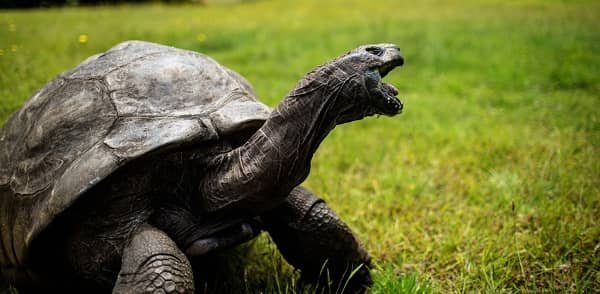
Jonathan is the world’s oldest living land animal and the oldest tortoise ever recorded — an Aldabra giant tortoise (Aldabrachelys gigantea) residing on the island of Saint Helena in the South Atlantic. Born around 1832, Jonathan was brought from the Seychelles to Saint Helena as a young adult in 1882, where he has lived on the grounds of Plantation House — the governor’s official residence — ever since. In 2022, Guinness World Records officially confirmed Jonathan as the world’s oldest living land animal. He is now blind from cataracts and has lost his sense of smell but maintains good appetite with hand-feeding from the island’s veterinarian. Jonathan has outlived five British monarchs, survived two World Wars, and inhabited the same garden grounds that hosted Napoleon Bonaparte’s exiled entourage generations before Jonathan’s own arrival. His continued survival has made him Saint Helena’s most celebrated resident.
2. Tu’i Malila — 188 Years Old (Radiated Tortoise, Tonga, Deceased)
Tu’i Malila — “King Malila” — was a radiated tortoise (Astrochelys radiata) that lived at the Royal Palace of Tonga and died on May 19, 1965, at the verified age of approximately 188 years. According to Tongan royal tradition, Tu’i Malila was presented to the Tongan royal family by the British navigator Captain James Cook during his visit to the island around 1777 — a provenance that, if accurate, makes it one of the most historically documented tortoise individuals in history. The Tongan royal family cared for Tu’i Malila across eleven generations of monarchs, and the tortoise became a revered symbol of the royal lineage’s continuity and stability. Verification of Tu’i Malila’s age through the Cook connection is supported by Tongan royal records, though some researchers argue the gifting may have occurred during a later Cook voyage or from a subsequent navigator.
3. Harriet — 175 Years Old (Galápagos Giant Tortoise, Australia, Deceased)
Harriet — a Galápagos giant tortoise (Chelonoidis niger) who died at Australia Zoo in Queensland on June 23, 2006 — was approximately 175 years old at death, making her one of the oldest verified tortoises in recorded history. She had been living at Australia Zoo under the care of the Irwin family since 1987 and had resided in Australia since the 1860s. The popular tradition that Harriet was one of three tortoises collected by Charles Darwin during his 1835 Galápagos voyage aboard HMS Beagle has been investigated — DNA analysis confirmed she was a Galápagos tortoise of the Santa Cruz subspecies, consistent with the Beagle voyage collection. At her death, Harriet weighed approximately 150 kilograms and remained active and healthy until the final days of her 175-year life, passing away from heart failure.
4. Adwaita — 150–250 Years Old (Aldabra Giant Tortoise, India, Deceased)
Adwaita — “One and Only” in Sanskrit — was an Aldabra giant tortoise who died on March 22, 2006, at the Alipore Zoological Gardens in Kolkata, India, at an age that was claimed to be approximately 250 years but which is more conservatively estimated at 150–175 years based on documentary evidence. According to popular tradition, Adwaita was one of several tortoises given to Robert Clive — the British East India Company general who established British dominance in India — and then donated to the Alipore Zoo when it opened in 1876. Carbon-dating of his shell fragments conducted after his death yielded dates approximately consistent with the 18th-century provenance claims, though the 250-year age estimate remains contested by some researchers who place his birth closer to 1750 than to 1750 BCE.
5. Timothy — 160 Years Old (Mediterranean Tortoise, UK, Deceased)
Timothy was a Mediterranean spur-thighed tortoise (Testudo graeca) who lived at Powderham Castle in Devon, England, and died on April 4, 2004, at the verified age of approximately 160 years. Timothy was believed to have been a ship’s mascot aboard a Royal Navy vessel during the Crimean War (1853–1856) — making him one of the few known animal participants in that conflict. After the war, he was donated to a Devon family and eventually became a permanent resident of Powderham Castle, where he lived for over 100 years. Remarkably, Timothy was believed to be female for most of his documented life — his sex was only corrected during a veterinary examination in 1926. Despite this confusion, Timothy’s documented history from the Crimean War period onward provides excellent verification of his extraordinary age.
6. Esmeralda — 170+ Years Old (Aldabra Giant Tortoise, Seychelles)
Esmeralda, a male Aldabra giant tortoise living on Bird Island in the Seychelles, is estimated to be over 170 years old and recognised as the world’s oldest known wild tortoise as well as the heaviest free-living tortoise on Earth at over 300 kilograms. Esmeralda wanders freely across Bird Island, which operates as a private nature reserve, and has been documented by visitors and researchers for decades. His extraordinary weight and size — exceeding virtually all other recorded Aldabra tortoises — reflect a lifetime of unrestricted access to the island’s vegetation and minimal competition. Esmeralda attracts visitors to Bird Island and has become one of the Seychelles’ most celebrated natural ambassadors, symbolising the conservation success that has allowed the Aldabra giant tortoise population to recover from near-extinction.
7. Solitary George — 100+ Years (Galápagos Giant Tortoise, Ecuador, Deceased)
Lonesome George was a Galápagos giant tortoise who was the last known individual of the Pinta Island subspecies (Chelonoidis abingdonii) — and therefore the rarest creature on Earth before his death on June 24, 2012, at an estimated age of over 100 years. Discovered on Pinta Island in 1971 when his subspecies was believed extinct, George became a global symbol of conservation and the tragedy of species extinction. Despite decades of attempts to breed him with females of the closest related subspecies, George never produced viable offspring. His death represented the complete extinction of the Pinta Island tortoise subspecies — an irreversible loss that catalysed significant conservation investment across the Galápagos Islands and generated broader public engagement with extinction issues globally.
8. Dirk — 157 Years Old (Aldabra Giant Tortoise, Scotland, Deceased)
Dirk was an Aldabra giant tortoise who lived at Colchester Zoo and later Edinburgh Zoo, estimated to be approximately 157 years old at his death. He had been in British captivity since the 19th century, with documentation supporting his arrival in the UK in the Victorian era as a young adult tortoise. His long history in British zoo systems, carefully maintained by successive zoo institutions across generations of keepers, provided the documentary evidence supporting his age estimate. Dirk’s longevity across multiple institutional homes demonstrated both the extraordinary survival capacity of Aldabra giant tortoises and the importance of institutional record-keeping in preserving the historical documentation necessary to verify extreme animal ages.
9. Tuki — 130+ Years Old (Aldabra Giant Tortoise, New Zealand)
Tuki, an Aldabra giant tortoise at Auckland Zoo in New Zealand, is estimated to be over 130 years old — with institutional records documenting his presence at the zoo from the early 20th century and provenance documentation suggesting he was collected in the late 19th century as a young adult tortoise from the Aldabra Atoll. Auckland Zoo’s meticulous animal records across over a century of operation provide the documentary foundation for Tuki’s age estimate. He has become one of Auckland Zoo’s most beloved residents, with multiple generations of New Zealand schoolchildren having encountered him during school visits — a living connection between contemporary New Zealand and the Victorian era when the Aldabra Atoll tortoises were being collected for the world’s zoological gardens.
10. Mzee — 130+ Years Old (Aldabra Giant Tortoise, Kenya)
Mzee — meaning “Wise Old Man” in Swahili — gained international fame in December 2004 when a young hippo named Owen, separated from his family during the Indian Ocean tsunami, was brought to the Haller Park wildlife sanctuary near Mombasa, Kenya, and formed an extraordinary and widely photographed friendship with Mzee, who was then estimated to be approximately 130 years old. The Owen-Mzee friendship — with the young hippo following the ancient tortoise everywhere, sleeping beside him, and mimicking his feeding behaviour — became one of the early internet age’s first global viral animal stories, inspiring multiple children’s books and a documentary. Mzee’s calm acceptance of the hyperactive young hippo demonstrated the remarkable equanimity that seems to characterise ancient tortoises — creatures for whom the urgencies that consume younger animals have long since become irrelevant.
Conclusion
These ten remarkable tortoises span nearly two centuries of individual existence and collectively represent some of the most extraordinary lives in the animal kingdom. Their longevity — rooted in biology but sustained by the conscious care of humans who recognised their historical significance — makes them living bridges between our present moment and the deep past. Protecting surviving tortoise populations ensures that future generations will have the privilege of encounters with beings who carry centuries of quiet, patient existence within them.

Brandon is the cheif editor and writer at WorldUnfolds.com. With a passion for storytelling and a keen editorial eye, he crafts engaging content that captivates and enlightens readers worldwide.