Trees are among the Earth’s most extraordinary living beings — organisms capable of surviving for millennia while ecosystems, civilisations, and species around them rise and fall. The oldest trees in the world were already ancient when the pyramids of Egypt were built, when the Roman Empire rose and collapsed, and when the entire recorded history of most human civilisations unfolded. Determining the oldest trees involves dendrochronology (counting growth rings), radiocarbon dating, and careful scientific verification. Here are the ten oldest trees on Earth, each a living monument to natural resilience spanning thousands of years.
1. Methuselah — Great Basin Bristlecone Pine (4,855 Years Old)
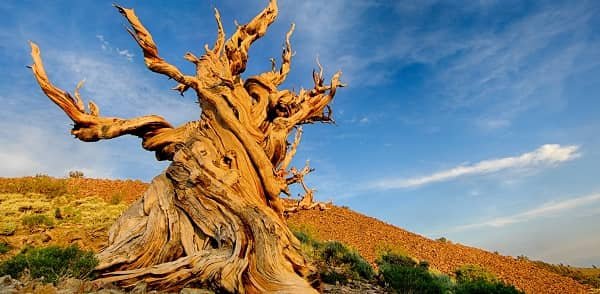
Methuselah is the world’s oldest known living non-clonal tree — a Great Basin Bristlecone Pine (Pinus longaeva) growing in the Inyo National Forest of California’s White Mountains at approximately 3,000 metres elevation. Discovered in 1953 by dendrochronologist Edmund Schulman and dated through ring counts, Methuselah was approximately 4,855 years old as of 2024 — meaning it germinated around 2833 BCE, when Egypt’s Old Kingdom pharaohs were building the first pyramids. The tree’s exact location within the Ancient Bristlecone Pine Forest is deliberately kept secret by the US Forest Service to protect it from vandalism. Bristlecone pines survive in their harsh, high-altitude, semi-arid environment precisely because the extreme conditions slow their growth — their dense, resinous wood resists insects, fungi, and rot in ways that faster-growing tree species cannot.
2. Prometheus — Great Basin Bristlecone Pine (4,900+ Years Old — Deceased)
Prometheus holds the tragic distinction of being the oldest tree whose age has been confirmed — and the oldest tree known to have been deliberately cut down. Growing in Wheeler Peak, Nevada, Prometheus was core-sampled in 1964 by researcher Donald Currey, who lost his borer in the tree and, with Forest Service permission, cut the tree down to count its rings. The ring count revealed the tree was approximately 4,900 years old — older than Methuselah — making it the oldest known non-clonal organism when it died. The discovery provoked significant controversy and contributed directly to the development of stronger scientific and conservation protocols governing the sampling of potentially ancient trees. Prometheus’s fate became a landmark event in conservation history.
3. Sarv-e Abarkooh (Zoroastrian Sarv) — Mediterranean Cypress (4,000–5,000 Years Old)
The Sarv-e Abarkooh — the Cypress of Abarkooh — in Yazd Province, Iran, is one of the world’s oldest known living trees, estimated to be between 4,000 and 5,000 years old. This Mediterranean cypress (Cupressus sempervirens) stands approximately 25 metres tall and has a trunk girth of 11.5 metres — dimensions reflecting millennia of slow, steady growth. Local tradition attributes its planting to the prophet Zoroaster or to the legendary Persian hero Japheth, son of Noah. The tree is a protected national monument of Iran and draws visitors from across the country as a symbol of continuity and endurance. It is not only a natural wonder but a cultural landmark deeply embedded in Persian national consciousness.
4. Llangernyw Yew, Wales, UK (4,000–5,000 Years Old)
The Llangernyw Yew in the churchyard of St Digain’s Church in Llangernyw, North Wales, is one of the world’s oldest living trees — a common yew (Taxus baccata) estimated to be between 4,000 and 5,000 years old. It was growing when the Bronze Age was at its height and when Stonehenge was under active construction. Yews are notoriously difficult to date precisely because their hollow trunks eliminate the central rings needed for accurate dendrochronology, but the Llangernyw Yew’s massive trunk fragment and its girth of approximately 9.3 metres support the estimated age range. The tree was designated one of 50 Great British Trees by the Tree Council during Queen Elizabeth II’s Golden Jubilee in 2002, and remains a living landmark connecting modern Welsh life to prehistoric Britain.
5. Pando — Quaking Aspen Colony (80,000 Years Old)
Pando — Latin for “I spread” — in Fishlake National Forest, Utah, is not a single tree in the conventional sense but a clonal colony of approximately 47,000 genetically identical quaking aspen trees (Populus tremuloides) sharing a single root system estimated to be approximately 80,000 years old. Weighing approximately 6,000,000 kilograms, Pando is considered the world’s heaviest known organism. The colony covers approximately 43 hectares — each visible trunk is a stem growing from the same ancient underground root mass. Individual stems live approximately 130 years, but the root system itself has been growing and regenerating since the last Ice Age. Pando is currently in decline due to overgrazing by deer and elk that prevent young stem regeneration — its conservation has become a significant priority for forest managers.
6. Old Tjikko — Norway Spruce (9,550 Years Old)
Old Tjikko on Fulufjället Mountain in Sweden is the world’s oldest known living individual clonal tree — a Norway spruce (Picea abies) whose root system has been radiocarbon dated to approximately 9,550 years. The visible trunk above ground is relatively young — only a few hundred years old — but it grows from the same root system that has been continuously regenerating since approximately 7550 BCE, shortly after Scandinavia’s Ice Age glaciers retreated. Named after the dog of Leif Kullman, the Swedish geologist who discovered it in 2004, Old Tjikko demonstrates the extraordinary regenerative capacity of clonal trees — where even when above-ground growth is destroyed by severe weather or grazing, the root system survives to produce new growth.
7. Chestnut Tree of One Hundred Horses (Italy) (2,000–4,000 Years Old)
The Castagno dei Cento Cavalli — the Chestnut Tree of One Hundred Horses — on the slopes of Mount Etna in Sicily is the world’s oldest and largest known chestnut tree (Castanea sativa). Estimated to be between 2,000 and 4,000 years old, the tree has a combined girth of approximately 57.9 metres and was historically a single massive trunk that has split into several sections. The name comes from a legend that Queen Joan I of Aragon and her escort of 100 knights sheltered under its canopy during a thunderstorm — a possible event given the original tree’s enormous spread. Protected as a national monument, the tree continues to produce chestnuts and remains a destination for visitors drawn to experience one of Europe’s most ancient living organisms.
8. Fitzroya Trees, Chile (3,600 Years Old)
The alerce or Fitzroya cupressoides trees of southern Chile and Argentina include some of the oldest living organisms in South America. The oldest confirmed alerce, growing in Chile’s Alerce Costero National Park, has been cored and dated to approximately 3,622 years old. Fitzroya — named after Captain Robert FitzRoy of HMS Beagle, who carried Charles Darwin on his famous voyage — can reach heights of 70 metres and trunk circumferences of several metres. These trees were heavily logged through the 19th and 20th centuries for their exceptionally durable, fragrant timber — now strictly protected by Chilean law. The alerce forests that survive represent extraordinary ecological and temporal continuity in one of the world’s most biodiverse temperate rainforest systems.
9. Ginkgo Trees, China (1,000–3,000 Years Old)
Ginkgo biloba is the world’s oldest tree species still living — a “living fossil” representing a lineage that has survived virtually unchanged for over 270 million years, making it older than the dinosaurs. Individual ginkgo trees can live for extraordinary lengths of time — the oldest known ginkgo specimens in China are estimated at over 3,000 years old, including sacred trees preserved in Buddhist and Taoist temple grounds. The famous Gu Guanyin ginkgo tree in the Zhongnan Mountains near Xi’an, China, is estimated at 1,400 years old. Six ginkgo trees famously survived the atomic bombing of Hiroshima in 1945 — sprouting green again the following spring within 1–2 kilometres of the explosion, earning them the name “bearer of hope.”
10. Jōmon Sugi, Japan (2,170–7,200 Years Old)
Jōmon Sugi on Yakushima Island, Japan, is the oldest and largest known Japanese cedar (Cryptomeria japonica) — with age estimates ranging from 2,170 to 7,200 years, though most scientists converge around 2,170–4,000 years for its reliable radiocarbon dating. The tree stands 25.3 metres tall with a trunk circumference of 16.4 metres — dimensions that convey extraordinary presence. Named after Japan’s Jōmon period of prehistoric culture, the tree was discovered in 1968 and became a key driver of Yakushima’s successful 1993 UNESCO World Heritage designation. The Yakushima cedar forests represented by Jōmon Sugi provide essential habitat for species found nowhere else on Earth, including the Yaku macaque and the Yaku deer — both subspecies endemic to the island.
Conclusion
These ten extraordinary organisms collectively span over 80,000 years of Earth’s living history. They have witnessed the rise and fall of civilisations, the extinction and evolution of species, and every climatic and geological change their environments have experienced. Their survival is a testament to life’s extraordinary resilience — and their continued existence depends on humanity’s commitment to protecting the ancient natural world that long preceded us.

Brandon is the cheif editor and writer at WorldUnfolds.com. With a passion for storytelling and a keen editorial eye, he crafts engaging content that captivates and enlightens readers worldwide.