The Shivling — the iconic representation of Lord Shiva as the formless, limitless, cosmic source of existence — is the most universally revered sacred object in Hinduism and one of humanity’s oldest continuously worshipped religious symbols. The Shivling (also written as Shivalinga) represents Shiva’s infinite nature through an aniconic form — a smooth, pillar-like stone that embodies the divine beyond any particular form or limit. Hindu tradition holds that certain Shivlings were not made by human hands but are Svayambhu (self-manifested) — appearing spontaneously from the earth as direct manifestations of Lord Shiva’s presence. Here are the ten oldest and most sacred Shivlings in the world, traced through historical records, archaeological evidence, and living religious tradition.
1. Jyotirlinga at Somnath, Gujarat (Prehistoric — Svayambhu)
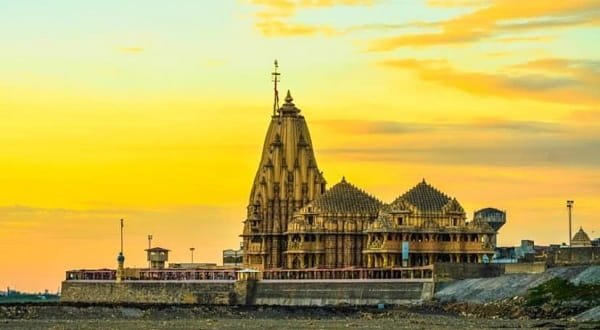
The Somnath Jyotirlinga in Prabhas Patan, Saurashtra, Gujarat, is considered the first and most sacred of the twelve Jyotirlingas — the most sacred Shivlings in Hinduism. The Shivling at Somnath is a Svayambhu linga, held in tradition to be self-manifested since the beginning of creation. The Skanda Purana and Shiva Purana both describe Somnath as the site of one of the most ancient Shiva temples in existence, and the Rigveda’s references to Prabhasa Tirtha — the sacred site’s ancient name — indicate worship here predating written history. The physical temple has been destroyed and rebuilt seventeen times — most famously by Mahmud of Ghazni in 1024 CE who reportedly plundered its legendary wealth — but the Shivling itself remained a site of continuous worship. The current magnificent temple, completed in 1951 and inaugurated by Sardar Vallabhbhai Patel, once again enshrines the sacred linga on the shore of the Arabian Sea.
2. Mahakaleshwar Jyotirlinga, Madhya Pradesh (Prehistoric — Svayambhu)
The Mahakaleshwar Jyotirlinga in Ujjain — one of India’s seven sacred cities — is a Svayambhu linga of extraordinary antiquity and unique character. Mahakaleshwar (Lord of Death and Time) is the only Jyotirlinga oriented southward (Dakshinamukhi) rather than northward — a characteristic considered especially powerful in the Tantric tradition. Kalidasa’s 4th–5th century CE masterpiece Meghadutam describes the Mahakaleshwar temple with such specificity that it confirms the shrine’s central place in ancient Ujjain’s religious and cultural life. Ujjain’s role as the site of the Simhastha Kumbh Mela — held every twelve years and drawing tens of millions of pilgrims — is inseparable from Mahakaleshwar’s presence. The temple’s famous Bhasma Aarti ceremony — performed at dawn using sacred ash — is considered one of Hinduism’s most spiritually potent rituals and draws thousands of devotees daily.
3. Kedarnath Jyotirlinga, Uttarakhand (Prehistoric — Himalayan Svayambhu)
The Kedarnath Jyotirlinga — situated at approximately 3,583 metres elevation in the Garhwal Himalaya, accessible only from May to November before snow closes the passes — is one of Hinduism’s most ancient and most demanding pilgrimage destinations. The stone Shivling at Kedarnath is part of the Panch Kedar — five Himalayan Shiva sites collectively held to embody different parts of Lord Shiva’s body as he descended into the mountain to avoid the Pandavas. The current temple structure at Kedarnath is believed to have been built or significantly renovated by Adi Shankaracharya in the 8th century CE, but the Shivling’s worship is held to predate any temple structure — ancient Puranic texts specifically identify Kedarnath as a Svayambhu linga of primordial antiquity. The temple’s remarkable survival of the devastating 2013 flash flood — which destroyed virtually everything around it while leaving the temple structurally intact — was widely regarded as miraculous by devotees.
4. Kashi Vishwanath Jyotirlinga, Varanasi, Uttar Pradesh (Prehistoric)
The Kashi Vishwanath Jyotirlinga in Varanasi — the sacred city that Mark Twain famously described as older than history itself — is one of Hinduism’s most revered sacred sites and an ancient Shivling of incomprehensible antiquity by devotional reckoning. Hindu tradition holds that Kashi (Varanasi) is Shiva’s own city — that he personally inhabits the space between the Varuna and Asi rivers — and that the Vishwanath Jyotirlinga is the physical manifestation of his eternal presence here. The Kashi Vishwanath temple has been destroyed and rebuilt multiple times across recorded history — most devastatingly under Mughal Emperor Aurangzeb in 1669 CE, who built the Gyanvapi Mosque on its ruins. The current temple was built by Maratha queen Ahilyabai Holkar in 1780 CE, with the golden spire donated later by Ranjit Singh. The Gyanvapi Mosque controversy surrounding the original temple site continues to generate significant Hindu religious and legal engagement.
5. Bhimashankar Jyotirlinga, Maharashtra (Prehistoric — Svayambhu)
The Bhimashankar Jyotirlinga in the Sahyadri ranges of Maharashtra — situated in dense forest at approximately 3,250 feet elevation — is associated with several ancient Puranic narratives and is held to be a Svayambhu Shivling of great antiquity. The Bhimashankar forest sanctuary surrounding the temple is designated as one of Maharashtra’s most important biodiversity conservation zones — home to the endangered Indian Giant Squirrel (Shekru) which serves as Maharashtra’s state animal. The temple’s dense Deccan forest setting creates a distinctly different atmosphere from the plains Jyotirlingas — the ancient stone temple surrounded by mist-covered jungle creates a primal sacred landscape consistent with the site’s claimed prehistoric antiquity. The Bhimashankar River originates near the temple, adding hydrological significance to the site’s spiritual character.
6. Tryambakeshwar Jyotirlinga, Nashik, Maharashtra (Prehistoric — Svayambhu)
The Tryambakeshwar Jyotirlinga near Nashik in Maharashtra is unique among all Jyotirlingas for a singular reason — it is the only Jyotirlinga where the linga has three faces, representing Brahma (the creator), Vishnu (the preserver), and Shiva (the destroyer) — embodying the entire Trimurti concept in a single sacred form. The Godavari River — one of India’s most sacred rivers — originates from the Brahmagiri hills adjacent to Tryambakeshwar, connecting the Shivling’s sacred site to one of Hinduism’s holiest waterways. The Nashik Kumbh Mela — one of India’s four Kumbh Mela sites — is held at Tryambakeshwar, drawing tens of millions of pilgrims every twelve years. The temple is built in the Hemadpanthi architectural style characteristic of Maharashtra’s medieval Hindu temple tradition, though the Shivling itself is held to be of prehistoric Svayambhu origin.
7. Brihadeeswara Temple Shivling, Thanjavur, Tamil Nadu (1,000 CE)
The Shivling at the Brihadeeswara Temple in Thanjavur — built by the Chola Emperor Raja Raja Chola I between 1003 and 1010 CE — is one of South India’s most architecturally magnificent Shiva temples and contains a Shivling of impressive scale and historical significance. The temple’s towering Vimana (temple tower) at 66 metres was the tallest temple tower in India at the time of its construction and remains an engineering marvel. The Shivling within the Garbhagriha (sanctum sanctorum) stands approximately 3.7 metres tall and was consecrated with elaborate Agamic rites by Raja Raja Chola personally, following the detailed prescriptions of Tamil Shaiva Siddhanta tradition. The temple is a UNESCO World Heritage Site and represents the absolute peak of Chola imperial temple architecture — a complete cosmological universe expressed in granite, with the Shivling at its absolute centre as the axis mundi around which the entire architectural programme revolves.
8. Lingaraj Temple Shivling, Bhubaneswar, Odisha (7th–11th Century CE)
The Lingaraj Temple in Bhubaneswar — built primarily between the 7th and 11th centuries CE — contains one of eastern India’s most revered Shivlings, worshipped simultaneously as Harihara (a form combining Shiva and Vishnu), reflecting Odisha’s distinctive blending of Shaiva and Vaishnava traditions. The Shivling is a Svayambhu linga — held in tradition to have self-manifested at this location — enshrined within a 54-metre-tall Deula (Odishan temple tower) that represents the most complete expression of Kalinga temple architecture. The temple is surrounded by approximately 150 smaller shrines, and the presiding deity Tribhuvaneshvara (Lord of the Three Worlds) has been continuously worshipped here for over a millennium. The temple is restricted to Hindus only, maintaining a sacred exclusivity that underscores the living religious significance of the Shivling within.
9. Ekambareshwara Temple Earth Lingam, Kanchipuram, Tamil Nadu (Prehistoric)
The Ekambareshwara Temple in Kanchipuram — one of the five Pancha Bhuta Sthalas representing Shiva as the element earth — contains a Prithvi Linga (earth lingam) that Hindu tradition holds to have manifested spontaneously from the earth itself. Kanchipuram’s temple complex, with its magnificent 59-metre-tall gopuram (gateway tower) and 1,000-pillared hall, represents Tamil Nadu’s most comprehensive Hindu temple campus. The mango tree within the temple precincts — held to be approximately 3,500 years old — is said to have four branches representing the four Vedas and bears fruit of four different flavours from a single tree. Goddess Parvati is said to have worshipped this Shivling under this very mango tree as penance — the temple’s name Ekambareshwara (Lord of the Single Mango Tree) reflects this foundational narrative that places the sacred linga’s origin in primordial mythological time.
10. Amarnath Cave Shivalinga, Jammu and Kashmir (Prehistoric — Natural Ice Formation)
The Amarnath Cave Shivalinga in the Himalayan mountains of Jammu and Kashmir — approximately 3,888 metres above sea level — is one of Hinduism’s most sacred and most dramatically situated sacred sites. The Shivling at Amarnath is unique among all sacred lingas: it is a naturally forming ice stalactite that grows and recedes in correspondence with the lunar calendar, reaching full size at Shravana Purnima (the full moon of July-August) and diminishing thereafter. This natural lunar cycle creates a living Shivling that devotees regard as a direct manifestation of Shiva’s cosmic rhythm — the waxing and waning of the divine itself made physically visible through the cave’s natural ice formation. Two smaller ice formations beside the main Shivling are identified as Parvati and Ganesha. The annual Amarnath Yatra pilgrimage — involving a 46-km trekking route through challenging Himalayan terrain — draws hundreds of thousands of devotees annually despite the journey’s genuine physical demands.
Conclusion
These ten Shivlings collectively represent the extraordinary continuity of Shiva worship across prehistoric, ancient, medieval, and modern India — a tradition that has maintained unbroken practice in several cases for thousands of years. From the self-manifested Svayambhu lingas of the Jyotirlinga tradition to the natural ice formation at Amarnath, each represents a distinct mode through which the divine makes itself perceptible to human experience — and the equally extraordinary human impulse to recognise, honour, and seek connection with that perceptible divinity across all of time.

Brandon is the cheif editor and writer at WorldUnfolds.com. With a passion for storytelling and a keen editorial eye, he crafts engaging content that captivates and enlightens readers worldwide.