Mummification — the preservation of a body after death, whether through deliberate human intervention or natural environmental conditions — has occurred across every continent, producing preserved human remains that connect us viscerally to people who lived thousands of years ago. The oldest mummies reveal an extraordinary diversity of preservation techniques and cultural practices surrounding death — from the desert desiccation of Chilean coastal communities to the deliberate chemical treatment of Egyptian royal remains. Each mummy represents not merely a scientific specimen but a human life lived thousands of years before our own. Here are the ten oldest mummies in the world.
1. Chinchorro Mummies, Chile (7,020 BCE)
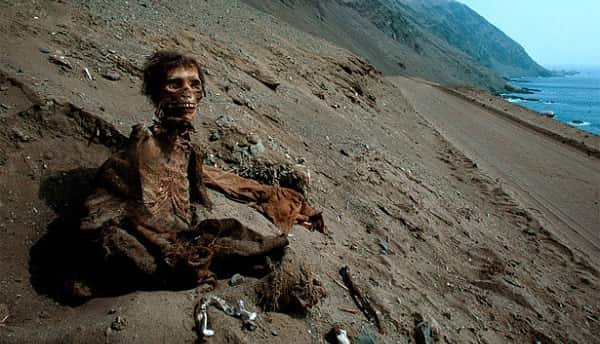
The Chinchorro mummies of northern Chile’s Atacama Desert coast are the world’s oldest deliberately mummified human remains — predating Egyptian mummification by over 2,000 years and representing the most extraordinary evidence of early human funerary practice in the Americas. Discovered along the Camarones and Arica coastal regions, Chinchorro mummies were created by a fishing and gathering people who developed sophisticated mummification techniques as early as 7,020 BCE. The process involved removing internal organs and skin, cleaning the skeleton, packing the body cavity with materials including clay, plant fibres, and animal hair, reconstructing the body with sticks and reeds, replacing the skin, and painting the completed mummy with red and black clay paste. The Chinchorro mummies include infants and foetuses among their subjects — suggesting that mummification was applied across all ages rather than being reserved for elite members of society, implying a communal spiritual motivation rather than social hierarchy. UNESCO added Chinchorro mummies to the World Heritage List in 2021.
2. Spirit Cave Mummy, Nevada, USA (7,420 BCE)
The Spirit Cave Mummy — discovered in a small cave near Fallon, Nevada, in 1940 but not fully analysed until the 1990s — is the oldest mummified human remains found in North America, with radiocarbon dating placing death at approximately 7,420 BCE. The naturally preserved body of a middle-aged man was found wrapped in a tule mat and wearing woven textile moccasins, both of which represent the oldest known woven textile artefacts in North America. The mummy’s preservation resulted from the extremely dry conditions within the cave rather than deliberate mummification. Controversy surrounded the Spirit Cave Mummy for decades — a legal dispute between scientists seeking study access and the Fallon Paiute-Shoshone Tribe claiming ancestral connection. DNA analysis eventually confirmed Indigenous American ancestry, though separated by thousands of years from modern Paiute populations.
3. Ötzi the Iceman, Italian-Austrian Alps (3,300 BCE)
Ötzi — discovered on September 19, 1991, by hikers on the Ötztal Alps glacier at the Italian-Austrian border — is the world’s oldest naturally preserved human mummy in Europe and one of the most scientifically valuable archaeological discoveries of the 20th century. Radiocarbon dated to approximately 3,300 BCE, Ötzi’s extraordinary preservation in glacial ice maintained not only his body but his complete clothing and equipment, including a copper axe (whose existence at this date was previously unknown), a bow with arrows, flint tools, and sophisticated leather and grass clothing. Scientific analysis has revealed an extraordinary level of biographical detail: Ötzi died in his mid-40s, had experienced episodes of violent injury earlier in his life, suffered from Lyme disease and tooth decay, had eaten a last meal of ibex, red deer, einkorn wheat, and various plants approximately 30 minutes before death, and was murdered — a flint arrowhead was found embedded in his left shoulder, and defensive wounds on his hands suggest a violent final confrontation.
4. Tarim Basin Mummies, China (2,000 BCE)
The Tarim Basin mummies — discovered in the Xinjiang region of western China in the 20th century — have provoked scientific and political controversy for decades due to their strikingly Caucasian physical features, which challenge assumptions about ancient population distributions in central Asia. Dating to approximately 2,000 BCE, these naturally preserved bodies include the “Cherchen Man” — a tall, red-haired adult male wearing tartan-like woollen clothing — and the “Beauty of Loulan” — a woman with long light-brown hair preserved so perfectly that her eyelashes remain intact. The mummies’ mitochondrial DNA analysis indicates they descended from populations with connections to both Eastern and Western Eurasian genetic lineages, suggesting the Tarim Basin was inhabited by mixed-heritage populations who participated in the Bronze Age trade networks that preceded the Silk Road by over a thousand years. Their clothing, burial goods, and physical characteristics collectively provide extraordinary evidence of Bronze Age cultural exchange across central Asia.
5. Egyptian Mummies (3,000 BCE)
Egyptian mummification represents the ancient world’s most systematic, most elaborate, and most culturally significant approach to bodily preservation — a practice developed from approximately 3,000 BCE during the Early Dynastic Period and refined over three millennia into an extraordinarily sophisticated process. The earliest deliberately preserved Egyptian bodies were relatively simple — bodies placed in hot desert sand that naturally desiccated and preserved them. By the New Kingdom (1,550–1,070 BCE), royal mummification involved a 70-day process: removal of organs (stored in canopic jars), dessication with natron salt, anointing with resins and oils, wrapping in hundreds of metres of linen bandages with protective amulets, and enclosure in nested coffins. Thousands of Egyptian mummies have been discovered — royal mummies including Ramesses II, Tutankhamun, and Hatshepsut provide direct physical access to ancient Egypt’s most celebrated historical figures. DNA analysis of royal mummies has revealed family relationships, diseases, and genetic inheritance patterns across Egypt’s dynasties.
6. Greenland Mummies (500 CE and 1,475 CE)
The Greenland mummies comprise two significant groups — a 6-month-old infant and accompanying adults from approximately 500 CE, and the famous “Qilakitsoq Eight” discovered in 1972 near the village of Qilakitsoq, dating to approximately 1,475 CE. The Qilakitsoq group — five women and three children found in two graves within a rock overhang — were preserved by the combination of freezing temperatures and desiccating Arctic winds into an extraordinary state of natural mummification. Their intact Inuit clothing — crafted from sealskin, caribou hide, and bird feathers — represents the most complete example of pre-contact Arctic clothing ever discovered, providing detailed information about traditional Inuit textile and survival technology. DNA analysis of the Qilakitsoq mummies provided important data on pre-contact Greenlandic Inuit population genetics and the family relationships between the eight individuals.
7. Bog Bodies, Northern Europe (8,000 BCE–400 CE)
Bog bodies — human remains naturally preserved in the acidic, oxygen-poor environments of northern European peat bogs — represent one of archaeology’s most extraordinary categories of ancient preserved human remains. The oldest examples date to approximately 8,000 BCE, though the most numerous and most well-preserved examples cluster between 500 BCE and 400 CE. Tollund Man (Denmark, approximately 400 BCE) is the most famous bog body — his face so perfectly preserved that he was initially reported as a recent murder victim. Grauballe Man (Denmark, approximately 310 BCE) has been fully studied and displayed at Moesgaard Museum. Lindow Man (UK, approximately 1 CE) was found in a Cheshire peat bog in 1984. Many bog bodies show evidence of ritual killing — multiple simultaneous causes of death including strangulation, throat cutting, and head trauma — interpreted by scholars as evidence of ritual sacrifice practices in Iron Age European religious culture.
8. Siberian Ice Maiden (Pazyryk), Russia (2,500 Years Old)
The Pazyryk Princess — known as the Siberian Ice Maiden or Princess Ukok — was discovered in 1993 by archaeologist Natalia Polosmak on the Ukok Plateau of the Altai Mountains in Russia, preserved in a permafrost burial approximately 2,500 years old. The young woman, approximately 25 years old at death, was found in a burial chamber lined with ice, wearing a white silk blouse, striped woollen skirt, white felt stockings, and elaborate headdress. Most spectacularly, she was tattooed — her arms displayed extraordinary tattoos of mythological animals including a deer with antlers transformed into flowers, a snow leopard, and a mountain sheep, executed in a sophisticated Scythian zoomorphic style. The tattoos represent the oldest preserved human tattoos in the world. A toxicological analysis suggested she suffered from ovarian cancer and breast cancer, and may have used cannabis as a pain management tool.
9. Guanajuato Mummies, Mexico (19th Century — Natural)
The Guanajuato mummies of central Mexico — approximately 100 naturally preserved bodies displayed in the Museo de las Momias de Guanajuato — were created naturally between the 1840s and 1950s through the combination of the region’s extremely dry, mineral-rich soil, creating ideal conditions for natural mummification. The mummies were exhumed from the Santa Paula Cemetery when families could not continue paying burial fees — and their extraordinary state of natural preservation led to their display as a public attraction. The Guanajuato mummies include the world’s smallest known mummy — a foetus — and several individuals preserved in strikingly lifelike poses, including apparent expressions of distress that led to folk legends about premature burial. The collection was made famous internationally by author Ray Bradbury, who described a childhood visit as a formative experience that inspired his writing throughout his career.
10. Lady Dai (Xin Zhui), China (168 BCE)
Lady Dai — Xin Zhui, the wife of the Marquis of Dai — was discovered in 1971 at Mawangdui near Changsha in Hunan Province, China, buried in a tomb dating to approximately 168 BCE. Her preservation is considered the most remarkable natural mummification in the world for a body of this age — after 2,100 years, her body retained skin elasticity, joint mobility, and internal organs intact enough for a complete autopsy. She was found immersed in a mysterious acidic liquid within four nested lacquered coffins insulated by charcoal and white clay. The autopsy revealed that Lady Dai had suffered from cardiovascular disease, arteriosclerosis, diabetes, gallstones, and had eaten 138 melon seeds shortly before death — the seeds found intact in her stomach. Her tomb also contained extraordinarily preserved silk garments, lacquerware, food provisions, and a T-shaped painted silk banner depicting her soul’s journey to paradise — one of the most important ancient Chinese art discoveries of the 20th century.
Conclusion
These ten mummies collectively span approximately 9,000 years of human history and every inhabited continent — from Chile’s Chinchorro fishermen to Egypt’s divine pharaohs to China’s aristocratic Lady Dai. Each represents a human being whose physical survival across millennia grants us an extraordinary and deeply personal window into lives that would otherwise be completely inaccessible to our understanding.

Brandon is the cheif editor and writer at WorldUnfolds.com. With a passion for storytelling and a keen editorial eye, he crafts engaging content that captivates and enlightens readers worldwide.