
Games — structured activities with rules, competition, and the element of play — are among humanity’s most ancient cultural expressions, predating writing, metal tools, and in some cases agriculture itself. Archaeological evidence, ancient texts, and surviving artefacts allow historians to trace the origins of specific games across thousands of years of human history. The oldest games reflect the deepest human impulses: strategic thinking, social bonding, the thrill of competition, and the simple pleasure of play. Here are the ten oldest games in the world, traced to their earliest confirmed origins.
1. Mancala (6,000+ BCE)
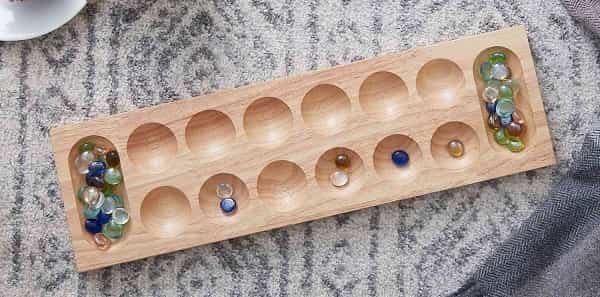
Mancala is almost certainly the world’s oldest game still actively played — a family of count-and-capture board games whose origins trace to approximately 6000 BCE or earlier. The name “mancala” derives from the Arabic word for “to transfer” and encompasses hundreds of related games played across Africa, the Middle East, South Asia, and the Caribbean under names including Oware, Bao, Awele, and Kalah. The oldest physical evidence consists of game boards carved into stone surfaces at ancient sites across Egypt and Ethiopia — some of these carved stone boards may be 7,000–8,000 years old, though definitively dating stone depressions to specific periods remains challenging. The game’s mechanics — distributing seeds or stones among shallow pits in a board — are simple enough to be played with any countable objects in any container, making mancala accessible across all economic circumstances and contributing to its extraordinary geographic spread and temporal persistence. Mancala is today one of the world’s most widely played traditional games, particularly across sub-Saharan Africa.
2. Senet (3,500 BCE)
Senet is the oldest board game for which we have clear, well-dated physical evidence — a two-player racing game played on an elongated board of thirty squares arranged in three rows of ten, with pieces moved according to the throw of flat sticks or bones used as randomisers. Board games identified as Senet appear in Egyptian predynastic burials dating to approximately 3500 BCE, and the game appears in Egyptian paintings throughout the Old, Middle, and New Kingdom periods. The most famous Senet board belonged to Tutankhamun — four boards were found in his tomb, reflecting the game’s importance in royal leisure. By the New Kingdom period (1570–1070 BCE), Senet had acquired religious symbolism — the game was believed to represent the soul’s journey through the afterlife — and images of Senet being played by the deceased appear regularly in tomb paintings. The complete rules of ancient Senet have been reconstructed by Egyptologists based on literary sources and game equipment analysis.
3. Go (Weiqi) (2,356 BCE)
Go — known as Weiqi in Chinese, Baduk in Korean, and Igo in Japanese — is the world’s oldest continuously played complex strategy board game, with historical records placing its origins in ancient China around 2356 BCE under the legendary Emperor Yao. The game is played on a 19×19 grid with black and white stones, with the objective of capturing territory by surrounding the opponent’s pieces. Go is widely regarded as the most strategically complex board game ever devised by humans — its number of possible game positions vastly exceeds the number of atoms in the observable universe, making it incomparably more complex than Chess. Go mastery has traditionally been considered a mark of scholarly and military excellence in East Asian culture. In 2016, Google DeepMind’s AlphaGo programme defeated the world’s top professional Go player — an event considered a landmark in artificial intelligence development precisely because of Go’s extraordinary strategic complexity.
4. Royal Game of Ur (2,600 BCE)
The Royal Game of Ur — also called the Game of Twenty Squares — was discovered by Leonard Woolley during 1920s excavations of the Royal Cemetery at Ur in ancient Mesopotamia (modern Iraq), with the oldest boards dating to approximately 2600 BCE. The game was played on a distinctive board of twenty squares with seven pieces per player and tetrahedral dice, and appears to have been a racing game combining strategy with the randomness of dice throws. Extraordinarily, a clay tablet from approximately 177 BCE discovered in the British Museum collection contains what appears to be a set of rules for the game — written in cuneiform by a Babylonian scribe named Itti-Marduk-balatu — providing direct textual evidence of the game’s rules across nearly 2,500 years of play. The Royal Game of Ur was played from Egypt to India, making it the ancient world’s most geographically widespread board game.
5. Backgammon (3,000 BCE)
Backgammon is one of the world’s oldest surviving race games, with origins traced to Mesopotamia around 3000 BCE. Archaeological excavations in Iran’s Burnt City (Shahr-e Sukhteh) discovered a game board dating to approximately 3000 BCE that closely resembles a backgammon set, complete with 60 pieces in two colours and dice. Similar games appear in ancient Egypt, Rome, and Persia under various names — the Romans called their version Tabula. The modern backgammon rules emerged in England in the 17th century, but the essential mechanic — racing pieces across a board while blocking opponents, using dice to determine moves — has remained fundamentally consistent across five millennia. Backgammon’s combination of skill and chance creates the democratic tension between preparation and luck that has sustained its appeal across thousands of years and dozens of cultures.
6. Chess (6th Century CE — India)
Chess in its recognisable modern form emerged in 6th century CE India as Chaturanga — a Sanskrit word referring to the four branches of the Indian military (infantry, cavalry, elephants, and chariots) represented by the pieces. From India, Chaturanga spread to Persia as Chatrang, then to the Islamic world as Shatranj following the Arab conquest of Persia in the 7th century, and finally to Europe through the Moorish conquest of Spain and the Crusades. The modern chess rules — including the powerful queen’s movement and castling — crystallised in Europe during the 15th century. Chess has since become the world’s most widely played and most studied strategy board game, with a global tournament structure, world championships dating to 1886, and an estimated 600 million players worldwide. Its cultural status as the ultimate game of pure strategic intelligence has made it a symbol of intellectual achievement across civilisations.
7. Dice Games (5,000 BCE)
While dice are not a single game but a gaming tool enabling countless games, the dice themselves represent one of humanity’s oldest gaming technologies — with the earliest known dice dated to approximately 5000 BCE from sites across the ancient Near East, South Asia, and Egypt. These earliest dice were made from bones, stones, ivory, and wood, with various face configurations preceding the standardised six-sided cubic die. Dice appear in virtually every ancient civilisation — Mesopotamian, Egyptian, Greek, Roman, Indian, and Chinese cultures all developed dice independently or through cultural exchange. The Roman Emperor Augustus was a notorious dice player, and dice are mentioned in the Indian Mahabharata epic as the catalyst for the Kurukshetra War. The appeal of dice games is elemental — randomness controlled by a simple physical object creates the essential human experience of facing uncertainty.
8. Knucklebones (Jacks) (3,600 BCE)
Knucklebones — played with the ankle bones of sheep or goats, later with manufactured replicas — is one of the ancient world’s most widely documented games, with examples found across Greek, Roman, Egyptian, and Asian archaeological sites dating to approximately 3600 BCE. The game was played by tossing the four-sided knucklebone and scoring points based on which face landed uppermost, or by tossing multiple bones and catching them on the back of the hand. Greek and Roman painters and sculptors depicted knucklebones play frequently, confirming its status as one of the ancient world’s most popular games across all social classes. Knucklebones evolved directly into the modern game of Jacks — played with a rubber ball and metal star-shaped pieces — making it one of the rare ancient games that maintains recognisable continuity with a contemporary form.
9. Wrestling (3,000 BCE)
Wrestling — competitive physical grappling between two opponents — is the world’s oldest documented sport and competitive game, with cave paintings depicting wrestling holds from Lascaux in France dating to approximately 15,000 BCE and clear artistic depictions from ancient Sumer and Egypt around 3000 BCE. The Mesopotamian Epic of Gilgamesh describes the legendary wrestling match between Gilgamesh and Enkidu — one of literature’s earliest sports descriptions. Ancient Egyptian tomb paintings at Beni Hasan dating to approximately 2000 BCE depict wrestling sequences in extraordinary detail — hundreds of different holds and techniques documented in stone, demonstrating that wrestling was both a competitive sport and a form of military training. Wrestling was included in the ancient Olympic Games from 708 BCE and remains an Olympic sport today, making it the sporting competition with the longest continuous documented presence in organised competitive athletics.
10. Polo (2,500 BCE)
Polo — a team sport played on horseback using mallets to drive a ball through the opposing team’s goal — originated in Central Asia around 2500 BCE as a training exercise for cavalry units and nomadic horse warriors. The earliest recorded polo tournament is documented in 600 BCE in Persia, where the game was played by Persian nobility as both military training and competitive sport. The word “polo” derives from the Tibetan “pulu” meaning ball. At the height of Persian civilisation, polo matches involved as many as 100 riders per side and were played across vast plains — a spectacle of horsemanship and tactical coordination. The sport spread from Persia to India — where British cavalry officers encountered it in the 19th century and codified the modern rules — and subsequently to England, Argentina, and globally. Polo’s ancient origins reflect the horse’s transformative role in ancient warfare and the natural evolution of military training into competitive sport.
Conclusion
These ten ancient games collectively trace humanity’s play instinct across eight millennia — from the stone-carved mancala pits of prehistoric Africa to the chess boards of medieval Europe. Each game survived not by accident but because it offered something genuinely satisfying — strategic depth, social bonding, the thrill of competition, or simply the pleasure of organised play. Their endurance across thousands of years is the most reliable evidence of their quality.

Brandon is the cheif editor and writer at WorldUnfolds.com. With a passion for storytelling and a keen editorial eye, he crafts engaging content that captivates and enlightens readers worldwide.