Rivers are among Earth’s most dynamic geological features — constantly eroding, depositing, changing course, and occasionally reversing direction in response to tectonic movements and climate changes over millions of years. Determining a river’s age involves complex geological detective work — examining the rock formations through which the river flows, the direction and age of sedimentary deposits, and evidence of the river’s existence in geological strata dating to specific periods. The oldest rivers have maintained their fundamental courses for tens or hundreds of millions of years, surviving continental drift, mass extinctions, and the rise and fall of mountain ranges. Here are the ten oldest rivers in the world.
1. Finke River, Australia (340–400 Million Years Old)
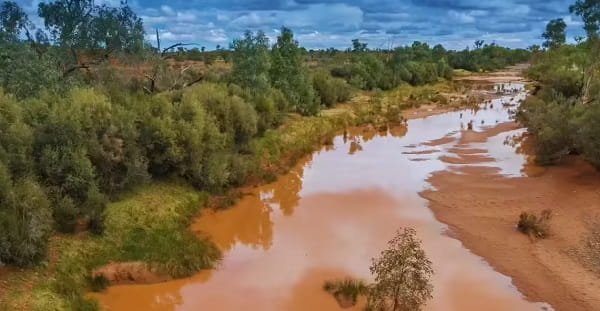
The Finke River in Australia’s Northern Territory is widely regarded as the world’s oldest river — with geological evidence suggesting its current course has been maintained for approximately 340 to 400 million years, though some estimates extend this further. The river flows through some of the world’s most ancient sedimentary rock formations in the MacDonnell Ranges, occupying valleys and gorges that have persisted since the Devonian Period — when the first land vertebrates were making their tentative appearances on Earth. The Finke’s extraordinarily ancient course is confirmed by the alignment of the sedimentary valleys through which it flows — valleys created by geological forces active hundreds of millions of years ago that the river has subsequently occupied. Though intermittent rather than perennial in modern times, flowing only after significant rainfall in Australia’s arid interior, the Finke qualifies as the world’s oldest continuous river course.
2. New River, USA (260–325 Million Years Old)
The New River in the Appalachian Mountains of North Carolina, Virginia, and West Virginia is perhaps North America’s most geologically confusing river — one whose name belies its extraordinary antiquity. Despite being called the “New River,” it is actually one of the world’s oldest rivers, with geological evidence placing its age between 260 and 325 million years old — predating the Atlantic Ocean. The river is antecedent to the Appalachian Mountains themselves, meaning it was flowing before the mountains rose and simply maintained its course by cutting downward through the rising rock as the land elevated around it — a process that created the spectacular New River Gorge, now a national park. The river flows northward — the opposite direction from most Appalachian rivers — a characteristic explained by its extraordinary antiquity predating the tectonic forces that shaped the current topography.
3. Susquehanna River, USA (300+ Million Years Old)
The Susquehanna River of the northeastern United States — flowing 715 km from New York State through Pennsylvania to Chesapeake Bay in Maryland — is considered one of North America’s oldest rivers by many geologists, with its origin traced to approximately 300 million years ago. Like the New River, the Susquehanna is antecedent to the Appalachian Mountains, having maintained its general course through the gradual uplift of the mountains around it. The river’s extraordinary age is reflected in its seemingly illogical course — it cuts directly through mountain ridges rather than following valleys, a behaviour only explicable if the river predated the ridges. The Susquehanna was identified by Native American peoples across many generations as a sacred waterway, and its ancient character has attracted scientific study since the 19th century.
4. French Broad River, USA (300+ Million Years Old)
The French Broad River in North Carolina and Tennessee is another of the Appalachian region’s extraordinarily ancient rivers — geologists estimate its age at over 300 million years, placing it among North America’s oldest waterways. Like the New River and Susquehanna, the French Broad is antecedent to the surrounding mountains, cutting through ridges in a manner that demonstrates the river’s existence before the current topography was formed. The river flows northwest — once again counterintuitively relative to the Appalachian Mountain grain — into the Tennessee River system. The French Broad’s ancient course flows through what is now western North Carolina, including the area around Asheville, a city that has developed adjacent to this ancient waterway largely unaware of the extraordinary geological time that the river represents.
5. Meuse River, Europe (320–340 Million Years Old)
The Meuse River — flowing approximately 925 km from northeastern France through Belgium and the Netherlands to the North Sea — is one of Western Europe’s oldest rivers, with geological evidence placing its origins at approximately 320–340 million years ago during the Carboniferous Period. Like the Appalachian rivers, the Meuse’s antiquity is revealed by its course through the Ardennes Massif — an ancient rock formation that the river cuts through in ways that demonstrate it predates the current landscape. The Meuse has been one of Europe’s most historically significant rivers — a boundary between Roman provinces, a medieval trade route, a contested frontier in both World Wars, and today a major European inland waterway connecting France, Belgium, and the Netherlands in one of the world’s most economically important regional economies.
6. Nile River, Africa (30+ Million Years Old)
The Nile — at approximately 6,650 km the world’s longest river — is geologically far younger than the Appalachian rivers but significantly older than most of the world’s major waterways in terms of its current course. The present Nile course was established approximately 30 million years ago during the Oligocene Epoch, following an earlier “Eonile” river system whose course extended even to the Mediterranean during the Messinian Salinity Crisis approximately 5.5 million years ago when the Mediterranean temporarily dried. The Nile’s extraordinary historical significance — as the foundation of ancient Egyptian civilisation, one of humanity’s greatest civilisational achievements — makes it culturally the world’s most important river regardless of its geological ranking. The annual Nile flood that deposited the rich black silt enabling Egyptian agriculture was the single most important environmental factor in the development of ancient Egyptian civilisation.
7. Colorado River, USA (6 Million Years Old)
The Colorado River of the American Southwest began cutting through the Colorado Plateau approximately 5–6 million years ago, creating the Grand Canyon — one of Earth’s most spectacular geological features — through 277 miles of continuous erosion that has exposed nearly 2 billion years of geological history in the canyon walls. The river’s relatively young age by geological standards belies the extraordinary landscape it has created — the Grand Canyon’s mile-deep exposure of ancient rock layers provides perhaps the world’s most accessible geological record. The Colorado has been heavily managed and diverted for human use over the past century — supplying water to approximately 40 million people across seven states and Mexico — making it simultaneously one of Earth’s most geologically significant and most human-impacted major rivers.
8. Amazon River, South America (11 Million Years Old)
The Amazon River — the world’s largest by volume, discharging approximately 20% of all freshwater entering the world’s oceans — established its current eastward-flowing course approximately 11 million years ago following the final rise of the Andes Mountains. Before the Andes rose, the Amazon system drained westward toward the Pacific — the mountains’ uplift reversed the entire drainage direction of a continent, creating the modern Amazon as it exists today. The Amazon basin contains the world’s most biodiverse tropical ecosystem — its 7 million square kilometres of rainforest supporting an estimated 10% of all species on Earth. The river’s relatively young geological age belies the extraordinary biological richness it sustains, developed over 11 million years of continuous tropical forest evolution in one of Earth’s most stable and most productive environments.
9. Ganges River, India (50 Million Years Old)
The Ganges River — the sacred river of Hinduism flowing approximately 2,525 km across the Indian subcontinent — began developing its current course approximately 50 million years ago as the Himalayan Mountains rose from the collision of the Indian and Eurasian tectonic plates. The river’s geological origin and its religious significance are thus connected — both derive from the same dramatic tectonic event that created the Himalayan mountain range and the glaciers that feed the river’s headwaters. For Hindus, the Ganges is not merely a river but a living goddess — Ganga Mata — whose waters are considered capable of cleansing spiritual impurity. The river sustains approximately 400 million people in the Gangetic Plain, one of the world’s most densely populated agricultural regions, making it arguably the single most important river in human civilisational terms after the Nile.
10. Tigris and Euphrates Rivers, Middle East (1–2 Million Years Old)
The Tigris and Euphrates Rivers of the Middle East — flowing through Turkey, Syria, and Iraq to the Persian Gulf — are geologically relatively young but historically the most consequential rivers in human civilisation, having nourished Mesopotamia’s ancient Sumerian, Akkadian, Babylonian, and Assyrian civilisations that produced humanity’s first cities, writing systems, and legal codes. The rivers in their current form developed approximately 1–2 million years ago during the Pleistocene Epoch. In the biblical tradition, these rivers are two of the four rivers flowing from the Garden of Eden — a mythological acknowledgment of their foundational importance to human agricultural and civilisational development. Today both rivers face severe water stress from upstream dams, agricultural irrigation, and climate-related drought reduction — an existential threat to the waterways that gave birth to civilisation.
Conclusion
These ten rivers collectively trace Earth’s hydrological history from the Devonian Period to the present — demonstrating that waterways are not merely geographical features but dynamic geological archives recording hundreds of millions of years of planetary history. Their preservation is essential to both scientific understanding and the ecological and cultural communities that depend on them.

Brandon is the cheif editor and writer at WorldUnfolds.com. With a passion for storytelling and a keen editorial eye, he crafts engaging content that captivates and enlightens readers worldwide.