Deserts cover approximately one-third of Earth’s land surface and represent some of the planet’s most extreme and most geologically ancient landscapes. While popular imagination associates deserts primarily with the Sahara, Earth’s oldest deserts far predate human civilisation — some have been continuously arid for tens of millions of years, shaped by tectonic movement, ocean currents, and atmospheric patterns that have persisted across geological epochs. Understanding the age of a desert involves examining continuous arid conditions supported by geological, palaeontological, and geomorphological evidence. Here are the ten oldest deserts in the world.
1. Namib Desert, Namibia (55–80 Million Years Old)
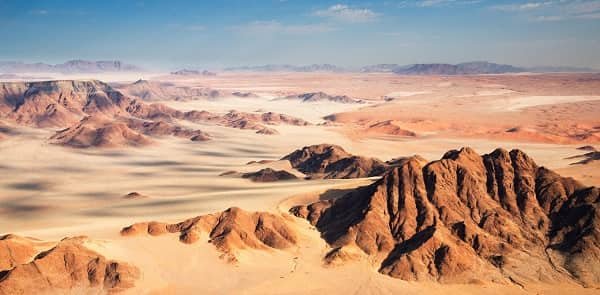
The Namib Desert along Africa’s southwestern Atlantic coast is the world’s oldest desert — scientists estimate its continuous aridity at between 55 and 80 million years ago, with some geological evidence suggesting it may have been arid for as long as 130 million years. The Namib predates the extinction of the dinosaurs, existing as a coastal desert during the Cretaceous period when Gondwana was still fragmenting. Its extraordinary age is explained by its unique causation — the Benguela Current, carrying cold water northward along the African coast, creates persistent atmospheric stability that inhibits rainfall. This ancient, stable arid environment has driven the evolution of remarkable endemic species found nowhere else on Earth, including the extraordinary Welwitschia mirabilis — a plant that grows only two leaves throughout its 1,000–2,000 year lifespan — and the Namib’s famous fog-basking beetles that harvest water from coastal fog.
2. Atacama Desert, Chile (15–150 Million Years Old)
The Atacama Desert along South America’s Pacific coast is the world’s driest non-polar desert — with some weather stations recording zero measurable rainfall for decades — and one of the Earth’s oldest. Geological evidence suggests continuous arid conditions for at least 15 million years, with some researchers arguing for hyperaridity extending back 150 million years. Like the Namib, the Atacama’s extreme dryness is caused by the cold Humboldt Current creating an inversion layer that prevents Pacific moisture from reaching the coast, combined with rain shadow effects from the Andes Mountains on the east. Despite its extreme aridity, the Atacama supports unique extremophile life forms — bacteria living beneath translucent quartz rocks, salt flat flamingos, and native plant species adapted to fog collection. NASA uses the Atacama to test Mars rovers because its surface chemistry most closely resembles Martian conditions.
3. Sahara Desert, Africa (7 Million Years Old)
The Sahara — at 9.2 million square kilometres the world’s largest hot desert — has a more complex age history than popular perception suggests. While isolated arid periods occurred earlier, continuous major desert conditions in the Sahara are estimated to have begun approximately 7 million years ago. The Sahara has experienced dramatic fluctuations — during the “Green Sahara” period between approximately 11,000 and 5,000 years ago, the region supported lakes, rivers, forests, and diverse wildlife including hippopotami and crocodiles. The discovery of ancient river valleys, lake beds, and rock art depicting swimming humans across what is now barren sand confirms this periodic greening. Climate models suggest the Sahara may green again in future millennia as Earth’s axial precession cycles continue their slow rotations.
4. Arabian Desert, Middle East (2–7 Million Years Old)
The Arabian Desert — covering approximately 2.3 million square kilometres across Saudi Arabia, Yemen, Oman, UAE, Jordan, and Iraq — is one of Earth’s most geologically interesting arid regions. Continuous aridity began approximately 2–7 million years ago as the Arabian tectonic plate separated from Africa, closing the ancient Tethys Sea and establishing the atmospheric patterns that maintain desert conditions. Within this vast desert lies Rub’ al Khali — the Empty Quarter — the world’s largest continuous sand sea, covering approximately 650,000 square kilometres. The Arabian Desert’s geological history reveals dramatic changes — ancient river valleys, fossil evidence of past grasslands, and massive underground aquifers filled during wetter periods thousands of years ago and now being depleted by modern irrigation.
5. Gobi Desert, China and Mongolia (65 Million Years Old)
The Gobi Desert — extending across southern Mongolia and northern China — contains geological formations dating to approximately 65 million years ago and has maintained semi-arid conditions for most of this period. The Gobi is classified as a cold desert — temperatures range from -40°C in winter to 45°C in summer — and is more rocky than sandy, with only about 5% of its surface covered in sand dunes. The Gobi holds one of palaeontology’s greatest treasures — the Flaming Cliffs (Bayanzag), where Roy Chapman Andrews discovered the first dinosaur eggs ever found in 1923. The desert continues producing extraordinary fossil discoveries, including numerous feathered dinosaur specimens that have revolutionised understanding of bird evolution. The ancient Silk Road trade routes traversed the Gobi’s margins, making it a landscape of both natural and human historical significance.
6. Patagonian Desert, Argentina (65 Million Years Old)
The Patagonian Desert — the largest desert in South America at approximately 673,000 square kilometres — is a cold semi-arid desert occupying the Argentine Patagonia region east of the Andes Mountains. Its aridity is maintained by the Andes rain shadow effect, which has been operative since the mountain range’s elevation significantly increased approximately 65 million years ago. The Patagonian Desert contains extraordinary palaeontological heritage — numerous massive sauropod dinosaur fossils including Argentinosaurus, believed to be the largest land animal ever to have existed, have been excavated from its ancient sediments. The desert’s remarkable wildlife includes Magellanic penguins, guanacos, Darwin’s rhea, and the Patagonian mara — endemic species that have adapted over millions of years to the steppe’s harsh conditions.
7. Great Basin Desert, United States (10 Million Years Old)
The Great Basin Desert — occupying approximately 492,000 square kilometres across Nevada, Utah, Oregon, California, and Idaho — is North America’s largest desert and is estimated to have maintained its general arid character for approximately 10 million years, though the current rain shadow conditions intensified with the Cascade Range’s volcanic activity approximately 5 million years ago. Unlike hot deserts, the Great Basin is a cold desert receiving most of its limited precipitation as snow. The desert’s ancient pluvial lakes — Lake Bonneville, whose remnant is the Great Salt Lake, and Lake Lahontan — represent massive former water bodies that filled during glacial periods, leaving behind salt flats, terraced shorelines, and rich fossil records. The ancient bristlecone pine forests at the Great Basin’s higher elevations include the famous Methuselah — the world’s oldest individual tree.
8. Karakum Desert, Turkmenistan (5–10 Million Years Old)
The Karakum — Black Sand Desert — occupies approximately 350,000 square kilometres of Turkmenistan and is one of Central Asia’s oldest desert formations, with arid conditions established approximately 5–10 million years ago as the ancient Paratethys Sea retreated and the Caspian Sea became enclosed. The Karakum is perhaps most famous for the Darvaza Crater — a 70-metre wide burning gas crater nicknamed the “Door to Hell” — created in 1971 when Soviet geologists accidentally discovered a natural gas pocket and set it afire to prevent methane release. The fire has burned continuously ever since. The Karakum Canal — at 1,375 km one of the world’s longest irrigation canals, diverting the Amu Darya River — has contributed to the catastrophic drying of the Aral Sea, one of the 20th century’s worst environmental disasters.
9. Kalahari Desert, Southern Africa (60 Million Years Old)
The Kalahari — spanning approximately 900,000 square kilometres across Botswana, Namibia, and South Africa — is technically a fossil desert rather than a true desert, as its annual rainfall (150–500 mm) supports enough vegetation to be classified as semi-arid savanna. However, its sandy substrate is ancient, with aeolian (wind-deposited) sands dating to approximately 60 million years ago indicating a much more arid past. The Kalahari is the ancestral homeland of the San people — one of humanity’s oldest surviving cultures with a continuous habitation record extending back at least 70,000 years. The desert supports the Kalahari lion, brown hyena, meerkat, and extraordinarily diverse bird species, as well as the famous Tsodilo Hills with their extraordinary rock art painted by San ancestors over 100,000 years.
10. Antarctic Desert (34 Million Years Old)
Antarctica is technically the world’s largest desert — receiving less than 200 mm of precipitation annually and covering approximately 14.2 million square kilometres. The Antarctic continent has been in a polar position for approximately 34 million years, when glaciation began dramatically cooling and drying the continent. Antarctica’s dry valleys — particularly the McMurdo Dry Valleys — are among the most extreme desert environments on Earth, where no rainfall has been recorded in millions of years. This landscape is so Mars-like that NASA conducts planetary analogue research here. Despite its apparent lifelessness, Antarctica harbours remarkable extremophile organisms including psychrophilic bacteria living in the ice, lichen growing on sheltered rock surfaces, and the extraordinary ecosystem of the Southern Ocean surrounding it.
Conclusion
These ten ancient deserts collectively represent billions of years of Earth’s climatic and geological history. Each has been shaped by forces operating on timescales that dwarf human comprehension — ocean currents, tectonic plate movements, and axial wobbles — and each supports unique life forms that have adapted to extreme conditions over evolutionary time. Their preservation is essential to both scientific understanding and global ecological health.

Brandon is the cheif editor and writer at WorldUnfolds.com. With a passion for storytelling and a keen editorial eye, he crafts engaging content that captivates and enlightens readers worldwide.