Bridges are among the most remarkable engineering achievements in human history — structures that connect cities, cross rivers, span valleys, and shrink distances that once took hours to travel. Over centuries, bridge engineering has evolved from simple wooden crossings to extraordinary modern viaducts stretching over 100 kilometres. Today’s longest bridges are not the dramatic suspension spans most people picture — they are high-speed rail viaducts, primarily built in China, that carry trains at over 300 km/h across vast floodplains and agricultural land. China dominates this list almost completely, reflecting its extraordinary investment in high-speed rail infrastructure over the past two decades. Understanding the world’s longest bridges gives a fascinating window into 21st-century engineering ambition, urban connectivity, and the infrastructure that is reshaping how billions of people move.
| Rank | Bridge Name | Country | Length | Purpose | Year Opened |
| 1 | Danyang–Kunshan Grand Bridge | China | 164.8 km | High-speed rail | 2011 |
| 2 | Changhua–Kaohsiung Viaduct | Taiwan | 157.3 km | High-speed rail | 2007 |
| 3 | Cangde Grand Bridge | China | 115.9 km | High-speed rail | 2011 |
| 4 | Tianjin Grand Bridge | China | 113.7 km | High-speed rail | 2011 |
| 5 | Weinan Weihe Grand Bridge | China | 79.7 km | High-speed rail | 2010 |
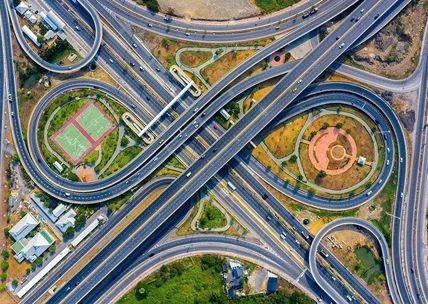
| 6 | Bang Na Expressway | Thailand | 54.0 km | Road/Highway | 2000 |
| 7 | Beijing Grand Bridge | China | 48.2 km | High-speed rail | 2011 |
| 8 | Lake Pontchartrain Causeway | USA | 38.4 km | Road/Highway | 1969 |
| 9 | Manchac Swamp Bridge | USA | 36.7 km | Road/Highway | 1979 |
| 10 | Yangcun Bridge | China | 35.8 km | High-speed rail | 2007 |
1. Danyang–Kunshan Grand Bridge — 164.8 km (China)
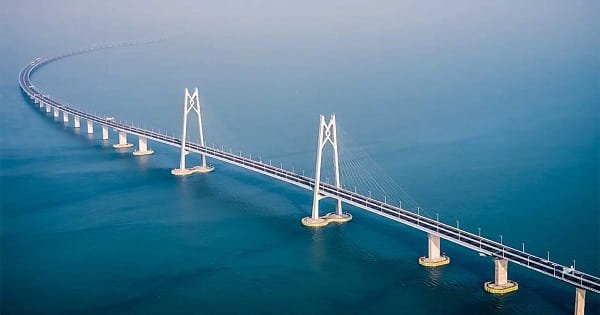
The Danyang–Kunshan Grand Bridge holds the Guinness World Record as the longest bridge on earth at an extraordinary 164.8 kilometres. Located in Jiangsu Province, it forms a major section of the Beijing–Shanghai High-Speed Railway — one of the busiest and most technically demanding rail corridors ever built. Construction began in 2006, employed over 10,000 workers, took four years to complete, and cost approximately $8.5 billion USD.
The bridge was built elevated because the region it crosses — a dense patchwork of canals, rivers, lakes, and rice paddies — made ground-level construction impractical without destroying vast areas of productive agricultural land. For approximately 9 kilometres, the structure crosses Yangcheng Lake directly. It rests on approximately 9,500 concrete piers and carries trains at speeds exceeding 300 km/h. The sheer scale of this structure remains unmatched anywhere in the world — no other bridge comes within 7 kilometres of its total length.
2. Changhua–Kaohsiung Viaduct — 157.3 km (Taiwan)
Taiwan’s Changhua–Kaohsiung Viaduct is the world’s second longest bridge and the longest bridge in Taiwan at 157.3 kilometres. It forms a critical section of the Taiwan High-Speed Rail network, connecting Changhua County to Kaohsiung across the densely populated western coastal corridor of the island.
Two factors drove the decision to build as an elevated viaduct rather than at ground level — Taiwan’s extremely dense population along the western plain, where land acquisition was prohibitively expensive, and the island’s severe seismic vulnerability. Taiwan sits at the junction of two major tectonic plates, making earthquake resilience a non-negotiable engineering requirement. The viaduct incorporates seismic isolation bearings at key structural points that allow the bridge to absorb ground motion without catastrophic failure — an engineering feature that proved its value during subsequent earthquakes after the bridge opened in 2007.
3. Cangde Grand Bridge — 115.9 km (China)
The Cangde Grand Bridge at 115.9 kilometres is the third longest bridge in the world and another major section of China’s remarkable Beijing–Shanghai High-Speed Railway. It crosses the extensive floodplains of Hebei Province — a flat, low-lying region prone to seasonal flooding that would have created enormous maintenance challenges for any ground-level rail installation.
The bridge has a total of 3,092 piers and was specifically engineered to withstand seismic activity. High-speed trains cross its entire length at over 300 km/h — demonstrating how the elevated viaduct design eliminates the gradient variations and level crossings that would slow conventional rail traffic. The Cangde Grand Bridge, like most structures on this list, prioritises engineering efficiency over visual spectacle, but its contribution to connecting Beijing and Shanghai in approximately four hours remains one of modern rail engineering’s finest achievements.
4. Tianjin Grand Bridge — 113.7 km (China)
At 113.7 kilometres, the Tianjin Grand Bridge is the fourth longest bridge in the world and yet another section of the Beijing–Shanghai High-Speed Railway — a single railway line that contains three of the world’s ten longest bridges within its corridor. The bridge extends between Langfang and Qingxian near Tianjin, carrying high-speed trains over one of China’s most heavily populated and economically productive regions.
Construction began in 2006 and was completed in 2010, with the bridge inaugurated in 2011 alongside the full railway opening. The structure comprises 32 individually built and installed sections — a construction methodology that allowed parallel work across multiple sections simultaneously, reducing the overall construction timeline considerably. The Tianjin Grand Bridge exemplifies China’s ability to execute infrastructure projects at a scale and speed that has no equivalent elsewhere in the world.
5. Weinan Weihe Grand Bridge — 79.7 km (China)
The Weinan Weihe Grand Bridge in Shaanxi Province stretches 79.7 kilometres across the Wei River valley — carrying the Zhengzhou–Xi’an High-Speed Railway through one of China’s most historically significant regions. The Wei River valley is considered the cradle of Chinese civilisation, and the bridge crosses this ancient landscape twice, running parallel to the river for much of its length across terrain that combines agricultural land, roads, and the river’s floodplain.
Completed in 2008 with the railway opening in 2010, the Weinan Weihe Grand Bridge was designed for trains travelling at 350 km/h and cost approximately $5 billion to construct. When it first opened, it briefly held the record as the world’s longest bridge before the even larger structures of the Beijing–Shanghai corridor surpassed it. The bridge connects the economic centres of central China and plays an important role in the high-speed rail network linking China’s interior provinces.
6. Bang Na Expressway — 54 km (Thailand)
The Bang Na Expressway in Bangkok, Thailand, stands as the world’s longest road bridge at 54 kilometres — a six-lane elevated highway that carries traffic above the existing National Highway 34 through the Bangkok metropolitan area. Unlike every other bridge on this list, it serves ordinary road vehicles rather than high-speed trains — making it the most directly relevant entry for the majority of the world’s road-using population.
Completed in 2000 at a cost of approximately $1 billion, the Bang Na Expressway was built specifically to relieve Bangkok’s notoriously severe traffic congestion by creating an elevated bypass above ground-level congestion. For several years after its completion, it held the record as the world’s longest bridge before China’s high-speed rail viaducts surpassed it in the following decade. It remains the longest elevated road structure in the world and a vital piece of Bangkok’s urban transport infrastructure.
7. Beijing Grand Bridge — 48.2 km (China)
The Beijing Grand Bridge at 48.2 kilometres serves as the approach section of the Beijing–Shanghai High-Speed Railway as it enters China’s capital from the southeast. The bridge crosses suburban areas, river valleys, and the densely developed urban fringe of Beijing — terrain where a ground-level railway would have required enormous land acquisition and created thousands of disruptive level crossings.
As one of the more visible sections of the Beijing–Shanghai corridor, the Beijing Grand Bridge represents the last major elevated section before trains descend to serve Beijing South Railway Station — one of Asia’s busiest and most architecturally dramatic rail terminals. The bridge demonstrates China’s consistent preference for elevated rail approaches into major cities, which improves operational efficiency, reduces noise at street level, and creates the seamless high-speed experience that the corridor is designed to deliver.
8. Lake Pontchartrain Causeway — 38.4 km (USA)
The Lake Pontchartrain Causeway in Louisiana is the longest bridge in the United States and holds the Guinness World Record for the longest bridge over water continuously — meaning no artificial islands or tunnel sections interrupt the water crossing. It consists of two parallel twin-span bridges crossing Lake Pontchartrain, connecting Metairie near New Orleans with Mandeville on the lake’s north shore.
The original bridge opened in 1956, with the second parallel span added in 1969. At its midpoint — approximately 19 kilometres from either shore — drivers cannot see land in any direction, creating one of the world’s most disorienting driving experiences. The bridge is supported by over 9,000 concrete pilings and requires continuous maintenance given its exposure to the Gulf of Mexico’s hurricane weather systems. For nearly half a century, the Lake Pontchartrain Causeway was widely considered the world’s longest bridge before Asian infrastructure projects surpassed it.
9. Manchac Swamp Bridge — 36.7 km (USA)
The Manchac Swamp Bridge is a twin concrete trestle bridge in Louisiana stretching 36.7 kilometres across the Manchac Swamp — one of the most ecologically distinctive bridge locations on this entire list. The bridge carries Interstate 55 and US Highway 51 through the cypress swamp environment of southern Louisiana, an area of extraordinary natural beauty and significant ecological sensitivity.
Completed in 1979, the Manchac Swamp Bridge required a specific elevated construction approach to minimise disruption to the swamp’s fragile ecosystem. Driving across it provides a genuinely memorable experience — the bridge passes so close to the water’s surface through dense cypress trees draped in Spanish moss that it creates an atmosphere quite unlike any other major highway bridge in the world. Its length reflects the physical extent of the swamp rather than any engineering ambition to span exceptional distances.
10. Yangcun Bridge — 35.8 km (China)
The Yangcun Bridge at 35.8 kilometres rounds out the top ten — another Chinese high-speed rail viaduct, this one forming part of the Beijing–Tianjin Intercity Railway. Opened in 2007, it was among the earliest of China’s modern high-speed rail viaducts and demonstrated the elevated construction approach that would subsequently be applied at far greater scale across the country’s expanding network.
The Beijing–Tianjin Intercity Railway was China’s first dedicated high-speed passenger rail line — a pilot project whose success drove the extraordinary expansion of high-speed rail infrastructure that produced the even longer bridges higher on this list. The Yangcun Bridge’s place in this history makes it more significant than its tenth-place ranking suggests.
Key Observations
Six of the world’s ten longest bridges are in China alone, all serving high-speed rail lines. The United States contributes two entries — both road bridges across water in Louisiana. Thailand and Taiwan each contribute one. The domination of Chinese high-speed rail viaducts reflects a specific infrastructure philosophy — building elevated railways across difficult terrain to achieve the grade consistency that 300+ km/h train speeds require, while simultaneously preserving agricultural land beneath.
Frequently Asked Questions (FAQs)
Q: Which is the longest bridge in the world?
A: The Danyang–Kunshan Grand Bridge in China at 164.8 kilometres is the world’s longest bridge by total length.
Q: Which is the longest bridge over water in the world?
A: The Lake Pontchartrain Causeway in Louisiana, USA holds the Guinness World Record for the longest continuously over-water bridge at 38.4 kilometres.
Q: Why does China have so many of the world’s longest bridges?
A: China’s massive investment in high-speed rail infrastructure has required construction of long elevated viaducts across flat terrain to maintain the precise gradients needed for trains operating at over 300 km/h.
Q: Which is the longest road bridge in the world?
A: The Bang Na Expressway in Bangkok, Thailand is the world’s longest road bridge at 54 kilometres.
Q: Is the Golden Gate Bridge among the world’s longest?
A: No — the Golden Gate Bridge is famous for its design and main span length (1,280 metres) but its total length of 2.7 kilometres places it far outside the top 10 longest bridges by total length.
Q: Which is the longest bridge in India?
A: The Bhupen Hazarika Setu (Dhola–Sadiya Bridge) in Assam at 9.15 kilometres is currently India’s longest river bridge.

Brandon is the cheif editor and writer at WorldUnfolds.com. With a passion for storytelling and a keen editorial eye, he crafts engaging content that captivates and enlightens readers worldwide.