The natural world contains creatures whose lifespans stretch the boundaries of what seems biologically possible — animals that outlive entire human civilisations, survive centuries of environmental change, and continue growing long after the oldest human has died. Understanding animal longevity fascinates scientists not merely as a curiosity but as a window into the biology of ageing, cellular repair, and the mechanisms that could one day extend human healthspan.
Measuring animal longevity is complex — many species have never been kept in captivity long enough to determine their natural lifespan, and wild specimens rarely carry birth certificates. The animals on this list are ranked by their verified or credibly estimated maximum lifespans, from the extraordinary to the virtually immortal.
| Rank | Animal | Lifespan | Location | Notable Record |
| 1 | Immortal Jellyfish | Theoretically infinite | Worldwide oceans | Only biologically immortal animal |
| 2 | Ocean Quahog Clam | 500+ years | North Atlantic | Oldest verified animal — 507 years |
| 3 | Greenland Shark | 400+ years | Arctic/North Atlantic | Longest-lived vertebrate |
| 4 | Bowhead Whale | 200+ years | Arctic Ocean | Oldest known whale — 211 years |
| 5 | Rougheye Rockfish | 200+ years | North Pacific | Oldest bony fish confirmed |
| 6 | Giant Tortoise | 150–200 years | Galápagos/Seychelles | Jonathan — 190+ years old |
| 7 | Greenland Sleeper Shark | 150–200 years | Arctic/Subarctic | Second oldest vertebrate |
| 8 | Red Sea Urchin | 150–200 years | Pacific Ocean | Negligible senescence |
| 9 | Geoduck Clam | 140–170 years | Pacific Northwest | World’s longest-lived burrowing clam |
| 10 | Koi Fish | 100–230 years | Japan/Asia | Hanako lived 226 years |
1. Immortal Jellyfish — Theoretically Infinite (Turritopsis dohrnii)
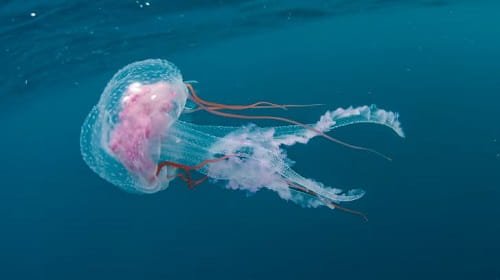
The immortal jellyfish — Turritopsis dohrnii — is the only animal on earth considered biologically immortal in the truest sense. When faced with starvation, physical damage, disease, or old age, this tiny marine creature — just 4–5 mm in diameter — can revert its cells back to their earliest state through a process called transdifferentiation, essentially restarting its entire life cycle from the polyp stage. It is the biological equivalent of a butterfly reverting back into a caterpillar.
This extraordinary ability means the immortal jellyfish has no theoretical maximum lifespan — it can cycle between maturity and juvenility indefinitely. First documented by German student Christian Sommer in 1988 in the Mediterranean and later studied extensively by Italian scientist Stefano Piraino, the species has since been found in oceans worldwide. Scientists are studying the cellular mechanisms behind transdifferentiation as a potential key to understanding ageing in other organisms, including humans.
2. Ocean Quahog Clam — 507 Years (Arctica islandica)
The ocean quahog clam holds the record for the oldest verified individual animal in history — a specimen nicknamed “Ming” (after the Chinese dynasty ruling at its birth) was dredged from Icelandic waters in 2006 and found to be 507 years old by counting the growth rings on its shell, much like tree rings. Born in 1499, Ming was alive during the Renaissance, Columbus’s voyages, and the reign of Henry VIII.
The clam’s extraordinary longevity is attributed to its exceptionally slow metabolism, efficient cellular repair mechanisms, and resistance to oxidative stress — biological characteristics that ageing researchers study intensely. Ocean quahog clams live in cold North Atlantic waters and grow very slowly, adding visible growth rings to their shells annually. Ming was unfortunately killed during the scientific examination process that determined its age — a somewhat ironic end for the world’s oldest recorded animal.
3. Greenland Shark — 400+ Years (Somniosus microcephalus)
The Greenland Shark is the world’s longest-lived vertebrate — a fish whose lifespan may exceed 400 years, according to a landmark 2016 study published in Science that used radiocarbon dating of proteins in the sharks’ eye lenses to estimate their ages. One female specimen was estimated to be approximately 392 years old, with an uncertainty range suggesting she could have been as old as 512 years.
Growing at just 1 centimetre per year, Greenland Sharks reach sexual maturity at approximately 150 years of age — the latest known reproductive maturity of any vertebrate. They inhabit the cold, deep waters of the Arctic and North Atlantic at temperatures near freezing, where their near-freezing environment slows metabolism to an extraordinary degree. Many Greenland Sharks are partially blinded by parasites attached to their corneas — a condition they appear to tolerate indefinitely across their centuries-long lives.
4. Bowhead Whale — 200+ Years (Balaena mysticetus)
The bowhead whale of the Arctic Ocean is the world’s longest-lived mammal — with the oldest confirmed specimen estimated at 211 years based on amino acid analysis of eye tissue. Indigenous Inuit hunters have long reported finding ancient stone harpoon fragments from the 19th century embedded in whale blubber, suggesting individual animals survive well beyond a century. The bowhead’s extraordinary longevity is supported by its unique genes — scientists have identified mutations in bowhead whale DNA associated with DNA repair, cancer suppression, and cell cycle regulation that appear to confer exceptional longevity.
The bowhead has the largest mouth of any animal relative to body size and can break through Arctic sea ice up to 60 centimetres thick using its massive bow-shaped skull. Despite centuries of commercial whaling that devastated populations, bowhead numbers have partially recovered under international protection.
5. Rougheye Rockfish — 200+ Years (Sebastes aleutianus)
The rougheye rockfish of the North Pacific is the world’s longest-lived confirmed bony fish — with specimens verified at over 200 years of age through otolith ring counting, the fish equivalent of tree ring dating. Found in deep Pacific waters from Alaska to California and across to Japan, rougheye rockfish are slow-growing, late-maturing fish that inhabit rocky deep-water habitats where they can live in remarkable obscurity for two centuries.
Their extraordinary lifespan has made rougheye rockfish a subject of serious ageing research — scientists have found that the species possesses unusually active insulin signalling pathways and telomere maintenance mechanisms that may explain their resistance to cellular ageing. Commercially they are caught for food fish markets, but their extremely slow reproduction rate makes them highly vulnerable to overfishing.
6. Giant Tortoise — 150–200 Years (Aldabrachelys gigantea)
The giant tortoise is the world’s longest-lived land animal and perhaps the most famous longevity example in the popular imagination. Jonathan, a Seychelles giant tortoise living on the island of St. Helena in the South Atlantic, was confirmed in 2022 as the world’s oldest living land animal at an estimated 190 years — born around 1832, the same decade Charles Darwin visited the Galápagos Islands. Jonathan still walks the grounds of Plantation House, the official residence of the Governor of St. Helena.
Giant tortoises’ exceptional longevity is attributed to their extremely slow metabolic rate, efficient DNA repair mechanisms, and a physiology adapted to survive periods of minimal food and water — an evolutionary adaptation to island environments where resources are unpredictable. Their shells provide protection from most natural predators, reducing the external mortality pressures that shorten the lives of most animals.
7. Red Sea Urchin — 150–200 Years (Mesocentrotus franciscanus)
The red sea urchin of the Pacific Coast of North America is among the most remarkable long-lived animals in the ocean — with specimens verified at over 200 years of age, showing negligible senescence — the biological term for essentially no observable deterioration in reproductive capability or physical function with age. Red sea urchins do not appear to age in any measurable biological sense, continuing to reproduce and grow indefinitely.
This extraordinary quality has made the red sea urchin one of the most studied organisms in ageing biology. Scientists have found that older specimens appear just as reproductively viable and physically capable as younger ones — defying the standard biological expectation that ageing produces declining function. The urchin’s spines regenerate rapidly from injury, and its tissues show no accumulation of the cellular damage markers that characterise ageing in most animals.
8. Geoduck Clam — 140–170 Years (Panopea generosa)
The geoduck (pronounced “gooey-duck”) is the world’s largest burrowing clam and one of North America’s longest-lived animals — with individuals verified at up to 168 years of age. Native to the Pacific Northwest coast from Alaska to Baja California, geoducks burrow up to one metre into subtidal sediments, extending their distinctive long siphon to the surface for feeding and breathing.
The geoduck’s slow growth rate and deep-burrowing habit protect it from most predators, contributing to its extraordinary natural lifespan. It is commercially harvested as a high-value seafood product — particularly prized in China where geoduck is considered a luxury delicacy commanding prices of up to $150 per kilogram. Washington State and British Columbia produce the largest commercial geoduck harvests, managed carefully given the animal’s slow reproductive cycle.
9. Bowfin and Koi Fish — 100–226 Years
The domestic koi fish (Cyprinus rubrofuscus) is famous for an extraordinary documented individual — Hanako, a scarlet koi belonging to a Japanese family in Gifu Prefecture, died in 1977 at a verified age of 226 years, determined through scale ring analysis. While most koi live 25–35 years, exceptional specimens in ideal conditions with excellent water quality, low stress, and genetic advantages can reach extraordinary ages.
Koi are descended from common carp and have been selectively bred in Japan for over 200 years for colour and pattern. The oldest koi reach their exceptional ages through a combination of cold water temperatures that slow metabolism, careful feeding management, and the genetic lottery of exceptional cellular repair capacity. Hanako remains the oldest verified koi on record and one of the oldest fish of any species.
10. Greenland Sleeper Shark — 150–200 Years (Somniosus pacificus)
The Pacific sleeper shark — closely related to the Greenland shark — inhabits the cold depths of the North Pacific from Japan to California, reaching depths of 2,000 metres. While less studied than its Atlantic cousin, radiocarbon analysis and size-based age estimations suggest Pacific sleeper sharks may live between 150 and 200 years — placing them among the vertebrate world’s longest-lived species.
Like the Greenland shark, the Pacific sleeper’s extraordinary longevity is attributed to its cold-water, deep-ocean environment, extremely slow metabolic rate, and minimal external mortality pressures at depth. Its slow growth — estimated at less than 2 centimetres per year — means large specimens represent decades of patient accumulation of size, and their reproduction strategy of producing relatively few pups makes them vulnerable to population depletion from fishing pressure.
Frequently Asked Questions (FAQs)
Q: Which is the longest living animal in the world?
A: The immortal jellyfish (Turritopsis dohrnii) is theoretically immortal. Among animals with verified maximum lifespans, the ocean quahog clam at 507 years holds the confirmed record.
Q: Which is the oldest living animal today?
A: Jonathan the giant tortoise on St. Helena island, estimated at approximately 190 years old, is the world’s oldest confirmed living land animal.
Q: Which is the longest living vertebrate?
A: The Greenland Shark is the world’s longest-lived vertebrate, with one female estimated at approximately 392 years old.
Q: Which is the longest living mammal?
A: The bowhead whale, with confirmed individuals exceeding 200 years, is the world’s longest-lived mammal.
Q: What makes some animals live so much longer than others?
A: Key factors include slow metabolic rates, efficient DNA repair mechanisms, resistance to oxidative stress, low external predation pressure, and in some cases specific genetic mutations that suppress cancer and cellular ageing.

Brandon is the cheif editor and writer at WorldUnfolds.com. With a passion for storytelling and a keen editorial eye, he crafts engaging content that captivates and enlightens readers worldwide.