In the animal kingdom, the tongue is far more than a sensory organ — it is a weapon, a trap, a venom-delivery system, and in some cases, the fastest moving body part on Earth. The most dangerous animal tongues have evolved extraordinary specialisations: speed that exceeds human reaction time, adhesive surfaces that can pull 1.5 times the animal’s own body weight, and in some species, glands that deliver toxins through the tongue’s surface directly into prey. This guide ranks the 10 most dangerous animal tongues in the world based on lethality, attack capability, venom delivery, and documented impact on prey and humans.
1. Gila Monster
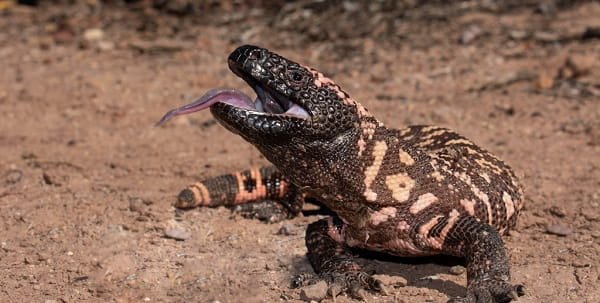
The Gila Monster is one of only two venomous lizards native to North America (the other being the Mexican beaded lizard). Unlike most venomous snakes, the Gila Monster delivers venom not through hollow fangs but through grooves in its lower jaw teeth — and the tongue plays a critical role in transferring venom into the wound by lapping it into the groove during a prolonged, tenacious bite. The venom contains gilatoxin, serotonin, and phospholipase A, causing severe pain, nausea, and in rare cases, life-threatening hypotension. The Gila Monster refuses to release once it bites, grinding its teeth and pushing venom deeper.
2. Chameleon
The chameleon’s tongue is arguably the most mechanically extraordinary tongue in the animal kingdom. The Rosette-nosed chameleon (Rhampholeon boulengeri) can launch its tongue at 0 to 97 kph in under 0.07 seconds — faster than any other tongue documented, with an acceleration exceeding 41g. The tongue tip is a mucilage-covered adhesive pad that can adhere to prey with a force 400 times the prey’s body weight. Large chameleon species (such as the Veiled Chameleon) regularly capture birds and other vertebrates. The tongue is stored in a coiled spring-like configuration around the hyoid bone, released by elastic recoil rather than muscle contraction alone.
3. Giant Anteater
The Giant Anteater has no teeth, but its tongue is one of the most efficient feeding instruments in the animal world. Extending up to 45 cm and flicking in and out up to 150 times per minute, coated in sticky saliva, the Giant Anteater’s tongue can consume 35,000 ants and termites in a single day. When threatened or cornered, Giant Anteaters rear up and slash with their 10 cm front claws — and the same tongue that demolishes insect colonies also picks up bacteria, pathogens, and toxic chemical defences from soldier ants and termites without harm to the anteater. Several human deaths from Giant Anteater attacks have been documented in Brazil.
4. Komodo Dragon
For decades, scientists attributed the Komodo Dragon’s lethal bite to the thousands of bacteria living in its mouth. More recent research (2009 by Bryan Fry) confirmed that Komodo Dragons also have venom glands that produce anticoagulant and hypotensive compounds, potentially delivered through grooves in the lower jaw — a mechanism similar to the Gila Monster. The forked tongue is extraordinarily sensitive, detecting chemicals in the air at concentrations as low as a few parts per trillion, allowing Komodo Dragons to track prey for up to 9 km. Komodo Dragons up to 3 metres and 70 kg have killed and consumed adult humans on the islands of Komodo, Rinca, and Flores.
5. Electric Eel
While the electric eel’s primary weapon is its electric organ — producing up to 860 volts — its feeding behaviour involves using its sensitive electroreceptors on and around the mouth and tongue to detect prey in murky Amazon waters. Research published in 2021 (Catania) demonstrated that electric eels can leap partially out of water to deliver higher-voltage shocks directly to the face and body of perceived threats, a behaviour that makes them the only animal known to use their body as a direct-contact high-voltage weapon against land-based threats. The tongue serves as a critical detection and targeting organ in this extraordinary predatory strategy.
6. Blue-ringed Octopus
The Blue-ringed Octopus carries enough tetrodotoxin (TTX) in its saliva glands to kill 26 adult humans, and its tongue-like radula (a file-toothed feeding organ) is the delivery mechanism. It bites prey or threats using its parrot-like beak, then its radula scrapes TTX-laced saliva into the wound. The bite is often painless — victims may not realise they have been bitten until paralysis begins within minutes. There is no antidote. The tongue/radula combination is the most quietly lethal feeding organ in the ocean, found in an animal that can fit in a teacup.
7. Sun Bear
The Sun Bear has the longest tongue of any bear species — up to 25 cm — adapted for extracting honey from hives and insects from tree bark. While this seems benign, Sun Bears are considered among the most dangerous bears in Southeast Asia. They are unpredictable, highly aggressive when threatened, and have the proportionally strongest bite of any bear. Their tongue is used to root out food from tight spaces, then their powerful claws and jaws do the rest. Documented human fatalities from Sun Bear attacks are proportionally higher than for many larger bear species.
8. Snapping Turtle
The Alligator Snapping Turtle has a worm-like lure appendage on its tongue — one of the most extraordinary examples of tongue-based deception in the animal kingdom. It lies motionless on the river bottom with its mouth open, wiggling the pink, worm-shaped tongue tip to attract fish. When prey comes close enough, the head snaps shut with a force capable of severing human fingers. The bite force of large Alligator Snapping Turtles exceeds 1,000 PSI, and the tongue-based luring behaviour makes them uniquely dangerous precisely because the attack mechanism is entirely unexpected.
9. Cone Snail
The geography cone snail (Conus geographus) has a proboscis — a highly extensible, tongue-like tube — that can extend in any direction (including backwards) to deliver a harpoon-like tooth loaded with conotoxin. The venom is a complex cocktail of over 100 peptides that target ion channels, causing paralysis, respiratory failure, and cardiac arrest. There is no antidote. Conus geographus has been called ‘the cigarette snail’ — supposedly, after being stung you only have time for one last cigarette before death. Their attractive shells make them popular to pick up, which is when most human fatalities occur.
10. Pangolin
The pangolin’s tongue can extend longer than its own body — up to 40 cm — stored in a sheath that passes through the chest cavity all the way to the pelvis when retracted. It is coated in thick, sticky saliva that can hold hundreds of ants simultaneously. While not directly dangerous to humans through its tongue, pangolins are significant because they are believed to be intermediary hosts for coronaviruses, including potentially SARS-CoV-2. As the world’s most trafficked mammal, their tongue-based feeding behaviour brings them into extensive contact with soil insects and their microbial communities — making the pangolin a critical node in emerging infectious disease transmission.
What Makes an Animal Tongue Dangerous?
- Speed: Chameleon tongues exceed 41g acceleration — faster than a fighter jet’s manoeuvres
- Venom delivery: Gila monsters and cone snails use tongue-associated mechanisms to introduce toxins into prey
- Adhesion and force: Chameleon mucilage produces 400× the prey’s body weight in adhesive force
- Reach and precision: Long tongues that extend beyond the animal’s visible profile create ambush attacks with no warning
- Sensory sophistication: Komodo dragon tongues detect chemicals at parts-per-trillion concentration, enabling lethal tracking
In nature, the most dangerous tongues are not the largest — they are the fastest, most precisely targeted, and most chemically sophisticated.
Frequently Asked Questions
Q: What animal has the fastest tongue in the world?
A: The rosette-nosed chameleon (Rhampholeon boulengeri) has been measured launching its tongue at 97 kph with an acceleration of 41g — making it the fastest tongue known in the animal kingdom. Larger chameleon species have slower tongues proportionally but greater absolute force due to mass. Among non-reptiles, the giant anteater flicks its tongue at 150 times per minute — the highest frequency tongue action among mammals.
Q: Can a Gila Monster bite kill a human?
A: Direct fatalities from Gila Monster bites are extremely rare in modern medical literature, though deaths have been documented historically. The primary danger is the venom’s hypotensive effects (sudden blood pressure drop), which can cause cardiovascular collapse in people with pre-existing heart conditions or those receiving alcohol before or during the bite — Gila Monster bites are far more dangerous to people who have been drinking, as alcohol dramatically amplifies the venom’s effects. The bite is intensely painful and the animal is notoriously difficult to remove without injury to both parties.
Q: Is the Komodo Dragon’s bite more dangerous because of bacteria or venom?
A: Current scientific consensus recognises both mechanisms. The 2009 research by Bryan Fry confirmed venom glands producing anticoagulant and hypotensive compounds. However, the oral bacteria also play a documented role — studies have found at least 57 bacterial species in Komodo saliva, including multiple dangerous pathogens. In practice, prey that escapes a bite often succumbs within days from septicaemia, blood loss from anticoagulant venom, and shock. The combination of venom and bacteria working together is what makes a Komodo Dragon bite so often fatal to large prey.
Q: How does the cone snail’s proboscis work as a weapon?
A: The cone snail’s proboscis is a muscular, flexible tube that can extend and rotate in any direction — including toward the shell, which is how most human stings occur (people pick up the shell and it stings their palm). The proboscis fires a hollow, harpoon-like radular tooth loaded with venom into prey. The conotoxins immediately begin disrupting ion channels in neurons and muscles, causing rapid paralysis. For fish-hunting species like Conus geographus, the venom must work fast enough to prevent the fish from swimming away before swallowing — which is why it is also fast enough to kill a human.
Q: Are pangolins dangerous to humans?
A: Pangolins are not aggressive toward humans and their tongue poses no direct threat. Their danger is indirect and epidemiological: as the world’s most trafficked mammal (primarily for meat and traditional medicine in Asia), their capture, slaughter, and consumption brings humans into close contact with the diverse viral communities they carry. Multiple studies have identified pangolins as potential hosts for bat coronaviruses with pandemic potential. The safest course is no contact with pangolins — both for human health and for the conservation of a critically endangered species.

Brandon is the cheif editor and writer at WorldUnfolds.com. With a passion for storytelling and a keen editorial eye, he crafts engaging content that captivates and enlightens readers worldwide.