The “most dangerous car” concept encompasses two very different categories: production vehicles with dangerous performance characteristics that can exceed driver skill limits, and vehicles with documented safety defects that make them statistically hazardous to occupants. This article examines both — from billion-dollar hypercars that can exceed 400 km/h to production vehicles flagged by safety agencies for critical structural or mechanical failures.
Performance cars are dangerous by design — pushing the boundaries of speed, grip, and aerodynamic force beyond the capabilities of most drivers. Safety recall vehicles are dangerous through failure — brakes that fade, steering that locks, and airbags that fire shrapnel. Both deserve to be understood. All performance specifications referenced are based on manufacturer data and independent testing conducted through 2026.
Dangerous Cars Overview
| Rank | Name | Key Trait | Danger Level |
| 1 | Bugatti Chiron Super Sport 300+ | 304 mph — fastest production car tested | Extreme Performance |
| 2 | Koenigsegg Jesko Absolut | 330 mph theoretical — unrestricted | Extreme Performance |
| 3 | Rimac Nevera (Electric Hypercar) | 0-300 km/h in 9.3 sec | Extreme Performance |
| 4 | Dodge Challenger SRT Demon 170 | 0-60 in 1.66 sec — most powerful muscle car | Very High Performance |
| 5 | Lamborghini Huracán Tecnica | Mid-engine snap-oversteer potential | High Performance |
| 6 | Mitsubishi Outlander (2003-2007) | Critical rollover risk — poor CG | Safety Defect |
| 7 | Ford Pinto (historical reference) | Fuel tank rupture design defect | Historical Safety Failure |
| 8 | Vehicles with Takata Airbag Recalls | Metal shrapnel from exploding airbags | Active Safety Risk |
| 9 | Nissan Titan (2016-2019) | NHTSA brake fluid leak recall | Safety Defect |
| 10 | Tesla Cybertruck (2024 recall) | Accelerator pedal trap recall | Safety Recall |
1. Bugatti Chiron Super Sport 300+
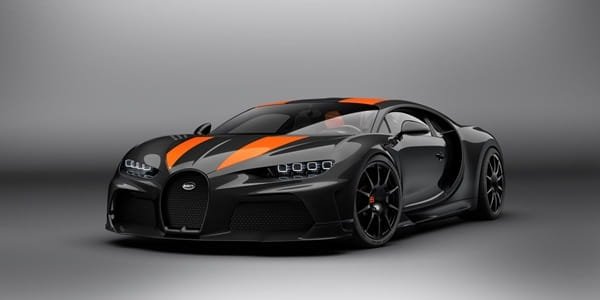
In 2019, a pre-production Bugatti Chiron Super Sport 300+ became the first production-based car to break the 300 mph (482 km/h) barrier — achieving 304.773 mph at Volkswagen’s Ehra-Lessien test track. The production version is limited to 440 km/h (273 mph) for tire safety reasons, but even this represents a level of velocity that no road tire or driver reflex can handle if something goes wrong.
At 300 mph, a car covers 134 meters per second. A tire failure at this speed is essentially unsurvivable. The Chiron Super Sport 300+ costs approximately $3.9 million and represents the absolute summit of legal automotive performance.
- Top speed: 304 mph (489 km/h) — production-based record
- At 300 mph, the car travels the length of a football field every 0.6 seconds
2. Koenigsegg Jesko Absolut
The Koenigsegg Jesko Absolut is theoretically the fastest car ever designed for production — with Koenigsegg’s aerodynamic and performance data supporting a calculated top speed of 330 mph (531 km/h), though this has not been independently verified on a closed track. Its 5.0-liter twin-turbo V8 produces 1,600 hp on E85 biofuel.
The car is sold out — 125 examples produced — at approximately $3 million each. Its theoretical speed is dangerous not because Koenigsegg has tested it there, but because the car exists in a performance envelope where the margin between controlled performance and catastrophic failure is measured in milliseconds.
- Calculated top speed: 330 mph — not yet verified in full-speed testing
- 1,600 hp on E85 biofuel — most powerful Koenigsegg ever produced
3. Rimac Nevera (Electric Hypercar)
The Rimac Nevera is Croatia’s electric hypercar and the world’s most powerful production electric vehicle. With four motors producing a combined 1,914 hp, it accelerates from 0-300 km/h in 9.3 seconds — faster than any production car in history at this benchmark. Its top speed of 412 km/h and the near-instantaneous torque delivery of its electric motors create a performance profile that is extraordinarily difficult for human reflexes to manage.
Rim ac’s safety systems are extensive, but the fundamental physics of 1,900 hp delivered with zero turbo lag remain a challenge for all but the most experienced high-performance drivers.
- 0-300 km/h in 9.3 seconds — fastest production car at this benchmark
- 1,914 hp — most powerful production electric vehicle as of 2025
4. Dodge Challenger SRT Demon 170
The Dodge Challenger SRT Demon 170 (2023) holds the record for the most powerful production muscle car in history — 1,025 hp on E85 ethanol. Its 0-60 mph time of 1.66 seconds represents the fastest 0-60 of any production car tested by Car and Driver, and it can cover the quarter mile in 8.91 seconds. Dodge specifically states it is for use on closed tracks with proper preparation.
The Demon 170 pulls more than 2.0G of lateral force off the line — more than a Formula 1 car at standing start — and requires DOT-approved drag radial tires (included with the car). It is the last Dodge Challenger SRT model before the platform was discontinued.
- 0-60 mph: 1.66 seconds — fastest production car 0-60 tested by Car and Driver
- 1,025 hp — most powerful American production car in history
5. Lamborghini Huracán Tecnica
The Lamborghini Huracán Tecnica is a road-legal, naturally aspirated 5.2-liter V10 rear-wheel-drive supercar producing 640 hp. Its mid-engine layout combined with rear-wheel drive creates a snap oversteer characteristic that can catch experienced drivers off-guard at the limit. Multiple Huracán variants have been involved in high-profile accidents when driver inputs exceeded the car’s predictability threshold.
This is not a criticism of the engineering — the Tecnica is a masterpiece — but its performance envelope demands a level of car control that most owners may not possess.
- 640 hp, rear-wheel drive, mid-engine — combination requires expert vehicle control
- 0-100 km/h: 3.2 seconds; top speed 325 km/h
6. Vehicles with Active Takata Airbag Recalls
The Takata airbag scandal remains the largest automotive recall in history — affecting approximately 67-100 million vehicles across multiple manufacturers worldwide. Takata’s ammonium nitrate inflators can rupture due to moisture exposure, sending metal fragments into the vehicle cabin at lethal velocities. As of 2025-2026, millions of vehicles containing unrepaired Takata airbags remain on US roads, and fatalities and injuries continue to occur.
Affected manufacturers include Honda, Toyota, BMW, Ford, Chrysler, Mazda, Subaru, and dozens more. NHTSA continues to push for completion of outstanding repairs.
- Largest automotive recall in history: 67-100 million vehicles globally
- Fatalities from Takata inflator ruptures documented through 2025 — ongoing risk
7. Ford Pinto (1971-1980) — Historical Safety Reference
The Ford Pinto is perhaps the most infamous safety failure in automotive history. Its fuel tank was positioned behind the rear axle in a way that, in rear-end collisions at speeds as low as 25 mph, would rupture and potentially cause fuel-fed fires. Internal Ford documents revealed the company had conducted cost-benefit analysis concluding that paying settlements for burn injuries and deaths was cheaper than redesigning the fuel system — an ethical and public relations catastrophe.
The Pinto scandal accelerated automotive safety regulation globally and remains a foundational case study in engineering ethics.
- Estimated 500-900 deaths linked to Pinto fuel tank defects
- Ford’s internal cost-benefit analysis memo became exhibit in US product liability law
8. Mitsubishi Outlander (2003-2007) — Rollover Risk
The early Mitsubishi Outlander SUV received poor rollover safety ratings due to a relatively high center of gravity and suspension tuning that encouraged body roll in emergency maneuver situations. NHTSA rated early models at 3 out of 5 stars for rollover resistance. While redesigned versions significantly improved this, the early models remain on roads globally as used vehicles with inadequate rollover protection.
- 3/5 NHTSA rollover rating for 2003-2007 models
- No electronic stability control in base trims — a critical safety omission
9. Nissan Titan (2016-2019) — Brake Safety
Nissan issued a significant recall for 2016-2019 Nissan Titan and Titan XD trucks due to a brake fluid leak issue that could result in a loss of braking ability. NHTSA investigation found that the brake master cylinder could develop leaks, potentially reducing hydraulic pressure in the system. Loss of braking capability in a full-size pickup truck traveling at highway speed presents an extremely serious safety risk.
- Recall affected approximately 400,000 vehicles in the US
- Brake fluid leak could result in gradual or sudden reduction in braking force
10 Tesla Cybertruck (2024 — Accelerator Pedal Recall)
In April 2024, Tesla issued a recall affecting all 3,878 Cybertrucks then delivered, after reports emerged of the accelerator pedal pad becoming dislodged and wedging under the interior trim, causing unintended acceleration. At least one accident was attributed to this issue. Tesla resolved the problem via a parts replacement campaign, but the recall raised quality control concerns about the highly anticipated vehicle’s production launch.
- Recall issued April 2024 — covered 100% of Cybertrucks delivered at the time
- Accelerator wedging under trim = unintended acceleration — a critical safety failure
Frequently Asked Questions (FAQs)
Q1. What is the most dangerous road-legal car ever made?
Ans: From a pure performance danger perspective, the Bugatti Chiron Super Sport 300+ holds the record for the highest verified speed of any road-legal production car. At its tested speed of 304 mph, the physics of any failure — tire blowout, steering issue, driver error — are unsurvivable. The Koenigsegg Jesko Absolut theoretically exceeds this, but the claim has not been independently verified.
Q2. Is my car affected by the Takata airbag recall?
Ans: The best way to check is to visit NHTSA’s official recall database at nhtsa.gov/recalls and enter your 17-digit VIN number. This will tell you instantly whether your vehicle has any open recalls, including Takata airbag recalls. This is a free, instant check that every vehicle owner should perform.
Q3. Are electric hypercars more dangerous than gasoline supercars?
Ans: Electric hypercars like the Rimac Nevera present a different danger profile. Their instant torque delivery (no turbo lag, no rev-matching required) means maximum acceleration is available immediately at any speed, making throttle management more critical. However, their lower center of gravity (heavy battery packs sit low in the chassis) and sophisticated traction control systems can make them more stable than gasoline mid-engine supercars at the limit.
Q4. What makes the Dodge Demon 170 so fast off the line?
Ans: The Demon 170’s 1.66 second 0-60 comes from a combination of its 1,025 hp E85 engine, its SoftTouch torque converter (which allows slip for optimal power transfer), TransBrake technology that holds the car stationary while building engine speed against the brake, and the drag-radial tires that provide maximum traction for launch. It is essentially a street-legal drag car.
Q5. What is the safest new car you can buy in 2026?
Ans: NHTSA and IIHS (Insurance Institute for Highway Safety) top safety picks for 2025-2026 include the Volvo XC90, Genesis GV80, Subaru Outback, and Toyota Camry as consistent top performers across crash tests, emergency braking, and safety technology metrics. Always check the current IIHS Top Safety Pick+ list for the most recent ratings.
Conclusion
The world’s most dangerous cars in 2026 exist at two extremes: machines of deliberately engineered performance excellence that demand extraordinary skill to survive, and vehicles where engineering or manufacturing failures have created inadvertent risks for ordinary drivers. Both demand respect — the hypercar through honest assessment of driver skill against machine capability, and the recalled vehicle through prompt action to address documented safety failures. In the rapidly evolving landscape of electric hypercars and autonomous driving technology, the definition of “dangerous car” will continue to evolve alongside the technology itself.

Brandon is the cheif editor and writer at WorldUnfolds.com. With a passion for storytelling and a keen editorial eye, he crafts engaging content that captivates and enlightens readers worldwide.