Motorcycles are statistically the most dangerous vehicles in common use — approximately 29 times more likely per mile to result in a fatal accident than a car. But within the world of motorcycles, certain machines push the performance envelope to a point where they require a level of skill, concentration, and physical capability that places them in an entirely different danger category. This list covers the 10 most dangerous motorcycles in the world based on power output, power-to-weight ratio, handling demands, speed capabilities, and the documented accident rates associated with each type.
| Rank | Name | Key Fact / Reason |
| 1 | Kawasaki Ninja H2R | 310 bhp; track-only; 400 kph; power-to-weight exceeds Formula 1 |
| 2 | Dodge Tomahawk (Concept) | 500 bhp Viper V10; theoretical 600 kph; 4-wheel concept; not rideable |
| 3 | Ducati Panigale V4R | 221 bhp; road-legal WSB race bike; 172 kg; 16,500 rpm peak power |
| 4 | BMW S1000RR M | 210 bhp; best all-round superbike; accessibility paradoxically increases danger |
| 5 | Aprilia RSV4 Factory | 217 bhp; V4 WSB-derived; most adjustable geometry; multiple fatalities in Europe |
| 6 | Suzuki Hayabusa (Gen 3) | Created hyperbike category; 190 bhp; 300 kph gentlemen’s agreement |
| 7 | MV Agusta F4 RR | Most mechanically complex production motorcycle; 201 bhp; 13,600 rpm peak |
| 8 | Kawasaki ZX-14R | Most powerful legal streetbike; 210 bhp; addictive power curve; 267 kg |
| 9 | MTT Y2K Turbine Superbike | Helicopter turbine engine; 320 bhp; jet exhaust ignites roadside materials |
| 10 | Honda RC213V-S | Road-legal MotoGP bike; 190 bhp (race kit: 265 bhp); $184,000; extreme ergonomics |
1. Kawasaki Ninja H2R (Most Powerful Production Motorcycle — 310 bhp)
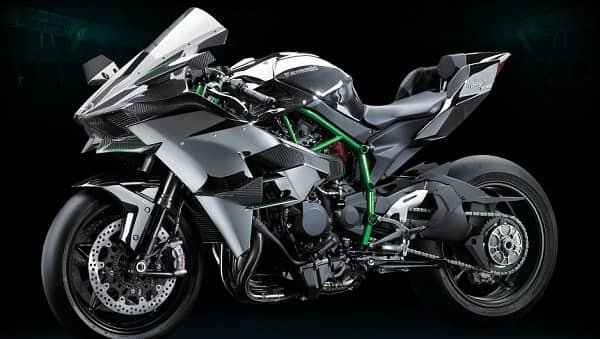
The Kawasaki Ninja H2R is the most powerful production motorcycle ever built, producing 310 bhp (326 hp with ram air) from its supercharged 998cc engine — generating a power-to-weight ratio that exceeds Formula 1 cars at comparable speeds. The H2R is not road-legal (it is a track-only machine) and accelerates from 0 to 100 kph in approximately 2.5 seconds, reaching 400 kph in under 26 seconds. At these speeds, the aerodynamic forces on the rider exceed 100 kg of drag, and a tyre failure, surface imperfection, or momentary distraction at maximum speed is essentially non-survivable. The H2R is one of the few production motorcycles where the primary limiting factor to speed is not engine power but rider biological capability.
2. Dodge Tomahawk (Concept) (Most Extreme Motorcycle Concept — 500 bhp V10)
The Dodge Tomahawk was a conceptual motorcycle unveiled at the 2003 Detroit Auto Show, powered by an 8.3-litre Dodge Viper V10 engine producing 500 bhp. It was never road-legal and never ridden at anywhere near its theoretical top speed (estimated 600 kph). Nine units were sold as static display items for $555,000 each. The Tomahawk serves as the absolute upper boundary of motorcycle dangerousness as a concept — a vehicle where the power plant completely overwhelms any conceivable ability to control or survive a loss of traction. Its four wheels (two pairs) were necessary simply to keep it from toppling over at rest.
3. Ducati Panigale V4R (MotoGP Technology on Public Roads)
The Ducati Panigale V4R is the road-legal version of Ducati’s World Superbike Championship machine, producing 221 bhp in standard form and up to 234 bhp with the race kit — from a 998cc V4 engine rev-matched to produce peak power at 16,500 rpm. The electronic systems (cornering ABS, traction control, launch control, wheelie control) are extraordinarily sophisticated, but even with full electronics, the Panigale V4R requires rider skill that most licence holders simply do not have. The combination of extreme lean angles, rapid throttle response at high rpm, and the extremely light kerb weight (172 kg) creates handling characteristics that can overwhelm less experienced riders in milliseconds.
4. BMW S1000RR M (German Precision — 210 bhp, 25,000 Km/h Power Density)
The BMW S1000RR M is widely considered the best all-round superbike in the world in 2025 — and that comprehensive excellence makes it one of the most dangerous motorcycles in inexperienced hands. Its 210 bhp inline-four engine produces its peak power in a linear, addictive power curve that encourages progressively faster speeds. The M version adds BMW’s most advanced electronic package: six riding modes, ten-level traction control, dynamic brake control, and BMW’s ShiftCam variable valve timing. The electronics make it more accessible, which paradoxically makes it more dangerous — riders reach speeds they are not competent to handle because the bike doesn’t inform them of the danger threshold until it is crossed.
5. Aprilia RSV4 Factory (Italian Superbike — Track Performance on Public Roads)
The Aprilia RSV4 Factory produces 217 bhp from its Superbike World Championship-derived 1,099cc V4 engine. It is characterised by the most adjustable and configurable chassis geometry of any production superbike — an advantage for track riders who want to optimise, but a source of danger if incorrectly configured by a less experienced owner. The RSV4’s steering geometry at full tuck at 280+ kph requires familiarity with the bike’s communication through handlebars and footpegs that only comes from extensive track time. Multiple fatalities in Italy and other European markets have been attributed to the RSV4 in untrained hands.
6. Suzuki Hayabusa (3rd Gen, 2021) (The Original Street Hyperbike — 190 bhp)
The Suzuki Hayabusa first broke the 300 kph barrier for production motorcycles in 1999 and created the ‘hyperbike’ category that redefined expectations of motorcycle performance. The third-generation Hayabusa (2021) produces 190 bhp and features comprehensive electronics, but its massive 1,340cc engine’s torque delivery and long-wheelbase stability make it deceptively easy to ride fast — the same characteristic that caused the original to be informally agreed to be limited at 299 kph by gentlemen’s agreement between Japanese and European manufacturers. The Hayabusa has disproportionately appeared in speed camera and police pursuit data across European and American motorways.
7. MV Agusta F4 RR (Most Complex Production Motorcycle Engine)
The MV Agusta F4 RR is a 201 bhp, 998cc inline-four motorcycle considered the most mechanically complex production motorcycle ever manufactured. Its engine produces peak power at 13,600 rpm and uses titanium connecting rods, a cassette-type gearbox, and radial valve actuation. The complexity is a double-edged sword — the exquisite engineering provides exceptional feedback to expert riders, but requires a level of mechanical sympathy and riding precision that can lead less experienced riders to misread the bike’s communications. MV Agusta’s limited service network adds the practical danger of maintenance issues going unaddressed.
8. Kawasaki ZX-14R (Ninja 14R) (Most Powerful Production Streetbike — 210 bhp)
The Kawasaki ZX-14R is the most powerful legal streetbike you can buy, producing 210 bhp in standard form with a 1,441cc inline-four producing massive mid-range torque across a broad rev range — making it addictively fast and comparatively easy to access that power. Unlike pure superbikes that demand precision to go fast, the ZX-14R delivers its performance accessibly, which means riders who are not superbike-trained can reach dangerous speeds very quickly without the physical feedback that warns more sensitive machines provide. It also weighs 267 kg — in a low-speed incident, this mass creates a serious physical injury risk from the bike falling on the rider.
9. MTT Y2K Turbine Superbike (Helicopter Engine in a Motorcycle Frame)
The MTT Y2K Turbine Superbike uses an Allison Rolls-Royce Model 250 turboshaft helicopter engine producing 320 bhp and 576 Nm of torque. It is road legal in the United States and was the world’s fastest production motorcycle when launched (claiming a 365 kph top speed, though independently verified speeds were lower). The turbine engine spins up differently from a piston engine — power delivery is less linear and the spool-up lag followed by sudden torque application requires complete adaptation. The jet exhaust exits approximately 50 cm from the rear tyre and at operating temperature can ignite roadside materials. Fewer than 15 units have been manufactured.
10. Honda RC213V-S (Street Legal MotoGP) (MotoGP Technology — $184,000)
The Honda RC213V-S is the only road-legal version of a current MotoGP championship motorcycle — Honda’s RC213V with detuned software (190 bhp vs. the race bike’s 265 bhp) and street equipment. For $184,000, buyers receive a machine that is physically identical to what Marc Marquez races at over 350 kph. The detuning is entirely software-based — a race kit restores full MotoGP power. The RC213V-S has the most extreme chassis geometry of any road-legal motorcycle, requiring the rider to adopt a near-horizontal position at speed that is only comfortable above 200 kph. At lower speeds in traffic, the lack of low-speed electronic assistance and the extreme ergonomics make it more difficult to handle than many 310 bhp superbikes.
Motorcycle Safety Facts
- Motorcycles are 29× more likely per mile to cause a fatal accident than cars (NHTSA 2024)
- 80% of motorcycle accidents result in injury or death vs. 20% for car accidents
- Speed and alcohol are the primary factors in 70% of fatal motorcycle accidents
- Helmets reduce motorcycle fatality risk by 37% and brain injury risk by 69%
- Most fatal motorcycle accidents involve riders on bikes less than 3 months old to them
The most dangerous motorcycle is the one most disproportionate to the rider’s experience and skill level — a 210 bhp superbike in the hands of a newly licensed rider is statistically more lethal than a 310 bhp hyperbike ridden by a professional.
Frequently Asked Questions
Q: What is the fastest production motorcycle in the world in 2025?
A: The Kawasaki Ninja H2R holds the record for fastest production motorcycle, having been clocked at approximately 400 kph (249 mph) in modified/tuned form at the Bonneville Salt Flats. In standard form, it is electronically limited to 400 kph. Among road-legal production bikes, the Kawasaki H2 (the road-legal version of the H2R) and the Dodge Tomahawk (disputed production motorcycle status) compete for the top speed record. The Bugatti Veyron-engined custom bikes built for specific clients claim higher speeds but are not standard production models.
Q: Why are superbikes more dangerous than regular motorcycles?
A: Superbikes are dangerous not primarily because of their top speed but because of their power delivery characteristics. A 200 bhp superbike at 50 kph can still produce wheelie-triggering torque if the throttle is opened abruptly. The extreme sensitivity to rider inputs at high lean angles means that errors that would be trivial on a regular motorcycle become crashes on a superbike. The electronics on modern superbikes manage much of this, but they also enable riders to approach limits they lack the training to recognise.
Q: Is the Kawasaki Ninja H2R street legal?
A: No. The Kawasaki Ninja H2R is a track-only motorcycle. It has no mirrors, no horn, no lights, and no number plate provision. The street-legal sibling, the Ninja H2, produces 200 bhp (with ram air) and is road legal in most markets. The H2R’s 310 bhp figure is for the track version only. In the European Union and UK, the H2R cannot be registered for road use under any circumstances.
Q: What protective gear should you wear on a high-performance motorcycle?
A: For high-performance motorcycles, the minimum appropriate protective equipment is: a full-face helmet meeting ECE 22.06 or DOT standards (preferably SNELL-rated), one-piece leather racing suit with CE Level 2 armour at shoulders, elbows, and knees, a certified spinal protector (either integrated into the suit or separate back protector), racing gloves with wrist protection, and racing boots with ankle protection. At speeds above 200 kph, airbag-equipped racing suits (which automatically inflate on crash detection) significantly reduce upper body injury.
Q: What is the most common cause of superbike accidents?
A: The most common causes of superbike accidents specifically are: target fixation (looking at the hazard rather than the escape route, causing the rider to steer toward it), running wide on corner entry (entering too fast for the chosen line), and throttle-induced instability (over-aggressive throttle on corner exit causing the rear to step out). Most superbike accidents do not involve high absolute speeds — the majority occur at below 100 kph during cornering maneuvers. The speed at which superbike accidents become non-survivable is lower than most riders appreciate.

Brandon is the cheif editor and writer at WorldUnfolds.com. With a passion for storytelling and a keen editorial eye, he crafts engaging content that captivates and enlightens readers worldwide.