Primates are our closest relatives in the animal kingdom, and that evolutionary proximity makes them uniquely dangerous in ways that other animals are not. They can read human body language with extraordinary accuracy, they can coordinate group attacks with tactical intelligence, they have hands capable of gripping and manipulating tools and weapons, and their canine teeth — particularly in large male primates — are designed to deliver devastating wounds in territorial and dominance conflicts. This list ranks the 10 most dangerous monkeys and primates in the world based on physical capability, documented attack history, aggression, and the severity of injuries they are known to cause.
1. Chimpanzee (Pan troglodytes) (Our Closest Relative — Highly Dangerous Group Hunter)
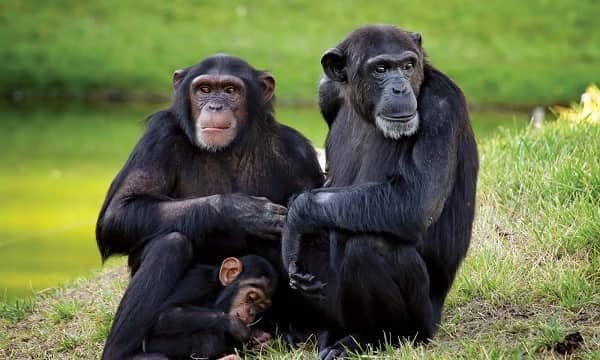
Chimpanzees are not technically monkeys (they are Great Apes), but are the most dangerous non-human primate for humans by documented injury record. Adult male chimpanzees are approximately 1.2-1.3 metres tall but possess muscle density roughly 1.35 times greater than human males, giving them functional strength 4-5 times that of an equivalent-sized human. Chimpanzees conduct coordinated raids on neighbouring groups — ‘tribal warfare’ — killing adult males and infants in calculated attacks. Attacks on humans have involved biting off fingers, hands, and faces. The most famous incident — Travis the chimpanzee’s 2009 attack in Connecticut — left a woman with permanent facial disfigurement and the loss of both hands. In West Africa, chimpanzees regularly raid farms and have attacked and killed children.
2. Mandrill (Mandrillus sphinx) (Largest Monkey — Dagger Canines)
The Mandrill is the world’s largest monkey species and arguably the most visually dramatic, with its multicoloured facial colouring of red and blue. Male Mandrills develop canine teeth up to 6.35 cm long — longer than a lion’s canines relative to skull size. These are used in territorial and dominance conflicts that can be explosively violent. Mandrills live in ‘hordes’ of up to 800 individuals — the largest social groups of any non-human primate. While attacks on humans are relatively rare, captive Mandrill attacks — usually from males in sexual maturity who have not been appropriately managed — have caused severe puncture wounds and lacerations requiring extensive surgery.
3. Olive Baboon (Papio anubis) (Pack Hunter with Carnivore-Level Aggression)
Olive Baboons are among the most aggressive monkeys and are documented omnivores that actively hunt gazelle calves, rabbits, and other mammals in coordinated group hunts. They are prolific crop raiders and their encroachment into human settlements across sub-Saharan Africa creates regular dangerous confrontations. Large male Olive Baboons have canines exceeding 4 cm and weigh up to 40 kg. They are not afraid of humans and will challenge, chase, and bite when they associate humans with food (as happens near tourist areas and camps). Baboon-inflicted injuries requiring hospitalisation are regularly recorded in Kenya, South Africa, and Tanzania.
4. Japanese Macaque (Macaca fuscata) (Urban Aggressive — Coordinated Human Attacks)
Japanese Macaques (‘Snow Monkeys’) have become increasingly aggressive toward humans in areas of Japan where urbanisation and feeding of tourist monkeys has reduced their natural fear of people. In Yamaguchi city, a 2022 incident involved a group of macaques conducting systematic attacks on residents over weeks — entering homes through open windows, attacking sleeping residents, and biting infants. Over 50 people were injured before the implicated monkeys were trapped. Macaques also carry the B virus (Herpes simiae) — a herpesvirus that is almost always fatal in humans. Even a superficial scratch or bite from a macaque can transmit the virus, adding a biological danger to the physical threat.
5. Rhesus Macaque (Macaca mulatta) (B Virus Carrier — World’s Most Common Research Primate)
The Rhesus Macaque is the world’s most widespread and best-studied primate outside of humans, but it is also one of the most medically dangerous to encounter. Approximately 80% of Rhesus Macaques carry the B virus (Cercopithecine herpesvirus 1 / Herpes simiae) as a benign latent infection. When transmitted to humans via bite, scratch, or mucous membrane contact, B virus causes rapidly progressive encephalitis that is fatal in approximately 80% of untreated cases. Of the approximately 50 documented human cases in medical literature, 21 have died. The virus can be managed with antiviral treatment if initiated within hours, but the window is narrow.
6. Bonobo (Pan paniscus) (Deceptive Gentleness — Capable of Extreme Violence)
Bonobos are often cited as the ‘peaceful’ great apes — matriarchal, sexually social, and conflict-resolving rather than conflict-seeking compared to chimpanzees. However, this reputation is somewhat misleading. While Bonobos use social sexual behaviour as a tension-reducing mechanism, captive Bonobo attacks on humans have resulted in severe injuries including finger amputations and deep facial bites. Their physical strength is comparable to chimpanzees. The primary reason they appear in this list is that their ‘peaceful’ reputation causes handlers and visitors to underestimate their capability — the most dangerous scenario with any powerful animal.
7. Howler Monkey (Alouatta species) (Bite and Projectile Defences)
Howler Monkeys produce the loudest vocalisation of any land animal — audible from 5 km — as a territorial signal. While they are primarily defensive rather than aggressive, cornered or injured Howler Monkeys bite with impressive force and will throw branches, urine, and faeces from the canopy at perceived threats. Their bites can cause serious lacerations requiring medical treatment, and their teeth are designed to strip bark and tear fruit. In Costa Rica and Central America, wildlife rehabilitation workers report regular Howler bites as an occupational hazard. They also carry several zoonotic diseases.
8. Gelada Baboon (Theropithecus gelada) (Cliff-Dwelling Aggressive Males)
Geladas are the only surviving member of a once-widespread grass-grazing primate group and are found exclusively in the Ethiopian Highlands. Large male Geladas have distinctive mane-like shoulder capes and exposed pink chest patches used in social signalling. Their canines are large and they are highly territorial, conducting dramatic threat displays that can escalate to actual combat. Geladas share the Simien Mountains with human communities, and crop raiding and territorial boundary disputes create regular confrontations. While less studied than savanna baboons for human attack incidents, their physical capability and territorial aggression make them a genuine hazard in their highland range.
9. Spider Monkey (Ateles species) (Canopy Aggressor — Fruit and Territory Defence)
Spider Monkeys are among the most agile primates in the world, using their prehensile tails as a fifth limb to move through the canopy at extraordinary speed. They live in fission-fusion societies and are highly territorial, with male groups coordinating the defence of fruiting trees. Spider Monkeys are known to break off branches and drop them on perceived threats below — a behaviour that has injured both tourists and researchers. Their bites are sharp and their strength, combined with the advantage of attacking from the canopy, makes encounters from below particularly one-sided.
10. Long-Tailed Macaque (Macaca fascicularis) (Temple Thief — Increasingly Aggressive Urban Primate)
Long-Tailed Macaques (‘Crab-eating macaques’) are among the most human-habituated primates in the world, living in temples, tourist areas, and urban green spaces across Southeast Asia. Their habituation to humans has made them increasingly bold — studies at Bali temples have documented macaques systematically stealing valuable items (glasses, phones, wallets) and ransoming them for food. More seriously, macaque bite incidents at tourist sites in Indonesia, Thailand, and Malaysia run into hundreds annually. Long-tailed macaques are also vectors for Simian Foamy Virus (SFV) and carry multiple zoonotic pathogens with pandemic potential.
Primate Safety: Critical Guidelines
- Never feed wild or temple primates — it eliminates fear of humans and escalates aggression
- Do not make eye contact with large male primates — direct eye contact is a dominance challenge
- Back away slowly if charged — running triggers pursuit instinct
- Any bite or scratch from a macaque requires immediate medical attention for B virus assessment
- Children and elderly people are disproportionately targeted in primate attacks — keep them away from primate zones
Primates are dangerous precisely because they are intelligent enough to learn, remember individual humans, and coordinate group behaviour. They are not ‘just animals’ in the conventional threat assessment sense.
Frequently Asked Questions
Q: How strong is a chimpanzee compared to a human?
A: Studies have consistently measured chimpanzee muscle as approximately 1.35 times denser in fast-twitch fibres than human muscle, translating to approximately 1.5 to 5 times the functional strength of a human male of equivalent size, depending on the type of strength being measured. A chimpanzee weighing 50 kg can outperform a human male weighing 80 kg in pulling, throwing, and grasping tasks. The combination of this strength with dagger-like canines and tactical intelligence makes chimpanzees among the most physically formidable animals a human is likely to encounter.
Q: What is the B virus and how dangerous is it?
A: The B virus (Cercopithecine herpesvirus 1) is a herpesvirus endemic in Old World macaques that causes benign latent infection in the monkeys but rapidly progressive, lethal encephalomyelitis in humans. It is transmitted via bite, scratch, or mucous membrane contact with infected saliva or tissue. The 80% untreated mortality rate and the speed of progression make it one of the most dangerous zoonotic viruses associated with a single animal species. Antiviral treatment with acyclovir initiated within hours of exposure can prevent progression.
Q: Are monkeys at temples safe to interact with?
A: No. Temple macaques and other habituated primates should never be considered safe for close interaction. Their habituation makes them bold rather than tame — they have lost natural fear without gaining tolerance. Bites and scratches at temple sites (particularly at Bali’s Ubud Monkey Forest, Lopburi in Thailand, and the Gibraltar Rock Apes) are common. All bites from macaques require immediate rabies prophylaxis assessment and B virus evaluation in endemic areas.
Q: Has a monkey ever killed a human?
A: Yes. Chimpanzee attacks on humans have resulted in fatalities, particularly in West and Central Africa where chimpanzees raid farms and villages. The 2009 Travis incident killed the chimpanzee’s owner (who was trying to stop the attack) and left the victim permanently disfigured. In India, a series of attacks by a rogue Rhesus Macaque troop in Delhi in 2007 resulted in at least one fatality — a government official who fell from a balcony while fleeing a macaque attack. Baboon attacks in South Africa have resulted in deaths, though exact figures are not systematically collected.
Q: Which primates are protected by law?
A: All great apes (chimpanzees, bonobos, gorillas, orangutans) are protected under CITES Appendix I — the highest protection level, prohibiting international commercial trade. Most monkey species are protected under national legislation in their range countries. In India, all macaque species are protected under Schedule II of the Wildlife Protection Act. In many countries, keeping primates as pets is illegal but enforcement is inconsistent. The exotic pet trade remains the primary driver of primate population decline in several species.

Brandon is the cheif editor and writer at WorldUnfolds.com. With a passion for storytelling and a keen editorial eye, he crafts engaging content that captivates and enlightens readers worldwide.