Rocket speed is the most conceptually complex speed category on any list because the same object can have completely different speeds depending on the reference frame. A rocket launching from Earth’s surface accelerates from zero to approximately 28,000 km/h to reach Low Earth Orbit — and that same rocket’s payload, once in orbit, is simultaneously moving at 28,000 km/h relative to Earth’s surface while standing still relative to the International Space Station beside it. The fastest human-made object in history is the Parker Solar Probe — not a rocket in the launch vehicle sense, but a spacecraft whose speed of 692,000 km/h was generated partly by the Atlas V that launched it and partly by seven Venus gravity-assist flybys over six years. This list covers launch vehicles and spacecraft across their peak recorded speeds.
| Rank | Rocket / Spacecraft | Top Speed | Mission | Status |
| 1 | Parker Solar Probe | 692,000 km/h (430,000 mph) | Solar corona study | Operational (Dec 2024 record) |
| 2 | Helios 1 & 2 | 252,792 km/h (157,078 mph) | Solar orbit probes | Retired (1970s) |
| 3 | New Horizons | 58,536 km/h (36,373 mph) | Pluto + Kuiper Belt | Operational |
| 4 | Voyager 1 | 62,100 km/h (38,600 mph) | Interstellar mission | Operational (furthest from Earth) |
| 5 | Apollo 10 Command Module | 39,897 km/h (24,791 mph) | Fastest crewed vehicle | Retired (1969) |
| 6 | Stardust | 46,446 km/h (28,856 mph) | Comet sample return | Retired (1999–2011) |
| 7 | Saturn V | 40,320 km/h (25,050 mph) | Apollo lunar missions | Retired |
| 8 | SpaceX Starship | ~28,000 km/h LEO | Next-gen super heavy | Operational test flights 2024–26 |
| 9 | NASA Space Launch System (SLS) | ~39,429 km/h | Artemis lunar programme | Operational (Artemis I, 2022) |
| 10 | SpaceX Falcon Heavy | ~40,140 km/h (payload velocity) | Heavy lift commercial | Operational |
1. NASA Parker Solar Probe – 692,000 km/h
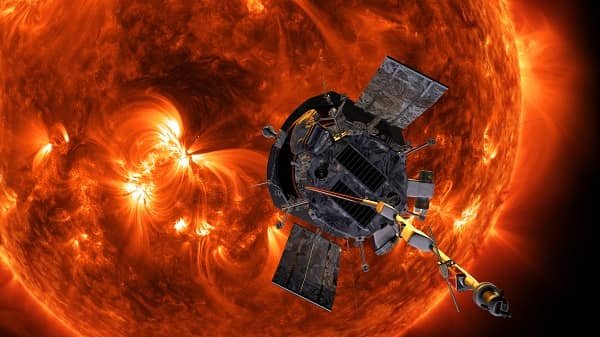
The fastest human-made object in history. On December 24, 2024, the Parker Solar Probe made its closest-ever approach to the Sun — just 3.8 million miles from the solar surface — and recorded a speed of 692,000 km/h (430,000 miles per hour) relative to the Sun. This speed was not generated by its rocket alone: the Atlas V launch vehicle provided the initial push to escape Earth’s gravity, and seven Venus gravity-assist flybys over six years redirected and accelerated the spacecraft progressively deeper into the Sun’s gravity well. Each solar approach increases speed further — the closer the probe gets to the Sun, the faster it falls toward it and the faster it must travel to maintain its orbit.
At 692,000 km/h, the Parker Solar Probe travels the distance from New York to Los Angeles in under 20 seconds. Its carbon-composite heat shield protects the instruments behind it from temperatures of 1,400°C while maintaining near-room temperature in the payload bay. It will continue breaking its own records on subsequent solar approaches.
2. Helios 1 and 2 – 252,792 km/h
NASA/German-built solar orbit probes launched in 1974 and 1976, the Helios spacecraft established the spacecraft speed record that stood for over four decades. Helios 2 reached 252,792 km/h at perihelion — its closest point to the Sun — a figure that remained the record until Parker Solar Probe surpassed it in 2018. The Helios probes were designed specifically to study the interplanetary medium and solar wind, and their solar orbit approach generated the gravity-assisted speed that no other spacecraft at the time had achieved.
3. New Horizons – 58,536 km/h (Highest Earth Escape Speed)
Launched in January 2006 on an Atlas V rocket configuration, New Horizons holds the record for the highest Earth-escape velocity achieved by any spacecraft: 58,536 km/h as it departed Earth’s gravitational influence. This extraordinary initial speed was required to reach Pluto in a reasonable timeframe — even at this speed, the 5 billion kilometre journey took nearly a decade. On July 14, 2015, it flew past Pluto at approximately 50,370 km/h, delivering the first close-up imagery of the dwarf planet and its moons.
4. Voyager 1 – 62,100 km/h
The most distant human-made object from Earth, Voyager 1 travels at approximately 62,100 km/h relative to the Sun as of 2026 — further from Earth than any other spacecraft and now confirmed to be in interstellar space beyond the heliopause. Launched in 1977, it received a gravitational boost from Jupiter and Saturn that accelerated it onto its current interstellar trajectory. Despite the extraordinary distance — over 23 billion kilometres from Earth — Voyager 1 remains in contact with NASA, though its radio signals take over 22 hours to reach Earth at the speed of light.
5. Apollo 10 Command Module – 39,897 km/h (Fastest Crewed)
Launched by Saturn V in May 1969 as a “dress rehearsal” for the Apollo 11 Moon landing, the Apollo 10 Command Module achieved 39,897 km/h during its Earth atmospheric reentry — the fastest speed any human being has ever travelled. This record remains unbroken. Apollo 10 descended to 14 km above the lunar surface without landing, verifying all mission systems before Armstrong and Aldrin made their July 1969 attempt.
The Stardust mission (46,446 km/h) collected cometary dust samples from Comet Wild 2 and returned them to Earth — one of the fastest unmanned spacecraft of the pre-Parker era. Saturn V accelerated Apollo spacecraft to 40,320 km/h for lunar trajectory — still among the most powerful launch events in history, with 7.6 million lbs of thrust at liftoff. SpaceX’s Starship, in operational test flights through 2024–26, achieves approximately 28,000 km/h in Low Earth Orbit and represents the current generation’s heavy-lift capability. NASA’s SLS (Space Launch System) achieved approximately 39,429 km/h sending Orion toward the Moon on Artemis I in November 2022. SpaceX Falcon Heavy’s 2018 test flight sent a Tesla Roadster payload to 40,140 km/h — exceeding Earth’s escape velocity.
FAQs – Fastest Rockets
Q: What is the fastest rocket in the world in 2026?
A: The Parker Solar Probe — launched by an Atlas V — holds the speed record at 692,000 km/h as of December 2024. Among launch vehicles by payload velocity, Saturn V (40,320 km/h) and Falcon Heavy (~40,140 km/h) are comparable. Among crewed vehicles, Apollo 10 at 39,897 km/h remains the fastest humans have ever travelled.
Q: How did the Parker Solar Probe reach 692,000 km/h?
A: The Atlas V launch vehicle provided Earth escape velocity. Seven subsequent Venus gravity-assist flybys over six years progressively redirected and accelerated the spacecraft. At each solar perihelion, the Sun’s gravity accelerates the probe further. The combination of rocket power and orbital mechanics produced the record speed.
Q: Is Voyager 1 still operational in 2026?
A: Yes. Voyager 1 launched in 1977 remains operational, communicating with NASA’s Deep Space Network. Its radio signals take over 22 hours to reach Earth. It is currently beyond the heliopause in interstellar space — the first human-made object to leave the solar system’s influence.
Q: What speed is needed to reach the Moon?
A: Approximately 40,000 km/h — which is the speed Saturn V accelerated Apollo spacecraft to for trans-lunar injection. At this speed, the Moon is approximately 10 hours away. Apollo missions took approximately 3 days due to navigational trajectory choices rather than straight-line speed.
Q: How much faster is the Parker Solar Probe than the ISS?
A: The International Space Station orbits at approximately 28,000 km/h. The Parker Solar Probe at its fastest reached 692,000 km/h — approximately 24.7 times faster than the ISS. The ISS’s speed is Earth orbit velocity; the probe’s speed is generated by solar gravity at its closest approach to the Sun.

Brandon is the cheif editor and writer at WorldUnfolds.com. With a passion for storytelling and a keen editorial eye, he crafts engaging content that captivates and enlightens readers worldwide.