Speed in snakes is a genuinely counterintuitive subject. Popular perception assumes the most dangerous snakes are the fastest — and often that is broadly true, but the relationship between speed and danger is more nuanced than a simple ranking suggests. The fastest snake on land is disputed between the sidewinder rattlesnake (by some measurements on sand) and the black mamba (by Guinness World Records on open ground). Snake speed is also measured in two entirely different ways: locomotion speed (how fast the snake travels from A to B) and strike speed (how fast the snake’s head moves in an attack). The two are completely different athletic capabilities — a slow-moving snake can have a near-instantaneous strike.
| Rank | Snake | Speed | Region | Venomous | Notable Feature |
| 1 | Sidewinder Rattlesnake | 29 km/h (18 mph) | SW USA / NW Mexico | Yes | Unique sidewinding locomotion on sand |
| 2 | Black Mamba | 19 km/h (12 mph) | Sub-Saharan Africa | Highly | Guinness WR fastest land snake; neurotoxic venom |
| 3 | Southern Black Racer | 16 km/h (10 mph) | SE United States | No | Fastest non-venomous snake |
| 4 | Eastern Brown Snake | 15 km/h (9.3 mph) | Eastern Australia | Highly | World’s 2nd most venomous land snake |
| 5 | Blue Racer | 14 km/h (8.7 mph) | North America | No | Fast, slender, ground-dwelling |
| 6 | Cottonmouth (Water Moccasin) | 13 km/h (8 mph) | SE United States | Yes | Fastest aquatic venomous snake in N. America |
| 7 | King Cobra | 12 km/h (7.5 mph) | South/SE Asia | Highly | World’s longest venomous snake; fastest raising strike |
| 8 | Coachwhip Snake | 10 km/h (6.3 mph) | North America | No | Extremely agile; can “stand” to survey terrain |
| 9 | Inland Taipan | 8 km/h (5 mph) | Central Australia | Most venomous | Fastest striker; most toxic land snake venom |
| 10 | Gaboon Viper | Strike: 175–200 mph | Central/West Africa | Highly | Fastest strike speed of any snake |
1. Sidewinder Rattlesnake – 29 km/h (18 mph)
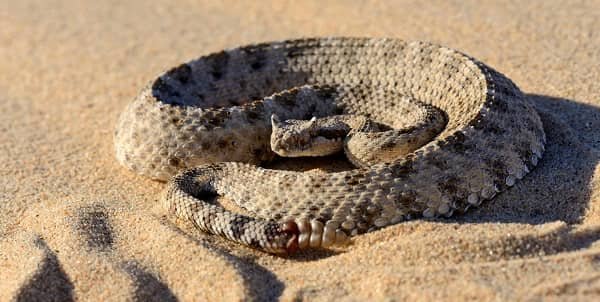
The fastest snake in the world by some measurements, the sidewinder achieves its extraordinary speed through a wholly unique locomotion technique. Rather than the S-shaped lateral undulation used by most snakes, the sidewinder lifts sections of its body sequentially off the desert sand, creating the sideways, looping track pattern that gives the snake its name. This approach generates explosive forward momentum across loose sand surfaces where standard undulation would lose traction. The 29 km/h figure represents maximum speed on sandy terrain — its natural environment. On hard ground, this advantage diminishes. Found in the sandy deserts of the southwestern United States and northwestern Mexico, it is a venomous pit viper with heat-sensing facial pits and the characteristic rattle.
2. Black Mamba – 19 km/h (12 mph)
The Guinness World Record holder for fastest land snake. The black mamba reaches up to 19 km/h in short bursts over open ground, moving in the lateral undulation pattern with the additional advantage of holding its head up to one metre above ground level while travelling — an elevated posture unique among snakes that reduces ground drag. It can reach approximately 4 metres in length, making its combination of speed and size genuinely alarming. Its venom is ferocious: 10–15 mg is lethal to an adult human, and a single bite can deliver 100–120 mg. Without antivenom, a bite can kill in as little as 30 minutes. The name comes not from body colour (which is olive to brown) but from the blue-black interior of its mouth, which it displays when threatened.
3. Southern Black Racer – 16 km/h (10 mph)
The fastest non-venomous snake in the world, the southern black racer inhabits the forests and grasslands of the southeastern United States and moves with a darting agility that gives it its name — it races rather than glides. At 10 mph it is significantly faster than a human walking pace. It uses speed both for hunting small mammals, lizards, and birds, and for escaping the birds of prey and larger mammals that target it.
4. Eastern Brown Snake – 15 km/h (9.3 mph)
Australia’s most feared snake and the world’s second most venomous land species after the inland taipan. The eastern brown snake reaches 15 km/h — fast enough to outpace most humans at a brisk walk — and combines this speed with a potent neurotoxic and haemotoxic venom responsible for more snakebite fatalities in Australia than any other species. Its aggressive defensive behaviour when threatened makes its speed particularly relevant: unlike most snakes that flee confrontation, the eastern brown will pursue a perceived threat.
5–10 Summary
The blue racer (14 km/h, North America) and coachwhip (10 km/h) complete the non-venomous speed group. The cottonmouth/water moccasin (13 km/h) is the fastest venomous aquatic snake in North America. The king cobra (12 km/h) is the world’s longest venomous snake at up to 18 feet, with the fastest threat-display striking speed — it can raise a third of its body off the ground to eye level and strike forward in a single motion. The inland taipan (8 km/h locomotion) earns its place through strike speed and the fact that its venom is the most toxic of any land snake on earth — a single bite contains enough venom to kill 100 adult humans. The Gaboon viper’s strike speed of 175–200 mph (head only, not locomotion) represents the fastest recorded strike of any snake — it can deliver its four-to-five-centimetre fangs to a target in 0.07 seconds.
5 FAQs – Fastest Snakes
Q: What is the fastest snake in the world in 2026?
A: The sidewinder rattlesnake at approximately 29 km/h (18 mph) on sandy terrain. The black mamba holds the Guinness World Record for fastest land snake at 19 km/h on open ground. The difference reflects measurement environment — sidewinder’s speed is maximised on its native sand; the mamba’s record is on open level ground.
Q: Can a human outrun a black mamba?
A: Most humans can outrun a black mamba at sustained speed — a human sprints at 25–35 km/h, faster than the mamba’s 19 km/h maximum. However, the mamba’s advantage is starting speed and that its 19 km/h is reached almost immediately. In practice, encountering a black mamba in African bush where clear running space is absent would be far more dangerous than the speed comparison suggests.
Q: What is the difference between a snake’s locomotion speed and strike speed?
A: Locomotion speed measures how fast the snake travels across the ground. Strike speed measures how fast the snake’s head moves during an attack. The Gaboon viper has the fastest strike (head travelling 175–200 mph) but moves very slowly overall — the two capabilities are entirely independent.
Q: Is the black mamba actually black?
A: No. The black mamba’s body is olive to grey-brown in colour. The name refers to the blue-black colour of the inside of its mouth, which it opens wide in a threat display when cornered. The gaping dark mouth is the visual warning it uses before striking.
Q: What is the fastest snake in Australia?
A: The eastern brown snake at approximately 15 km/h — which also happens to be Australia’s most deadly snake by fatal bite statistics. It is responsible for more human snakebite deaths in Australia than any other species.

Brandon is the cheif editor and writer at WorldUnfolds.com. With a passion for storytelling and a keen editorial eye, he crafts engaging content that captivates and enlightens readers worldwide.