Water is 800 times denser than air. Everything about high-speed vessel design works against this fundamental fact — hulls must either cut through water with minimum resistance, lift above it on hydrofoils, or skim its surface like a hovercraft. The fastest ship in the history of naval records is Ken Warby’s Spirit of Australia — but it is a jet-powered hydroplane designed purely for one straight line, not a vessel in any functional sense. The fastest operationally significant vessels are hydrofoil warships, surface effect ships, and high-speed catamarans that serve real transport functions at speeds that redefine what waterborne travel means.
| Rank | Vessel | Top Speed | Type | Status |
| 1 | Spirit of Australia | 511 km/h (317 mph) | Jet hydroplane (record only) | Record vehicle; displayed in museum |
| 2 | USS Plainview (AGEH-1) | 170 km/h (91.9 knots) | Military hydrofoil | Retired (1970s); unbeaten warship record |
| 3 | A-90 Orlyonok (Ekranoplan) | 400–440 km/h (216+ knots) | Ground effect vehicle | Retired (Soviet); experimental |
| 4 | HSC Francisco (Buquebus) | 107 km/h (58.1 knots) | High-speed catamaran ferry | Operational (Buenos Aires–Montevideo) |
| 5 | Freedom-class LCS (USS Freedom) | 88 km/h (47 knots) | US Navy Littoral Combat Ship | Operational |
| 6 | Independence-class LCS | 81 km/h (44 knots) | US Navy Littoral Combat Ship | Operational |
| 7 | Canadian HMCS Bras d’Or | 117 km/h (63 knots) | Military hydrofoil | Retired (1969 trials record) |
| 8 | SS United States | 70 km/h (38 knots+) | Ocean liner (Blue Riband) | Retired (1952 record) |
| 9 | Royal Australian Navy Armidale-class | 46 km/h (25 knots) | Patrol boat | Operational |
| 10 | Incat Hull 061 / HSC Benchijigua | 80 km/h (43.5 knots) | High-speed wave-piercer ferry | Operational |
1. Spirit of Australia – 511 km/h (47-Year Record)
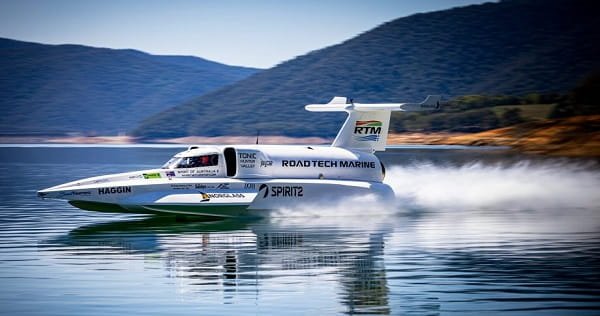
The world water speed record that has stood since October 8, 1978. Ken Warby, an Australian engineer, built the jet-powered wooden hydroplane Spirit of Australia in his backyard for approximately $10,000 and drove it to 511.11 km/h on Blowering Dam in New South Wales. Two subsequent attempts to break the record both resulted in the pilot’s death. Ken Warby died in February 2023 at 83, and his son Dave Warby is currently developing Spirit of Australia II, which reached 278 mph in 2025 testing — still short of the 47-year record. The Spirit of Australia is displayed at the Australian National Maritime Museum in Sydney.
2. USS Plainview (AGEH-1) – 91.9 Knots (Fastest Warship Ever)
The USS Plainview, a US Navy hydrofoil experimental vessel, exceeded 91.9 knots (170 km/h) during trials in the 1970s — the fastest speed ever achieved by a self-propelled military vessel. This record has never been broken by any commissioned warship. The Plainview was a gas turbine-powered hydrofoil designed to test the tactical potential of hydrofoil warships for the US Navy. The programme was cancelled in 1971.
3. A-90 Orlyonok (Ekranoplan) – 400+ km/h
The Soviet Union’s ground effect vehicles — ekranoplans — are the most extraordinary high-speed water vehicles ever built. The A-90 Orlyonok was an amphibious ground effect vehicle that flew approximately 3–5 metres above the water surface using the aerodynamic cushion created by its wings in close proximity to a flat surface. At this altitude it was invisible to both radar (it flew below radar horizon) and sonar (it didn’t touch the water). It achieved 400–440 km/h — not technically a ship, not technically an aircraft, but something entirely its own. Five were built in the 1970s; all were retired by 1993 as Soviet military budgets contracted.
4. HSC Francisco – 58.1 Knots (Fastest Commercial Ferry)
The HSC Francisco holds the Guinness World Record for the fastest passenger ferry in regular commercial service. Built by the Argentine company Incat and operated by Buquebus on the Rio de la Plata between Buenos Aires and Montevideo, it carries over 1,000 passengers and 150 vehicles at sustained speeds approaching 60 knots. Its wave-piercing catamaran hull uses two slender hulls and a central wave-piercer that cuts through rather than over waves, maintaining stability and speed in open-water conditions that would slow conventional hull designs dramatically.
5. Freedom-class LCS – 47 Knots (88 km/h)
The US Navy’s Freedom-class Littoral Combat Ship represents the current standard for production naval vessel speed. At 47 knots, it can respond to threats or pursue targets faster than any conventional warship. Built by Lockheed Martin using Rolls-Royce MT30 gas turbines combined with diesel engines and waterjet propulsion, the Freedom class is designed for anti-piracy, mine countermeasures, and anti-submarine warfare in shallow littoral waters where larger destroyers cannot operate.
Summary
The Independence-class LCS (44 knots) shares the Freedom class’s mission profile but uses an aluminium trimaran hull designed by Austal USA — its wider stern provides a larger flight deck than any other surface combatant. The Canadian HMCS Bras d’Or’s 1969 hydrofoil trial record of 63 knots remains the fastest confirmed speed by a naval vessel that was armed — the current Guinness record for fastest warship (excluding hovercraft) among commissioned vessels. The SS United States’ 1952 Blue Riband record of over 38 knots for the fastest transatlantic ocean liner crossing remains unbroken by any commercial passenger ship since. Incat’s wave-piercer catamarans — including the Benchijigua Express — sustain 43–44 knots on ferry routes across the Canary Islands and Mediterranean.
FAQs – Fastest Ships
Q: What is the fastest ship in the world in 2026?
A: Spirit of Australia at 511 km/h holds the absolute water speed record (1978). The fastest operational warship type is the USS Plainview hydrofoil record at 91.9 knots (170 km/h) — though this vessel is retired. The fastest active naval vessels are US LCS ships at 47 knots. The fastest commercial passenger vessel is HSC Francisco at 58.1 knots.
Q: Is the Spirit of Australia’s record likely to be broken?
A: Dave Warby is attempting to break his father’s record with Spirit of Australia II, which reached 278 mph in 2025 testing — still approximately 40 mph short. The record has survived two fatal record attempts (Lee Taylor 1980, Craig Arfons 1989). It is one of the most dangerous and most enduring records in sport.
Q: What makes hydrofoils so much faster than conventional ships?
A: Hydrofoils lift the hull entirely out of the water at speed, supported by underwater wings. Eliminating hull drag — the primary resistance limiting conventional ship speed — allows hydrofoils to sustain speeds twice or three times those achievable by displacement hull vessels.
Q: What is the fastest naval warship currently operational in 2026?
A: The US Navy Freedom-class Littoral Combat Ship at 47 knots and the Independence-class at 44 knots are the fastest active production warships. The Arleigh Burke destroyer, which forms the backbone of most NATO navies, reaches only approximately 30 knots — the LCS’s speed advantage is significant for its shallow-water mission profile.
Q: What was the Caspian Sea Monster?
A: The Caspian Sea Monster — the KM ekranoplan — was a Soviet ground effect vehicle over 100 metres long that flew at approximately 300–400 km/h above the Caspian Sea in the 1960s and 70s. Larger than the A-90 Orlyonok, it was the largest flying vehicle by weight ever built at the time. It operated below radar horizon, making it effectively invisible to Western surveillance during the Cold War. It sank in 1980 after a pilot error.

Brandon is the cheif editor and writer at WorldUnfolds.com. With a passion for storytelling and a keen editorial eye, he crafts engaging content that captivates and enlightens readers worldwide.