A coastline is where land meets the sea — one of the earth’s most dynamic, economically vital, and ecologically diverse geographical features. Countries with long coastlines enjoy natural advantages in trade, fishing, tourism, and maritime resources that have shaped their entire economic and cultural identity. The measurement of coastlines is more complex than it appears — the famous “coastline paradox” means that the more precisely you measure, the longer a coastline becomes, which is why figures vary between sources.
The world’s total coastline length is estimated at approximately 502,000 kilometres. The ten countries on this list collectively account for a significant majority of that total — each shaped by oceans in profoundly different ways, from Canada’s frozen Arctic shores to Indonesia’s tropical island paradise.
| Rank | Country | Coastline Length | Oceans Bordered | Notable Feature |
| 1 | Canada | 202,080 km | Pacific, Atlantic, Arctic | Longest coastline on earth |
| 2 | Indonesia | 54,716 km | Indian, Pacific, South China Sea | World’s largest archipelago |
| 3 | Norway | 83,281 km (incl. islands) | North Atlantic, Barents Sea | Famous fjords |
| 4 | Greenland (Denmark) | 44,087 km | Arctic, North Atlantic | World’s largest island |
| 5 | Russia | 37,653 km | Arctic, Pacific, Atlantic | Crosses 11 time zones |
| 6 | Philippines | 36,289 km | Pacific Ocean, South China Sea | 7,641 islands |
| 7 | Japan | 29,751 km | Pacific Ocean | 6,852 islands |
| 8 | Australia | 25,760 km | Pacific, Indian, Southern Ocean | Great Barrier Reef |
| 9 | USA | 19,924 km | Pacific, Atlantic, Arctic, Gulf | Alaska has most US coastline |
| 10 | New Zealand | 15,134 km | Pacific Ocean, Tasman Sea | Dramatic fjords and cliffs |
1. Canada — 202,080 km
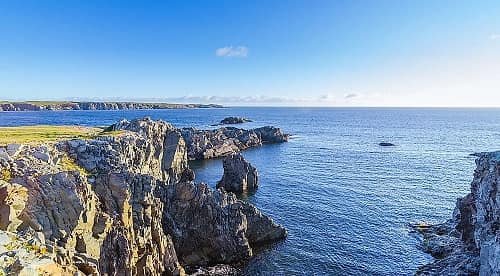
Canada possesses the longest coastline of any country on earth — an extraordinary 202,080 kilometres that is longer than the combined coastlines of the next five countries on this list. Bordered by three oceans — the Pacific in the west, the Atlantic in the east, and the Arctic in the north — Canada’s coastal geography encompasses virtually every coastal landscape type found anywhere on the planet, from tropical-adjacent temperate rainforests on British Columbia’s coast to the permanently frozen Arctic shores of Nunavut where polar bears hunt on sea ice.
The sheer length of Canada’s coastline is a product of its extraordinarily complex and convoluted coastal geography — thousands of islands, deeply indented bays, river deltas, and the intricate fractal geometry of its northern Arctic Archipelago together produce a measurement that seems almost impossible for a single country. The Bay of Fundy in Nova Scotia hosts the world’s highest tidal range — rising and falling up to 16 metres twice daily — while British Columbia’s Inside Passage is considered one of the world’s most spectacular coastal waterways.
Canada’s coastline supports major economic activities including fishing (particularly the rich Atlantic cod and Pacific salmon fisheries), shipping through major ports like Vancouver and Halifax, and the offshore oil and gas industry in Atlantic Canada. Indigenous coastal communities have maintained relationships with these coastlines for thousands of years, with cultural traditions deeply entwined with the sea.
2. Indonesia — 54,716 km
Indonesia’s 54,716-kilometre coastline is the product of the country’s extraordinary geography — an archipelago of over 17,000 islands stretching 5,120 kilometres from Sumatra in the west to Papua in the east, making it the world’s largest archipelago nation. This island configuration means that virtually no point in Indonesia is far from the coast, and the sea is central to the country’s culture, economy, and daily life in ways that few continental nations can replicate.
Indonesia’s coastline encompasses an extraordinary range of environments — the volcanic black sand beaches of Java, the white coral sand beaches of the Gili Islands, the mangrove forests of Kalimantan and Sumatra, the dramatic cliffs of Komodo Island, and the world-renowned dive sites of Raja Ampat in West Papua which are considered among the most biodiverse marine environments on earth. The coral triangle — the area of ocean where Indonesia’s coastline meets those of the Philippines and Papua New Guinea — contains more coral species and reef fish species than anywhere else on the planet.
Indonesia’s coastal communities depend heavily on the sea for their livelihoods, with fishing, aquaculture, and coastal tourism all major economic activities. The country faces significant coastal management challenges — coral reef degradation from warming waters and destructive fishing practices, plastic pollution on beaches and in coastal waters, and the increasing threat of sea level rise to low-lying coastal and island communities.
3. Norway — 83,281 km
Norway’s coastline measurement requires explanation — the figure of 83,281 kilometres includes the coastlines of all Norway’s numerous offshore islands and the deeply indented fjords that are the country’s most internationally recognised geographical feature. The mainland coastline alone is approximately 25,148 kilometres, but the full measurement including islands and fjords makes Norway’s coast the second most complex per unit of mainland area after Canada.
Norway’s fjords — long, narrow sea inlets carved by glaciers during past ice ages that now penetrate deep into the mountainous interior — are among the world’s most dramatic and most visited natural landscapes. Sognefjorden, the world’s second deepest fjord at 1,308 metres, stretches 204 kilometres inland — demonstrating the extraordinary scale of Norway’s coastal indentation. UNESCO has recognised the Western Norwegian Fjords as a World Heritage Site in recognition of their outstanding natural beauty and geological significance.
Norway’s economy has been profoundly shaped by its coastline — the fishing industry has supported Norwegian communities for thousands of years, the country is a major global exporter of farmed salmon, and the offshore oil and gas industry (centred on the North Sea and Norwegian Sea) has made Norway one of the world’s wealthiest nations. More recently, Norway has become a world leader in offshore wind energy, using the same maritime expertise built through generations of fishing and oil extraction.
4. Greenland — 44,087 km
Greenland — an autonomous territory of Denmark and the world’s largest island — has a 44,087-kilometre coastline that is among the most dramatically pristine and least visited of any major coastline on earth. Its Arctic and North Atlantic shores are characterised by towering icebergs calved from the island’s massive ice sheet, deeply carved fjords filled with tidewater glaciers, and rocky tundra shores where polar bears, Arctic foxes, and musk oxen occupy a landscape that looks much as it did thousands of years before human settlement.
Greenland’s coastline holds extraordinary scientific significance at this moment in history — it is on the coastline that the consequences of climate change are most immediately visible. The Greenland Ice Sheet, which covers approximately 80% of the island’s total area, is melting at an accelerating rate, and the tidewater glaciers that reach the coast are calving icebergs at a pace not seen in recorded history. Sea level researchers and climate scientists study Greenland’s coastline intensively because the complete melting of the Greenland Ice Sheet would raise global sea levels by approximately 7 metres — a catastrophic outcome for coastal communities worldwide.
Despite its enormous size and coastline length, Greenland has a population of only approximately 56,000 people, most of whom live in small settlements along the southwestern coast where conditions are most hospitable. Ilulissat, situated on one of the world’s most active glacier fjords, is Greenland’s most visited tourist destination — its combination of icebergs, Northern Lights, and midnight sun creating one of earth’s most extraordinary natural environments.
5. Russia — 37,653 km
Russia’s 37,653-kilometre coastline is distributed across the widest geographic and climatic range of any country’s coast — stretching from the Baltic Sea in the northwest to the Bering Strait at the extreme northeast where Russia is separated from Alaska by just 85 kilometres of ocean, and from the Barents Sea’s permanently ice-covered waters to the relatively mild shores of the Black Sea’s resort coastline. Russia’s coastline spans 11 time zones — meaning that when it is dawn on the Black Sea coast, it is already late afternoon on Russia’s Pacific shores.
The majority of Russia’s coastline borders the Arctic Ocean and its associated seas — the Kara Sea, Laptev Sea, East Siberian Sea, and Chukchi Sea — much of which is ice-covered for significant portions of the year. Russia has invested heavily in icebreaker technology and Arctic shipping infrastructure to exploit the Northern Sea Route — a shipping lane along Russia’s Arctic coast that connects European and Asian ports with dramatically shorter distances than routing through the Suez Canal.
Russia’s Pacific coastline — particularly around the Kamchatka Peninsula and Sakhalin Island — is one of the world’s most ecologically rich and least visited coastal environments, home to enormous populations of brown bears, Steller sea lions, and the world’s largest concentration of spawning Pacific salmon.
6. Philippines — 36,289 km
The Philippines’ 36,289-kilometre coastline is the product of a country composed of 7,641 islands scattered across the western Pacific Ocean — an island configuration that creates proportionally more coastline per unit of land area than almost any other significant nation on earth. Approximately 60% of the Philippines’ population lives along or near the coast, and coastal livelihoods — fishing, aquaculture, boat building, and increasingly tourism — dominate the economic life of the country’s diverse regions.
The Philippines’ coastline encompasses some of the world’s most spectacular marine environments. Tubbataha Reef Natural Park in the Sulu Sea is a UNESCO World Heritage Site and one of the world’s premier dive destinations. Palawan’s island-studded coast — with its dramatic limestone karst formations rising from turquoise waters — is consistently rated among the world’s most beautiful island coastlines. The Visayan Sea and the waters around Cebu and Bohol contain extraordinary coral reef biodiversity that attracts divers from across the world.
The Philippines faces severe coastal vulnerability — the country experiences an average of 20 typhoons annually, more than almost any other nation, and its low-lying coastal communities are among the world’s most exposed to tropical storm surge. The 2013 Typhoon Hainan (locally known as Yolanda) caused catastrophic coastal flooding in Tacloban and the Eastern Visayas, demonstrating the extreme vulnerability of densely populated Philippine coastlines to intensifying tropical storms.
7. Japan — 29,751 km
Japan’s 29,751-kilometre coastline reflects the country’s fundamental identity as an island nation — a civilisation defined by its relationship with the surrounding ocean. The Japanese archipelago consists of 6,852 islands, the five largest of which — Honshu, Hokkaido, Kyushu, Shikoku, and Okinawa — contain the majority of the population and the most economically developed coastal areas. Japan’s coastal cities, including Tokyo, Osaka, Yokohama, Kobe, and Nagoya, are among Asia’s largest and most economically productive urban centres.
Japan’s coastal geography is extraordinarily diverse — from the rocky volcanic coastlines of Hokkaido in the north, through the heavily industrialised coastal plains of central Honshu, to the subtropical coral beaches of Okinawa in the far south. The Rikuchu Coast along the Sanriku region’s Pacific shores is one of Japan’s most ruggedly beautiful coastal landscapes — dramatic cliffs, sea stacks, and sea caves carved by the Pacific Ocean’s full force into some of the world’s most resistant granite.
The devastating 2011 Tōhoku earthquake and tsunami — which struck Japan’s Pacific coastline with waves reaching 40 metres in some locations — demonstrated the extraordinary vulnerability of coastal communities to the seismic hazards associated with Japan’s tectonic setting. Japan has since invested billions in tsunami warning systems, seawall construction, and coastal community resilience planning that represents the world’s most advanced approach to coastal hazard management.
8. Australia — 25,760 km
Australia’s 25,760-kilometre coastline surrounds the world’s only country that is simultaneously a continent — the only nation-continent on earth, whose coastline is shared with three major oceans simultaneously. The Great Barrier Reef stretching 2,300 kilometres along the Queensland coast is the world’s largest coral reef system — visible from space and home to an estimated 1,500 fish species, 4,000 mollusc species, and 400 coral species. It is Australia’s most iconic natural landmark and a UNESCO World Heritage Site of global ecological significance.
Australia’s coastal landscape varies dramatically from east to west and north to south — the surfing beaches of New South Wales and Victoria attract wave riders from around the world, the tropical beaches of Queensland and the Northern Territory are flanked by mangrove forests and crocodile habitats, the dramatic sea cliffs of the Great Australian Bight along the Nullarbor Plain drop vertically into the Southern Ocean, and the stark red-earthed shores of Western Australia’s remote Pilbara coast are among the most spectacularly desolate landscapes on earth.
The vast majority of Australia’s 26 million people live within 50 kilometres of the coast — a concentration of population along the coastal fringe that reflects both the continent’s extraordinarily inhospitable interior and the historical development of coastal cities that were founded on maritime trade.
9. United States — 19,924 km
The United States’ 19,924-kilometre coastline (by CIA World Factbook measurement) borders four different bodies of water — the Pacific Ocean in the west, the Atlantic Ocean in the east, the Arctic Ocean north of Alaska, and the Gulf of Mexico in the south. However, it is important to note that the National Oceanic and Atmospheric Administration (NOAA) measures the US coastline at a significantly larger 153,646 kilometres when including all tidal inlets, bays, and detailed coastal features — which would make it the world’s second longest coastline by that methodology.
Alaska alone accounts for approximately 10,686 kilometres of US coastline — more than the entire continental US combined — reflecting its extraordinary island-studded south coast, the Alaska Peninsula, and the Aleutian Island chain extending 1,900 kilometres into the Pacific. The continental US coastline includes some of the world’s most iconic beach destinations — Miami Beach, the Outer Banks of North Carolina, the Jersey Shore, Malibu and Santa Barbara in California, and the dramatic Big Sur coastline along Highway 1.
The Gulf of Mexico coastline — shared by Texas, Louisiana, Mississippi, Alabama, and Florida — supports major petrochemical industries alongside some of America’s most productive fishing grounds for shrimp, oysters, and Gulf fish species. The 2010 Deepwater Horizon oil spill, which released nearly 5 million barrels of crude oil into the Gulf, caused catastrophic damage to this coastline’s ecology and the fishing communities depending on it.
10. New Zealand — 15,134 km
New Zealand’s 15,134-kilometre coastline provides extraordinary coastal diversity for a country of its modest size — concentrated across three main islands and approximately 600 smaller islands in the southwestern Pacific Ocean. The North Island’s coastal character ranges from the geothermally active Bay of Plenty to the rugged Northland peninsula’s ancient kauri forest-backed beaches, while the South Island’s dramatic Fiordland coast — with its glacier-carved fjords plunging directly from alpine peaks into the Tasman Sea — is considered one of the world’s most spectacular coastal landscapes.
Milford Sound and Doubtful Sound in Fiordland National Park are among the most photographed coastal environments in the Southern Hemisphere — their dramatic combination of 1,200-metre vertical cliff faces, cascading waterfalls, and pristine dark waters accessible only by boat or aircraft creating a visitor experience of extraordinary natural theatre. The Abel Tasman Coast Track on the northern tip of the South Island offers golden sand beaches, turquoise waters, and coastal forest trekking that is considered among the world’s finest coastal walking experiences.
New Zealand’s coastal waters are home to extraordinary marine life including the Hector’s dolphin — the world’s smallest and rarest dolphin, endemic to New Zealand — along with the New Zealand sea lion, fur seals, little blue penguins, and the royal albatross.
Frequently Asked Questions (FAQs)
Q: Which country has the longest coastline in the world?
A: Canada has the world’s longest coastline at 202,080 kilometres — bordered by the Pacific, Atlantic, and Arctic Oceans.
Q: Which country has the longest coastline in Asia?
A: Indonesia has Asia’s longest coastline at 54,716 kilometres, followed by the Philippines at 36,289 kilometres and Japan at 29,751 kilometres.
Q: Which country has the longest coastline in Europe?
A: Norway has Europe’s longest coastline. Including all islands and fjords, the total measurement exceeds 83,000 kilometres.
Q: What is the coastline paradox?
A: The coastline paradox is the observation that coastline measurements increase as measurement precision increases — the more detailed the measurement, the more bays, inlets, and irregularities are captured, resulting in a longer total figure.
Q: Does India have a long coastline?
A: India has a coastline of approximately 7,517 kilometres — the 16th longest in the world — bordered by the Arabian Sea, Bay of Bengal, and Indian Ocean.
Q: Which is the longest coastline in Africa?
A: Madagascar has Africa’s longest coastline at approximately 4,828 kilometres, followed by Somalia at approximately 3,025 kilometres.

Brandon is the cheif editor and writer at WorldUnfolds.com. With a passion for storytelling and a keen editorial eye, he crafts engaging content that captivates and enlightens readers worldwide.