Lakes present a deceptively peaceful face to the world. Many of the most dangerous lakes in the world look completely benign — clear blue waters, picturesque settings, sometimes even tourist amenities. The danger comes from invisible chemistry, volcanic gases dissolved under pressure, extreme alkalinity or acidity, lethal bacteria, dangerous currents, and in several cases, explosive eruptions that can asphyxiate entire communities overnight. Here are the 10 most dangerous lakes in the world.
1 — Lake Nyos, Cameroon (CO₂ Limnic Eruption Killed 1,746 People Overnight)
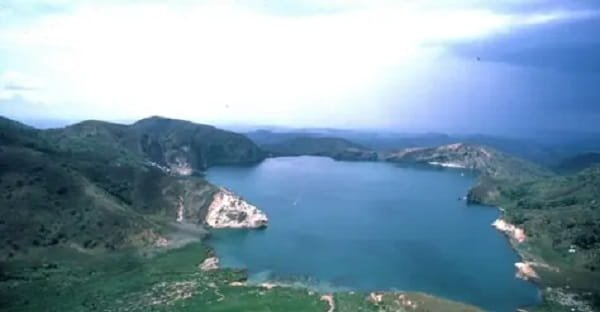
Lake Nyos in the Northwest Region of Cameroon is the site of one of the most catastrophic natural disasters of the 20th century involving a body of water. On August 21, 1986, a limnic eruption released approximately 1.6 million tonnes of CO₂ from the lake’s depths in a single explosive outgassing event. The CO₂ (which is heavier than air) flowed down nearby valleys as an invisible cloud, asphyxiating 1,746 people and 3,500 livestock in surrounding villages within hours — without any advance warning. The Nyos event was the first confirmed lethal limnic eruption in history. Today, degassing pipes installed by French engineers bleed off accumulated CO₂ continuously, but the risk of another event is not zero if the pipes fail.
2 — Lake Natron, Tanzania (Alkaline Lake That Calcifies Living Animals)
Lake Natron in northern Tanzania is one of the most hostile environments on Earth for most living creatures. Its pH regularly reaches 10.5 (nearly as alkaline as ammonia), the water temperature around hydrothermal vents reaches 60°C, and its sodium carbonate/sodium bicarbonate concentration is so high that it calcifies organic material — photographs by wildlife photographer Nick Brandt showed birds and bats that had died in the lake, their bodies perfectly preserved in stone-like salt deposits. The alkalinity burns eyes and skin on contact. Paradoxically, Lake Natron is one of Africa’s most important flamingo breeding grounds — the flamingos’ hardened leg skin protects them from the caustic water. No other vertebrate breeds in the lake’s central section.
3 — Lake Kivu, DRC/Rwanda (Exploding Lake — CO₂ and Methane at Depth)
Lake Kivu, on the border of the Democratic Republic of Congo and Rwanda, is one of the world’s three known ‘exploding lakes’ (alongside Nyos and Monoun in Cameroon). It contains approximately 300 cubic km of dissolved CO₂ and 60 cubic km of dissolved methane at depth, held under pressure by the weight of the overlying water column. A destabilising event — a sufficiently large earthquake, volcanic activity from the nearby Nyiragongo volcano, or a critical mass disturbance — could theoretically trigger a limnic eruption of a scale that would dwarf Lake Nyos, potentially threatening the approximately 2 million people living on its shores. Scientists monitor the lake closely, and methane is currently being extracted commercially for power generation.
4 — Lake Monoun, Cameroon (First Documented Limnic Eruption — 1984)
Lake Monoun is the smaller sibling of Lake Nyos and was the site of the world’s first documented limnic eruption (August 15, 1984) — two years before the more catastrophic Nyos event. The Monoun eruption killed 37 people in a CO₂ outgassing event. The two lakes are part of a chain of crater lakes in Cameroon’s northwest, all sitting above CO₂-generating volcanic plumbing. The Monoun event was initially misattributed to a terrorist chemical attack before the limnic eruption mechanism was identified by scientists. Like Nyos, Monoun now has degassing pipes installed.
5 — Boiling Lake, Dominica (World’s Second Largest Boiling Lake)
The Boiling Lake in Dominica’s Morne Trois Pitons National Park is the world’s second-largest boiling lake — a crater filled with superheated water and steam directly above a volcanic vent. Surface temperatures range from 82-92°C at the edges to boiling in the centre, with the central section in a state of constant violent boiling and bubbling. The lake regularly emits thick sulphur dioxide fumes, and sudden changes in volcanic activity below can cause the lake to drain and refill rapidly, releasing massive steam venting events. The path to the lake is strenuous and involves navigating the Valley of Desolation — a volcanic landscape of boiling mud vents, acidic hot springs, and sulphur fumaroles.
6 — Lake Michigan, USA (Most Dangerous Great Lake — Rip Currents and Longshore Currents)
Lake Michigan is the deadliest of the five Great Lakes, with an average of 35-65 drowning deaths per year — more than any ocean beach location in the United States. The danger is counterintuitive for a freshwater lake: Lake Michigan generates some of the most powerful rip currents of any inland body of water, created by its orientation relative to prevailing winds (southwest to northeast), the shape of its Indiana Dunes shoreline, and underwater topography that channels currents. Additionally, unlike ocean rip currents that can be escaped by swimming parallel to shore, Lake Michigan’s longshore currents run parallel to the shore and can carry swimmers rapidly along a beach away from safety.
7 — Lake Victoria, Africa (Storms, Fishing Boat Fatalities — Deadliest Lake in Africa)
Lake Victoria — shared by Uganda, Tanzania, and Kenya — is the largest tropical lake in the world and generates more fatal water accidents than any other lake in Africa. Its unique topography creates localised storm cells that develop with extraordinary speed — afternoon thunderstorms in equatorial Africa can escalate from calm conditions to 50+ knot squalls within 30 minutes, capsizing fishing vessels with no warning. An estimated 3,000-5,000 people drown in Lake Victoria annually — mostly fishermen on traditional wooden or fibreglass boats without life jackets. The 1996 MV Bukoba disaster, where an overloaded ferry sank in a storm, killed between 800 and 1,000 people.
8 — Lake Champlain, USA/Canada (Cold Water Drowning — Spring Ice Break)
Lake Champlain on the border of Vermont, New York, and Quebec presents a specific seasonal danger that claims multiple lives annually: the spring ice break. As ice melts in late March to April, the lake’s temperature remains near 0°C for weeks while ice sheets fracture unpredictably. People fishing on the ice, walking near shore, and recreational users underestimate how rapidly the ice deteriorates. Cold water immersion in 0-2°C water causes cold water shock within 1 minute (involuntary gasping, cardiac arrest risk), swimming failure within 3-5 minutes (muscle incapacitation), and death within 10-30 minutes without rescue. The lake also generates severe storm conditions in autumn and early winter.
9 — Lake Malawi (Lake Nyasa) (Bilharzia and Crocodile Danger)
Lake Malawi/Nyasa, in the Rift Valley of southern Africa, presents a dual biological threat. First, the lake is one of the primary reservoirs of Schistosoma (bilharzia), a parasitic flatworm that penetrates skin during swimming and causes chronic organ damage affecting kidneys, liver, and bladder. The WHO estimates over 200 million people are infected with schistosomiasis globally, primarily from Rift Valley lakes. Second, Nile crocodiles inhabit the northern sections of the lake and have killed and consumed swimmers and fishermen. Crocodile attacks at Lake Malawi are not uncommon in the northern regions around Nkhata Bay and the Tanzania border area.
10 — Horseshoe Lake, California (CO₂ Tree Kill Zone — Invisible Death Zone)
Horseshoe Lake in Mammoth Lakes, California sits in a geothermal zone in the Long Valley Caldera — one of North America’s most seismically and volcanically active areas. Since the 1990s, CO₂ venting from the magma chamber below has killed approximately 100 acres of trees around the lake (visible as white, bare dead trunks) and has been measured at concentrations up to 95% in soil pockets — instantly lethal. Several hikers and campers have been asphyxiated in tents pitched in low-lying areas where CO₂ pools overnight. The US Forest Service posts warnings and has installed CO₂ monitoring in the area, but visitors without awareness of the hazard can wander into lethal CO₂ concentrations.
Why Lakes Can Be More Dangerous Than Oceans
- Lakes have no tides that remove swimmers from dangerous zones over time
- Freshwater is less buoyant than saltwater — swimming in freshwater requires more effort
- Lake temperature stratification can change rapidly with wind patterns, suddenly exposing swimmers to cold water
- Dissolved gases build up in lakes over geological time without the deep-ocean mixing that oceanic bodies provide
- Lakes are perceived as less dangerous than oceans — this complacency is a primary factor in lake drowning incidents
The most dangerous lakes in the world often appear completely benign. The gas that killed 1,746 people at Lake Nyos was invisible, odourless, and silent. The only warning was the birds and insects dying first.
Frequently Asked Questions
Q: What is a limnic eruption and how does it happen?
A: A limnic eruption occurs when CO₂ dissolved under pressure in the deep water of a lake is suddenly released — similar to opening a carbonated drink bottle, but at catastrophic scale. It requires a deep lake, volcanic CO₂ inputs to the bottom water, and a stratified structure that prevents mixing. The trigger can be an earthquake, volcanic activity, a landslide, or a cold rain event that disturbs the stratification. Once released, CO₂ (heavier than air) flows down valleys as an invisible asphyxiating cloud. Only three lakes in the world are currently considered limnic eruption risks: Nyos, Monoun (both Cameroon), and Kivu (DRC/Rwanda).
Q: How do animals survive in Lake Natron?
A: The lesser flamingo (Phoeniconaias minor) has evolved specific adaptations including thick, leathery skin on their legs that resists the caustic sodium carbonate, and the ability to drink freshwater from hot springs near the lake shore rather than the lake water itself. The alkalinity actually protects the flamingos’ nesting sites — the caustic water deters most predators from approaching. Tilapia fish have also evolved to survive in the slightly less alkaline peripheral areas of the lake. The extreme environment creates a paradox where only highly specialised species can survive, making it an important protected breeding habitat.
Q: Is Lake Kivu actually going to explode?
A: The risk is real but not imminent by current scientific assessment. Lake Kivu’s dissolved gas levels are monitored by the Kivu Belt Research Programme and by the commercial methane extraction operations (which actually reduce risk by removing dissolved methane). The most immediate trigger risk is the Nyiragongo volcano — a 2002 eruption sent lava flows into the northern end of the lake, temporarily disturbing the stratification. Scientists estimate that the current rate of gas accumulation, without intervention, would reach critical levels over centuries rather than decades.
Q: Why does Lake Michigan have such dangerous currents?
A: Lake Michigan’s dangerous currents result from its elongated north-south orientation combined with the prevailing south-westerly winds. Waves refract off the curved shoreline and create complex longshore current patterns. The Indiana Dunes National Park area specifically generates structural rip current-like systems because the underwater sandbars run parallel to shore, channelling return flow into narrow gaps. Unlike ocean rip currents which pull perpendicular to shore (easier to escape by swimming parallel to shore), Lake Michigan’s shore-parallel longshore currents can carry swimmers along the beach faster than they can swim back, ultimately exhausting them.
Q: What is bilharzia and how do you avoid it in Lake Malawi?
A: Bilharzia (schistosomiasis) is a parasitic infection caused by Schistosoma flatworm larvae (cercariae) that live in freshwater snails and are released into the water. They penetrate skin directly during swimming — within seconds of water contact in infected areas. Initial infection causes a transient rash, but within 4-6 weeks systemic infection develops, eventually causing fibrosis of the liver, bladder, and intestines with long-term morbidity. It is treated with praziquantel. To avoid it in Lake Malawi: swim in deep open water away from snail habitats (reeds and shores), towel dry vigorously immediately after leaving the water (dislodges cercariae before penetration completes), and take prophylactic praziquantel if prolonged exposure has occurred.
Disclaimer: Information provided is for educational purposes only. Always consult relevant experts, authorities, and safety guidelines before engaging with any of the subjects discussed in this article.

Brandon is the cheif editor and writer at WorldUnfolds.com. With a passion for storytelling and a keen editorial eye, he crafts engaging content that captivates and enlightens readers worldwide.