Insect speed measurement is one of entomology’s most contested topics. The challenge is methodology: tethering an insect in a wind tunnel measures sustainable airspeed but not burst speed; observational field estimates are wildly inconsistent; and the animals themselves do not cooperate with standardised testing. The Guinness World Record for fastest flying insect cites the Australian dragonfly Austrophlebia costalis at 58 km/h maximum airspeed in short bursts. Other sources place the horsefly at 145 km/h based on field estimates that have never been rigorously reproduced. The fastest ground insect — the Australian tiger beetle — covers 171 body lengths per second. For scale, that equates to a human running approximately 770 km/h.
| Rank | Insect | Speed | Category | Verified By |
| 1 | Horsefly (Tabanus bovinus) | Up to 145 km/h (90 mph) | Flying (estimated) | Field observations; not wind tunnel verified |
| 2 | Dragonfly (Austrophlebia costalis) | 58 km/h (36 mph) | Flying (airspeed) | Guinness WR; wind tunnel + field |
| 3 | Hawk Moth (Sphingidae) | 54 km/h (33.7 mph) | Flying | Wind tunnel and field data |
| 4 | Hornet (Vespa mandarinia) | 50 km/h (31 mph) | Flying | Field observation |
| 5 | Honey Bee (Apis mellifera) | 65 km/h (40 mph) estimated | Flying (unloaded) | Field observation |
| 6 | Desert Locust (Schistocerca gregaria) | 33 km/h (20 mph) | Flying (wind tunnel) | Controlled experiment |
| 7 | Hoverfly (Syrphidae) | 45 km/h (28 mph) | Flying | Field observation |
| 8 | Australian Tiger Beetle (Cicindela hudsoni) | 9 km/h (5.6 mph) ground; 171 body lengths/sec | Ground running | Scientific measurement |
| 9 | Deer Bot-fly (Cephenemyia pratti) | 39 km/h maintainable; disputed higher claims | Flying | Guinness WR maintainable speed |
| 10 | Saharan Silver Ant (Cataglyphis bombycina) | 1.76 km/h; 108 body lengths/sec | Ground running | Scientific measurement (2019) |
1. Horsefly – Up to 145 km/h (Fastest Estimated)
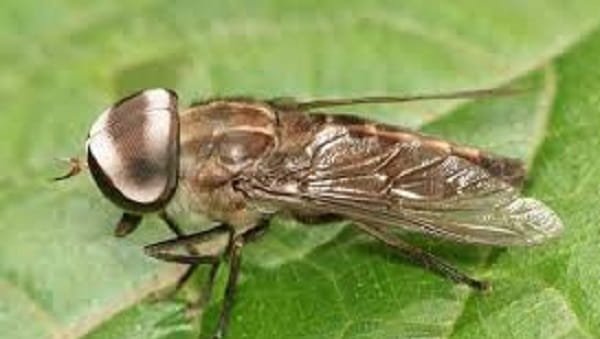
The horsefly holds the most contested position on any fastest insect list. Field observations — primarily researchers attempting to pace or pursue horseflies in vehicles — have estimated speeds of up to 145 km/h in short pursuit bursts. This figure has never been replicated under controlled wind tunnel conditions, and the scientific community treats it as an upper-bound estimate rather than a verified measurement. What is indisputable is that horseflies are extremely fast relative to most observable flying insects, capable of persistent pursuit of large mammals across open terrain, and producing painful bites that suggest successful high-speed interception of moving targets.
Their speed is evolutionary necessity: horseflies feed on blood from large, mobile animals. Pursuit requires closing distance at speeds that exceed the target’s escape pace. The bite itself is not a sting — it is a physical cutting action by modified mouthparts designed to create blood flow, which means the horsefly must physically land, making accurate high-speed approach essential.
2. Dragonfly – 58 km/h (Guinness World Record)
The Guinness World Record for fastest flying insect belongs to the Australian dragonfly Austrophlebia costalis at 58 km/h in short bursts, with a maintainable airspeed of 39 km/h shared with hawk moths and horseflies as the highest reliably measured maintainable speed. A 1917 ground velocity measurement of 98.6 km/h for the same species is noted in the Guinness records, but this measured ground speed — incorporating wind — rather than airspeed.
Dragonflies are the most aerodynamically sophisticated insects on earth. Their four wings operate independently, allowing them to fly forward, backward, sideways, and hover with a precision that no human-built flying machine currently matches at any scale. More remarkably, they catch approximately 95% of the prey they pursue — the highest success rate of any predator in the animal kingdom. Research has established that dragonflies do not simply chase prey; they calculate interception trajectories, predicting where the prey will be in three-dimensional space and flying to that point rather than following the prey’s current position.
3. Hawk Moth (Sphingidae) – 54 km/h
The hawk moth family includes the hummingbird hawkmoth — so named because its hovering feeding technique at flowers is visually identical to a hummingbird from a distance. Wind tunnel measurements have established hawk moth sustainable speed at approximately 36 km/h, with bursts reaching 54 km/h. They are among the few insects that can be reliably measured because their commercially important status as pollinators has generated research funding for controlled experiments. They feed while hovering, requiring precisely controlled forward and backward flight at sustained speeds — the opposite of the dragonfly’s high-speed interception approach.
4. Hornet (Vespa mandarinia) – 50 km/h
The Asian giant hornet — the largest hornet species in the world — reaches approximately 50 km/h in flight. Its sustained flight speed is used during colony raiding behaviour: when attacking honeybee colonies, hornets travel efficiently over distances of several kilometres to locate and return to target hives. Their flight speed is secondary to their structural power — a single Asian giant hornet can kill 40 honeybees per minute, and a group of 30 can destroy a colony of 30,000 bees within hours.
5. Honey Bee – 65 km/h (Estimated Unloaded)
The honey bee’s advertised 65 km/h figure is an unloaded sprint estimate — in normal foraging with a full nectar load, cruising speed drops to approximately 25–30 km/h. The unloaded burst speed is physiologically plausible: honey bees have extremely high wing-beat frequencies (200–240 beats per second in some measurements) and exceptional flight muscles relative to body mass. They are also among the most rigorously studied flying insects, with wind tunnel data generally placing sustained speed around 30 km/h and burst speed estimates in the 40–65 km/h range.
Summary
The desert locust at 33 km/h is the most reliably wind-tunnel-measured insect on this list — agricultural research incentivises controlled studies of swarm behaviour, and their 33 km/h figure is among entomology’s most reproducible. The hoverfly (45 km/h estimated) uses its speed for both predator evasion and flower-to-flower foraging. The Australian tiger beetle holds the ground insect speed record at 171 body lengths per second — the fastest relative movement of any insect, equivalent to a 1.8 m human running at 770 km/h. The deer bot-fly shares the Guinness maintainable airspeed record with dragonflies and hawk moths at 39 km/h. The Saharan silver ant completes the list not for absolute speed but for the most spectacular body-length-per-second ratio among ground runners: 108 body lengths per second, measured in 2019 using high-speed cameras in the Saharan desert.
FAQs
Q: What is the fastest insect in the world in 2026?
A: The horsefly with an estimated 145 km/h burst speed is the fastest by field observation. The Guinness World Record for fastest flying insect (verified) is the Australian dragonfly Austrophlebia costalis at 58 km/h airspeed. The desert locust is the most reliably measured at 33 km/h sustained in controlled wind tunnel conditions.
Q: Why are insect speed records so difficult to verify?
A: Insects are small, highly manoeuvrable, and behaviorally unpredictable. Wind tunnel testing measures sustainable airspeed in artificial conditions. Field measurements cannot separate the insect’s airspeed from wind-assisted ground velocity. Most insects do not reach top speed in captivity, making controlled studies inherently limited.
Q: What makes the dragonfly such a successful predator despite other insects being faster?
A: Speed alone does not determine predation success. Dragonflies calculate interception trajectories rather than chasing prey directly, achieving approximately 95% hunting success rates — the highest of any known predator. Their four independently controlled wings give them three-dimensional agility unmatched by faster but less manoeuvrable insects.
Q: What is the fastest insect on the ground?
A: The Australian tiger beetle (Cicindela hudsoni) at 171 body lengths per second — the highest relative speed of any ground-moving insect. At 9 km/h absolute speed, it moves so fast that it temporarily goes blind during pursuit because its visual system cannot process images quickly enough at full running speed.
Q: How does the Saharan silver ant survive in extreme desert heat at such speeds?
A: The Saharan silver ant forages during midday desert heat when predators are sheltering, relying on speed to minimise time on superheated sand before returning to the cool underground nest. Its silvery hair reflects solar radiation while dissipating heat. Speed and the ability to navigate precisely are both essential survival mechanisms in this extreme environment.

Brandon is the cheif editor and writer at WorldUnfolds.com. With a passion for storytelling and a keen editorial eye, he crafts engaging content that captivates and enlightens readers worldwide.