The helicopter has a fundamental aerodynamic problem that airplanes do not: at high speed, the rotor blade advancing into the airstream approaches the speed of sound while the retreating blade on the opposite side moves through relatively still air. This “retreating blade stall” creates asymmetric lift that limits conventional helicopter speed to approximately 270 km/h in standard operational designs. Breaking beyond that ceiling requires either novel rotor configurations, supplementary propellers, or abandoning the traditional helicopter definition entirely. The fastest machines on this list each solved that problem differently — and the solutions produced some of the most technically remarkable rotorcraft in aviation history.
| Rank | Helicopter | Top Speed | Type | Status |
| 1 | Bell Boeing V-22 Osprey | 563 km/h (351 mph) | Military tiltrotor | Operational (USMC/USAF/Navy) |
| 2 | Eurocopter X3 | 472 km/h (293 mph) | Experimental compound | Retired demonstrator (2013) |
| 3 | Sikorsky X2 | 481 km/h (299 mph) | Experimental coaxial compound | Retired demonstrator (2011) |
| 4 | Westland Lynx (Modified) | 400 km/h (249 mph) | Modified military | FAI Speed Record (1986) |
| 5 | Sikorsky S-97 Raider | 407 km/h (253 mph) claimed | Military light attack | Advanced development |
| 6 | Boeing–Sikorsky SB-1 Defiant | 460 km/h (286 mph) target | Military medium-lift | Advanced development (Future Vertical Lift) |
| 7 | Bell V-280 Valor | 518 km/h (322 mph) | Military tiltrotor | Development (FLRAA winner) |
| 8 | Mil Mi-35 (Hind) | 335 km/h (208 mph) | Military attack/transport | Operational (Russia) |
| 9 | Boeing CH-47 Chinook | 315 km/h (196 mph) | Military heavy-lift | Operational (US Army, RAF) |
| 10 | AgustaWestland AW139 | 310 km/h (193 mph) | Commercial/military | Operational worldwide |
1. Bell Boeing V-22 Osprey – 563 km/h (Tiltrotor Champion)
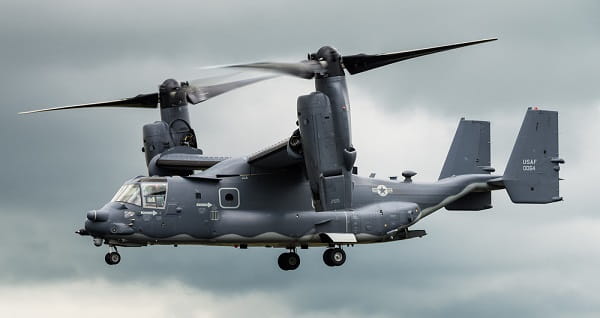
The V-22 Osprey holds an asterisk: it achieves its extraordinary speed not as a traditional helicopter but as a tiltrotor, rotating its enormous nacelles horizontally to fly as a fixed-wing turboprop aircraft once airborne. In helicopter mode — vertical takeoff and landing — it behaves like an extraordinarily large helicopter. In cruise mode it becomes something else entirely, and its top speed of 563 km/h reflects that dual capability. Used extensively by the US Marine Corps, US Air Force Special Operations Command, and the US Navy, the Osprey has participated in virtually every US military operation since its introduction in 2007. Its speed advantage over conventional helicopters translates directly into mission radius — it can project forces faster and further than anything else in the rotorcraft inventory.
2. Sikorsky X2 – 481 km/h (Unofficial Helicopter Record)
The Sikorsky X2 is the fastest machine that operates primarily as a helicopter — using coaxial counter-rotating main rotors rather than a tail rotor, combined with a pusher propeller for forward thrust. This configuration directly solves the retreating blade stall problem: with two counter-rotating rotors, the advancing blade on each side simultaneously compensates for the limitations of the other, allowing both rotors to generate symmetrical lift at speeds that would stall a single rotor. The X2 technology demonstrator reached 481 km/h in 2010, unofficially breaking the helicopter speed record. It was never submitted for FAI certification — leaving the Westland Lynx’s 1986 record officially intact — but the X2’s technologies directly spawned the Sikorsky S-97 Raider and the Boeing-Sikorsky SB-1 Defiant, both under active development in 2026.
3. Eurocopter X3 – 472 km/h (Unofficial Record, 2013)
On June 7, 2013, the Eurocopter (now Airbus Helicopters) X3 reached 472 km/h — surpassing the Sikorsky X2’s informal record. The X3 uses a different technical approach: a conventional main rotor paired with two wing-mounted turboprop engines that provide forward thrust and counteract torque, eliminating the need for a tail rotor. The combination provides both the helicopter’s vertical capability and the compound aircraft’s forward speed. Like the X2, the X3 was a one-off demonstrator, never intended for production, designed to prove the technology and generate customer interest in the RACER programme — Airbus Helicopters’ production fast rotorcraft targeting 250 mph for commercial service in the late 2020s.
4. Westland Lynx (Modified) – 400 km/h (FAI World Record)
The only official FAI (Fédération Aéronautique Internationale) world speed record for a helicopter belongs to a specially modified Westland Lynx, flown by test pilot Trevor Eggington with flight test engineer Derek Clews over Somerset, England, on August 11, 1986. The record-breaking aircraft was stripped of operational equipment, fitted with specially developed rotor blades, and flown at the absolute limits of its structural envelope. At 400 km/h it held the official record for rotorcraft speed from 1986 through the X2 and X3 unofficial challenges — and because neither experimental aircraft submitted formal FAI applications, the Lynx technically retains the official record in 2026.
5. Sikorsky S-97 Raider – 407 km/h
A direct commercial derivative of the X2 programme, the S-97 Raider is designed for the US Army’s Future Attack Reconnaissance Aircraft (FARA) requirement. Using the same coaxial rotor and pusher propeller configuration as the X2, it targets 407 km/h in a 5,670 kg airframe that carries two crew plus six combat troops. Its development has faced competition and budget pressures but continues in 2026 as the US Army evaluates next-generation light attack rotorcraft options.
Summary
The Boeing-Sikorsky SB-1 Defiant — developed under the US Army’s Future Long-Range Assault Aircraft (FLRAA) programme — targets 460 km/h and was competing against the Bell V-280 Valor, which the Army selected as its FLRAA winner in December 2022. The Bell V-280 Valor tiltrotor achieved 518 km/h in testing, exceeding the original Black Hawk’s speed by over 160 km/h while carrying the same troop load. Russia’s Mil Mi-35 Hind (335 km/h) remains the fastest operational attack helicopter in active service. The Boeing CH-47 Chinook (315 km/h) is the fastest heavy-lift helicopter in service with any military force. The AgustaWestland AW139 (310 km/h) leads the commercial helicopter market for sustained high-speed operations.
FAQs – Fastest Helicopters
Q: What is the fastest helicopter in the world in 2026?
A: The Bell Boeing V-22 Osprey at 563 km/h is fastest if tiltrotors are included. The fastest conventional helicopter-type aircraft by test speed is the Sikorsky X2 at 481 km/h (experimental, 2010). The official FAI world speed record for a helicopter is still held by the modified Westland Lynx at 400 km/h (1986).
Q: What limits conventional helicopter speed?
A: Retreating blade stall — at high forward speeds, the rotor blade moving backward relative to airflow loses lift while the advancing blade risks exceeding the speed of sound. This creates asymmetric lift and structural stress that conventional single-rotor designs cannot overcome above approximately 270 km/h.
Q: What is the difference between the Sikorsky X2 and Eurocopter X3 approaches?
A: The X2 uses coaxial counter-rotating rotors and a pusher propeller, eliminating the tail rotor entirely. The X3 uses a conventional main rotor plus two wing-mounted turboprop engines that supplement thrust and counter torque. Both solve the retreating blade problem differently, and both produced comparable speeds.
Q: Is the Bell V-280 Valor faster than the V-22 Osprey?
A: No. The V-22 Osprey reaches 563 km/h; the V-280 Valor demonstrated 518 km/h in testing. The V-280 was selected by the US Army as the future Black Hawk replacement under the FLRAA programme, with its speed, range, and improved handling over the V-22 as key factors.
Q: What is the fastest commercial helicopter in 2026?
A: The AgustaWestland AW139 at 310 km/h leads commercial operators in top speed for a production aircraft in regular service. It is used by offshore energy operators, VIP transport services, and search-and-rescue organisations globally.

Brandon is the cheif editor and writer at WorldUnfolds.com. With a passion for storytelling and a keen editorial eye, he crafts engaging content that captivates and enlightens readers worldwide.