Ants are among the most successful animals on Earth — estimated to constitute approximately 20% of all terrestrial animal biomass. With over 20,000 known species, most ants are harmless to humans, but a select group has evolved stings, venoms, mandibles, and colonial behaviors that make them genuinely dangerous. Some deliver the most painful stings in the insect world; others attack in armies of millions; and a few are invasive species reshaping ecosystems and threatening agricultural systems worldwide.
In 2026, ant research has accelerated significantly due to growing concerns about invasive species, ecosystem disruption, and the medical implications of ant venom. This ranking draws on toxicology data, the Schmidt Pain Index, invasion biology reports, and documented human fatality records.
| Rank | Name | Key Trait | Danger Level |
| 1 | Bullet Ant (Paraponera clavata) | Most painful sting — Schmidt Index 4+ | Extremely Painful |
| 2 | Fire Ant (Solenopsis invicta) | Invasive, mass stings, anaphylaxis deaths | Very High |
| 3 | Driver Ant / Siafu (Dorylus spp.) | Million-strong columns, strip flesh | Very High |
| 4 | Jack Jumper Ant (Myrmecia pilosula) | Anaphylaxis deaths — Australia | High |
| 5 | Army Ant (Eciton burchellii) | Swarm intelligence, destroy everything in path | High |
| 6 | Pony Ant / Maricopa Harvester Ant | Most toxic insect venom by volume | High |
| 7 | Trap-Jaw Ant (Odontomachus bauri) | Fastest jaw movement in nature | Moderate-High |
| 8 | Red Harvester Ant (Pogonomyrmex barbatus) | Potent venom — painful, lasting sting | Moderate |
| 9 | Argentine Ant (Linepithema humile) | Global invasive — destroys native ecosystems | Ecological |
| 10 | Carpenter Ant (Camponotus spp.) | Structural damage — large mandible bites | Property/Moderate |
1. Bullet Ant (Paraponera clavata)
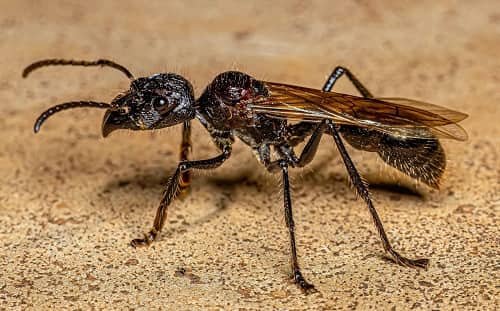
The Bullet Ant earns the top spot on this list through the pure, extraordinary intensity of its sting. Entomologist Justin Schmidt described the experience as “pure, intense, brilliant pain. Like walking over flaming charcoal with a 3-inch nail embedded in your heel” — earning a 4+ rating on the Schmidt Pain Index, his scale’s highest tier. The sting causes waves of pain lasting 12-24 hours, along with trembling and temporary loss of muscle control.
Found in the rainforests of Central and South America from Nicaragua to Bolivia, Bullet Ants are solitary hunters and rarely sting unless their nest is threatened. The Sateré-Mawé people of Brazil use Bullet Ant gloves (filled with sedated ants) in coming-of-age rituals where initiates must wear them for ten minutes — deliberately receiving hundreds of stings.
- Schmidt Pain Index: 4+ — the maximum rating on the scale
- Sting effects last 12-24 hours — the longest duration of any hymenoptera sting
2. Fire Ant (Solenopsis invicta — Red Imported Fire Ant)
Invasive Red Imported Fire Ants are now established on every inhabited continent except Antarctica, and their spread continues in 2026 with confirmed European populations in Italy and Spain. Their venom (solenopsin alkaloids) causes immediate burning pain, raised pustules, and in 1-2% of stings, severe anaphylactic reactions that can be fatal without rapid epinephrine treatment.
The economic and ecological impact of fire ants is staggering — the US alone spends an estimated $6 billion annually on fire ant control, medical treatment, and agricultural losses. They routinely kill young wildlife, attack livestock eyes, and destroy native ant species.
- 80 anaphylaxis deaths per year in the US attributable to fire ant stings
- Confirmed in Europe (Italy, Spain) since 2023 — range expected to expand
3. Driver Ant / Siafu (Dorylus species)
Driver Ants — called Siafu in East Africa — form nomadic colonies of up to 20 million individuals that move in organized columns, consuming every animal in their path that cannot escape. Their powerful mandibles can strip flesh from bone, and they have been documented killing incapacitated or restrained humans, infants, and small animals. In Central and East Africa, siafu raids on villages are taken seriously and require immediate evacuation.
Driver Ants have no permanent nest — they form living bivouacs with their own bodies. Their raids are among the most organized and devastating in the animal kingdom.
- Colony size: up to 20 million individuals — one of the largest social insect colonies
- Mandibles so strong they are used as emergency surgical sutures by some indigenous communities
4. Jack Jumper Ant (Myrmecia pilosula)
The Jack Jumper Ant is Australia’s most medically dangerous ant. Found across southeastern Australia and Tasmania, it has a venom that causes severe anaphylactic reactions in approximately 3% of people stung. Deaths from Jack Jumper anaphylaxis occur every year in Australia — more people die from Jack Jumper stings than from snake bites in Tasmania annually.
An immunotherapy program developed specifically for Jack Jumper allergy has been in use in Australia since the early 2000s, significantly reducing fatalities among known allergy sufferers.
- More deaths in Tasmania from Jack Jumper stings than snake bites annually
- Immunotherapy available — reduces anaphylaxis risk by over 95%
5. Army Ant (Eciton burchellii)
Eciton burchellii — the archetypal Army Ant of Central and South America — conducts devastating swarm raids of up to 200,000 individuals that flush out and kill virtually every invertebrate in a section of forest floor. They follow a precise internal migration pattern, building new bivouacs each evening from the bodies of thousands of ants.
While Army Ants rarely threaten healthy adult humans (they move slowly enough to step around), their raids disrupt wildlife for hundreds of meters in every direction, and falls or incapacitation in their path carry serious risk.
- 200,000 ants per raid column — consume up to 100,000 prey items per day
- More than 300 other species have evolved to live with and follow army ant swarms
6. Maricopa Harvester Ant (Pogonomyrmex maricopa)
The Maricopa Harvester Ant, found in the desert Southwest of the United States, holds the distinction of producing the most toxic insect venom on Earth by volume. Its venom is 12 times more toxic than honeybee venom on a per-volume basis. The LD50 (lethal dose for 50% of subjects) is achieved with approximately 12 stings per kilogram of body weight — meaning 350 stings could theoretically kill a 2 kg infant.
In practice, the ants are not particularly aggressive if their nest is not disturbed, but accidental contacts in desert areas are common.
- Most toxic insect venom by volume — LD50 12x honeybee venom
- Sting described as intense burning and localized necrosis, lasting 4+ hours
7. Trap-Jaw Ant (Odontomachus bauri)
The Trap-Jaw Ant possesses the fastest appendage movement recorded in the animal kingdom. Its mandibles close at speeds of 126-230 km/h (35-64 m/s) and generate forces sufficient to launch the ant itself into the air as an escape mechanism — a phenomenon called “ballistic escape” where the ant uses its own jaw strike against the ground to fling itself away from threats.
The sting is painful and the rapid mandible strike can cause significant skin damage. They are found in Central and South America.
- Mandible strike: 126-230 km/h — fastest appendage movement in known animal kingdom
- Uses mandible impact against ground to launch itself 8+ cm into the air
8. Red Harvester Ant (Pogonomyrmex barbatus)
The Red Harvester Ant is a common species of the American Southwest with a sting that, while not as toxic as the Maricopa Harvester, still causes intense pain lasting several hours. Their venom contains components that interfere with the nervous system, and multiple stings can cause significant distress. They are commonly confused with fire ants but are larger and less aggressive when undisturbed.
- Sting pain duration: 4-8 hours
- Seeds are primary food — they are important dispersers of desert plant species
9. Argentine Ant (Linepithema humile)
The Argentine Ant is one of the world’s most successful invasive species — having established supercolonies across Europe (notably a single colony estimated at 6,000 km along the Mediterranean coast), the US West Coast, Australia, Japan, and South Africa. While its sting is minor, its ecological impact is catastrophic: it displaces native ant species, disrupts the food chains that depend on them, and destroys populations of reptiles and ground-nesting birds that depend on native ants for food.
- Mediterranean supercolony estimated at 6,000+ km in length
- Identified in 150+ countries — one of the world’s 100 worst invasive species (IUCN)
10. Carpenter Ant (Camponotus species)
Carpenter Ants are the largest ants commonly encountered in North America and Europe. While their sting is relatively mild, their mandibles can deliver a surprisingly painful bite that introduces formic acid into the wound. Their primary danger to humans is structural: they excavate galleries in dead or moist wood, and infestations within building structures can cause significant damage if unchecked over months or years.
- Can cause significant structural damage to wooden buildings over time
- Workers can reach 25 mm — among the largest ants in North America
Frequently Asked Questions (FAQs)
Q1. Which ant has the most painful sting in the world?
The Bullet Ant (Paraponera clavata) holds the top position on the Schmidt Pain Index at 4+, the maximum rating. Its sting is described as the most intensely painful of any insect sting, with effects lasting 12-24 hours. The Warrior Wasp is the only other insect to approach this level.
Q2. Are fire ants now in Europe?
Yes. Red Imported Fire Ants (Solenopsis invicta) were confirmed in Sicily, Italy in 2023 — the first confirmed population in Europe. Subsequent surveys found populations in Catalonia, Spain as well. Climate modeling suggests they could potentially colonize much of southern Europe by 2050 if not aggressively controlled.
Q3. Can Driver Ants really kill humans?
Verified deaths of healthy adult humans from Driver Ant attacks alone are rare. However, documented cases of infant deaths, fatalities of incapacitated or sleeping individuals in remote areas, and deaths of restrained livestock exist in the historical record from Central and East Africa. For healthy, mobile adults, the primary response is rapid evacuation of their path.
Q4. What is the world’s most toxic insect venom?
By LD50 (lethal dose measurement), the Maricopa Harvester Ant (Pogonomyrmex maricopa) produces the most acutely toxic insect venom known — 12 times more toxic per volume than honeybee venom. However, the overall lethality of Fire Ants globally is higher due to their vast numbers and invasive range.
Q5. How can I safely remove a fire ant mound?
Do not disturb the mound by digging or pouring water — this triggers mass defensive stinging. Contact a professional pest control service for large infestations. For smaller mounds in the US, baiting systems using hydramethylnon or spinosad are effective and recommended by entomologists. Always wear protective footwear in fire ant territory and treat stings with cold packs and antihistamines; seek emergency care for anaphylaxis symptoms.
Conclusion
The world’s most dangerous ants demonstrate that danger in the natural world rarely correlates with size. From the solo, excruciating punch of the Bullet Ant to the continent-reshaping invasion of the Argentine Ant, these species interact with human life in ways that range from medical emergencies to ecological catastrophe. In 2026, invasive ant species represent one of the most urgent biodiversity challenges facing ecosystems worldwide, while venomous species continue to pose direct threats that demand both respect and preparedness.

Brandon is the cheif editor and writer at WorldUnfolds.com. With a passion for storytelling and a keen editorial eye, he crafts engaging content that captivates and enlightens readers worldwide.