Across every civilization in human history, mythology has conjured deities of terrifying power — gods and goddesses embodying forces of destruction, chaos, death, and cosmic catastrophe. These divine figures reflect humanity’s deepest fears and its attempt to explain the inexplicable: war, plague, volcanic eruption, famine, and the underworld. In 2026, global interest in comparative mythology is at an all-time high, driven by popular culture, academic study, and the search for meaning in timeless stories.
This list ranks the most dangerous gods and divine figures from world mythologies — Hindu, Norse, Greek, Egyptian, Aztec, and beyond — based on their attributed powers, the scale of destruction they embody, and their cultural significance as forces of destruction or chaos. These are not ranked by religion but by mythological narrative impact and the scope of devastation attributed to them.
| Rank | Name | Key Trait | Danger Level |
| 1 | Shiva (Hindu) | The Destroyer — cosmic dissolution | Cosmic / Absolute |
| 2 | Kali (Hindu) | Goddess of destruction & time | Absolute |
| 3 | Loki (Norse) | Agent of chaos & Ragnarok | Cosmic |
| 4 | Set (Egyptian) | God of storms, chaos & evil | Extreme |
| 5 | Ares (Greek) | God of war & carnage | Very High |
| 6 | Hades (Greek) | Ruler of the dead | Very High |
| 7 | Tezcatlipoca (Aztec) | God of darkness, conflict & night sky | Very High |
| 8 | Hel (Norse) | Ruler of Helheim — realm of the dead | High |
| 9 | Eris (Greek) | Goddess of discord & strife | High |
| 10 | Apep / Apophis (Egyptian) | Serpent of chaos, enemy of Ra | Cosmic |
1. Shiva (Hindu Mythology)
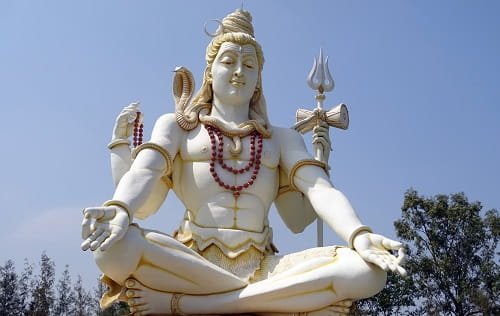
In Hindu cosmology, Shiva is one of the Trimurti — the supreme triad of deities — and embodies the force of destruction that precedes regeneration. Known as the “Destroyer,” Shiva wields the power to bring entire yugas (cosmic ages) to an end in his Tandava dance of destruction. His third eye, when opened, releases divine fire that can annihilate the universe. Paradoxically, Shiva is also deeply venerated as a deity of auspiciousness, yoga, and liberation.
His manifestation as Mahakala (Great Time) positions him as the inevitable end of all things — not evil, but cosmic necessity embodied.
→ The Nataraja (Dancing Shiva) represents the cycle of creation and destruction
→ Shiva’s third eye burned Kama (the god of love) to ashes in Hindu texts
2. Kali (Hindu Mythology)
Kali is perhaps the most visually and conceptually arresting deity in all of world mythology — a goddess depicted with a garland of severed heads, a tongue dripping blood, and a skirt of dismembered arms, yet simultaneously a loving mother figure. She embodies Shakti (divine feminine power) in its most destructive form, representing time, change, and the annihilation of ego.
In mythology, Kali was summoned from Durga’s forehead to destroy the demon Raktabija — a demon who replicated from every drop of his own blood. Kali consumed every drop before it could touch the ground, ending the demonic threat.
→ Her name derives from “Kala” — time or darkness
→ Worshipped extensively in Bengal, Assam, and Kerala in India
3. Loki (Norse Mythology)
Loki is the most complex figure in Norse mythology — a shape-shifting trickster who begins as an ambiguous ally of the Aesir gods and ends as the architect of Ragnarok, the apocalyptic twilight of the gods. He fathers three of the most terrifying beings in Norse mythology: Fenrir (the wolf who swallows Odin), Jormungandr (the World Serpent who kills Thor), and Hel (ruler of the dead).
After engineering the death of Baldr (the most beloved god), Loki was bound until Ragnarok, when his release would signal the beginning of the end of the world.
→ Father of Fenrir, Jormungandr, and Hel — three agents of Ragnarok
→ Popularized in modern culture through Marvel’s MCU (played by Tom Hiddleston)
4. Set (Egyptian Mythology)
Set is the Egyptian god of storms, the desert, chaos, and foreigners — and one of the most controversial deities in the Egyptian pantheon. He murdered and dismembered his own brother Osiris, scattering his body parts across Egypt. Set’s battle with Horus (Osiris’s son) is one of the foundational mythological conflicts of ancient Egyptian religion, representing the eternal struggle between chaos and order.
Paradoxically, Set was also worshipped as a protector against foreign enemies and a defender of Ra’s solar barque against the chaos serpent Apep.
→ The original “evil god” archetype that influenced later mythology and religion
→ Set’s worship peaked during the Hyksos period (~1650-1550 BCE)
5. Ares (Greek Mythology)
Ares is the Greek god of war — not strategic warfare (that is Athena’s domain) but the raw, bloody, chaotic violence of battle. He embodies bloodlust, slaughter, and the frenzy of combat. Even among the Olympians, Ares was disliked — Homer describes Zeus calling him “the most hateful of all gods.” His Roman equivalent, Mars, was more dignified and associated with military strategy.
Ares’s children — Phobos (Fear) and Deimos (Terror) — accompany him into battle.
→ His companions: Phobos (Fear), Deimos (Terror), and Eris (Discord)
→ Despite being god of war, Ares often lost battles in myth — including to Athena and Hercules
6. Hades (Greek Mythology)
Hades rules the Greek underworld — a realm from which no living being returns without divine intervention. While not a god of evil per se (unlike the Judeo-Christian devil), Hades governs inevitable death and the permanence of mortality. His helmet of invisibility, the three-headed dog Cerberus at the gates, and the rivers Styx and Lethe make his domain impenetrable.
The abduction of Persephone and the Orpheus myth are among the most powerful mythological narratives involving Hades.
→ Ruled the underworld — one of three domains divided with Zeus (sky) and Poseidon (sea)
→ The name “Hades” was also used for the underworld itself in Greek mythology
7. Tezcatlipoca (Aztec Mythology)
Tezcatlipoca — “Smoking Mirror” — is one of the principal deities of the Aztec religion, associated with darkness, the night sky, conflict, sorcery, and the earth. He is an all-seeing deity whose obsidian mirror reveals all sins and hidden truths. In the Aztec creation cycle, multiple worlds (Suns) were destroyed and created, often involving Tezcatlipoca’s conflict with Quetzalcoatl.
He required human sacrifice to sustain the universe and was associated with jaguars — symbols of royal power and the underworld.
→ Required human sacrifice — particularly through the feast of Toxcatl
→ His obsidian mirror sees all — a concept reflected in modern fiction
8. Hel (Norse Mythology)
Hel is the ruler of Helheim — the Norse realm of the dead for those who die of illness, old age, or causes other than battle (warriors go to Valhalla). Half her body is described as alive and flesh-colored, and half dead and rotting — a powerful visual metaphor for her dual nature. She is the daughter of Loki and the giantess Angrboda.
Hel’s realm is cold, dark, and without the feasting and glory of Valhalla — a gray, bleak existence. She refused to release Baldr from her realm even when all the world wept for him.
→ The English word “Hell” derives from the Norse “Hel”
→ Daughter of Loki — one of three monstrous children who cause Ragnarok
9. Eris (Greek Mythology)
Eris, the goddess of discord, is responsible for arguably the single most catastrophic event in Greek mythology: throwing the golden “Apple of Discord” (inscribed “To the Fairest”) at the wedding of Peleus and Thetis — an event that set in motion the entire chain of events leading to the Trojan War. Through one act of deliberate chaos, she caused a decade-long war and the death of countless heroes and civilians.
→ Her apple started the chain of events leading to the 10-year Trojan War
→ Her Roman equivalent is Discordia
10. Apep / Apophis (Egyptian Mythology)
Apep (or Apophis) is the great serpent of chaos in Egyptian mythology — the eternal enemy of Ra (the Sun God) who attempts to swallow the solar barque every night as Ra travels through the underworld. Egyptian priests performed daily rituals to defeat Apep, including burning effigies and reciting specific curses. Apep represents primordial chaos that pre-existed creation and perpetually threatens to consume it.
Unlike most deities, Apep was never worshipped — only feared and ritually defeated.
→ Never worshipped — only ritually defeated daily
→ Later adapted into the Greek figure of Typhon, who threatened the Olympian gods
Frequently Asked Questions (FAQs)
Q1. Who is the most powerful god in all mythologies?
This depends entirely on the mythological system. In Hindu mythology, Shiva (or Brahman as the ultimate reality) holds the highest power. In Norse mythology, Odin is most powerful, though Ragnarok suggests his power has limits. In Greek mythology, Zeus reigns supreme but is himself bound by the Fates. Each tradition defines “most powerful” differently.
Q2. Is Loki actually evil in Norse mythology?
Loki is more accurately described as morally ambiguous than purely evil. In earlier Norse texts, he often helps the gods with his cleverness. His transformation into an architect of destruction comes later, particularly after the death of Baldr. Modern scholarship sees Loki as a trickster archetype — a necessary agent of change rather than a symbol of pure malice.
Q3. Why is Kali feared in Hinduism?
Kali is not primarily feared in Hinduism — she is deeply revered, particularly in Bengali tradition, as a maternal and protective force. Her fearsome appearance represents her role as destroyer of ego and ignorance. The Tantric tradition sees Kali’s destruction as liberating rather than terrifying. The “fear” interpretation is often a Western misreading of her iconography.
Q4. What is the most destructive event in world mythology?
Norse Ragnarok — the twilight of the gods — is arguably the most comprehensively destructive mythological event, involving the death of most major gods, the end of the world, and its eventual rebirth. The Hindu concept of Pralaya (cosmic dissolution) is even more absolute, ending the universe entirely before the next cycle of creation.
Q5. How has modern culture influenced mythological popularity?
Enormously. The Marvel Cinematic Universe has made Thor, Loki, and the Norse pantheon globally familiar. Games like God of War (2018 and 2022) introduced millions to both Greek and Norse mythology. The Percy Jackson series has sustained Greek mythology’s popularity with younger audiences. Hindu mythology has seen increased global interest through platforms like YouTube and web series.
Conclusion
The most dangerous gods in world mythology are not simply beings of destruction — they are mirrors of human nature, reflecting our fear of chaos, death, and the unknown. Whether it is Shiva’s cosmic dissolution, Kali’s time-consuming darkness, or Loki’s world-ending mischief, these divine figures have shaped human philosophy, art, and understanding for millennia. In 2026, their stories continue to resonate because the forces they represent — destruction, change, the inevitable end of things — are as relevant today as they were in the ancient world.

Brandon is the cheif editor and writer at WorldUnfolds.com. With a passion for storytelling and a keen editorial eye, he crafts engaging content that captivates and enlightens readers worldwide.