The development of firearms has fundamentally shaped human history, geopolitics, and warfare. In 2026, the world’s most dangerous guns range from man-portable infantry weapons capable of penetrating armored vehicles to hypersonic projectile systems that represent the frontier of directed energy and kinetic kill technology. This list covers both conventional and emerging weapons systems in active service or recently deployed globally.
Rankings are based on destructive capacity, effective combat range, rate of fire, penetration capability, tactical impact, and deployment in real-world conflicts. This is a factual reference article intended for military history enthusiasts, defense analysts, and informed citizens. All weapons mentioned are in the inventories of recognized national armed forces.
| Rank | Name | Key Trait | Danger Level |
| 1 | Barrett M82A1 / M107 | .50 BMG anti-materiel — 1,800m range | Extreme Anti-Materiel |
| 2 | DEFA 791B Cannon (Rafale) | 30mm aircraft cannon — 2,500 rds/min | Extreme (airborne) |
| 3 | GAU-8 Avenger (A-10 Thunderbolt) | 30mm rotary cannon — 3,900 rds/min | Extreme (airborne) |
| 4 | Milkor MGL / M32A1 | Semi-auto 40mm grenade launcher | Very High |
| 5 | M134 Minigun | 7.62mm — 6,000 rounds per minute | Very High |
| 6 | CheyTac M200 Intervention | .408 CT — 2,250m+ sniper range | Very High |
| 7 | FN Minimi / M249 SAW | Squad automatic — suppressive fire machine | High |
| 8 | AK-47 / AKM | Most proliferated — 100M+ worldwide | High (global reach) |
| 9 | Heckler & Koch HK416 | NATO standard assault rifle — elite forces | High |
| 10 | XM7 (Sig Sauer NGSW) | US Army’s 6.8mm replacement for M4 | High (cutting-edge) |
1. Barrett M82A1 / M107 (.50 BMG)
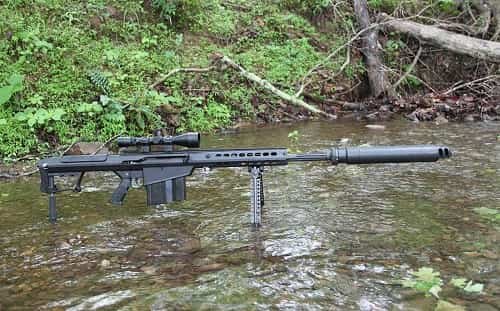
The Barrett M82A1, chambered in .50 BMG (12.7x99mm NATO), is the definitive anti-materiel rifle of modern warfare. Capable of engaging targets at ranges exceeding 1,800 meters with devastating effect on light vehicles, radar equipment, parked aircraft, and ammunition stores — as well as individual combatants — it has seen extensive use in every major conflict since the Gulf War. Ukrainian forces have deployed the Barrett extensively against Russian equipment since 2022.
Its semi-automatic action allows for rapid follow-up shots at extreme distances, making it far more tactically flexible than single-shot alternatives.
- Effective range: 1,800 m (anti-materiel), 1,200 m (anti-personnel)
- Muzzle velocity: 853 m/s — round remains supersonic well beyond 1,500 m
2. DEFA 791B Cannon (Dassault Rafale)
The Rafale’s integrated 30mm DEFA 791B revolver cannon delivers 2,500 rounds per minute and is carried internally on one of the world’s most combat-proven multirole fighters. The Rafale has seen combat in Afghanistan, Libya, Mali, Iraq, Syria, and most recently in Indian Air Force operations. The cannon is effective against aircraft, light armor, and ground targets.
- Rate of fire: 2,500 rounds per minute
- Used operationally in 6+ active conflict theaters
3. GAU-8 Avenger (A-10 Thunderbolt II)
The GAU-8 Avenger is a 30mm hydraulically driven seven-barrel Gatling-type rotary cannon that IS the A-10 Thunderbolt — the aircraft was designed around the gun. At 3,900 rounds per minute, firing depleted uranium or high-explosive incendiary rounds, the Avenger can destroy main battle tanks. Despite repeated US Air Force attempts to retire the A-10, Congressional support has kept it operational into 2026.
- The A-10 airframe was literally designed around the GAU-8
- Recoil force of the gun is approximately equal to the thrust of one of the A-10’s two engines
4. Milkor MGL / M32A1 Grenade Launcher
The Milkor Multiple Grenade Launcher (and its US military version, the M32A1) is a semi-automatic 40mm grenade launcher capable of firing six rounds in under three seconds. This allows a single soldier to saturate a target area with explosive rounds, dramatically increasing the firepower of a small infantry unit. In use with US Marine Corps, South African SANDF, and multiple other militaries.
- 6 rounds in under 3 seconds — unmatched in infantry grenade launcher category
- Effective range: 375 m (point target), 400 m (area target)
5. M134 Minigun (7.62mm)
The M134 Minigun is a six-barrel, electrically driven rotary machine gun capable of firing between 2,000 and 6,000 rounds per minute of 7.62x51mm NATO. Mounted on helicopters (UH-60 Black Hawk, AH-6 Little Bird), naval vessels, and ground vehicles, the Minigun creates a near-continuous wall of fire that is virtually unsurvivable in the open. It remains one of the most psychologically devastating weapons in modern arsenals.
- 6,000 rounds per minute = 100 rounds per second
- Used extensively in Vietnam War, both Gulf Wars, and ongoing special operations
6. CheyTac M200 Intervention
The CheyTac M200 Intervention fires the proprietary .408 Cheyenne Tactical cartridge — a round specifically designed for extreme long-range precision shooting. With verified kills at distances exceeding 2,100 meters, it extends the lethal reach of a single sharpshooter to over two kilometers. The ballistically superior .408 CT maintains supersonic flight and terminal performance at distances where conventional .308 or .338 rounds lose stability.
- Verified engagement distances exceeding 2,100 m
- Proprietary .408 CT cartridge remains supersonic beyond 2,000 m
7. FN Minimi / M249 SAW (Squad Automatic Weapon)
The FN Minimi, adopted by the US military as the M249 Squad Automatic Weapon, is the standard light machine gun for NATO infantry squads. Its combination of belt-fed ammunition (200-round box), 800+ rounds per minute rate of fire, and infantry portability gives a single soldier the sustained firepower of multiple riflemen. In every major NATO engagement since 1982, the SAW has been the backbone of infantry fire superiority.
- Rate of fire: 750-1,000 rounds per minute
- Standard issue in 40+ NATO and partner nation militaries
8. AK-47 / AKM (Kalashnikov)
The AK-47 and its evolved variants represent the most proliferated firearm in human history — with an estimated 100 million+ in circulation globally. Its simplicity, reliability in adverse conditions, and low manufacturing cost have made it the weapon of choice for militaries, insurgents, and armed groups across the planet since 1947. No single weapon has contributed to more conflict deaths in the 20th and 21st centuries.
- Estimated 100 million+ AK-pattern rifles in worldwide circulation
- Functional after being submerged in mud — legendary reliability
9. Heckler & Koch HK416
The HK416 is the gold standard assault rifle for elite military and special operations forces globally. It is chambered in 5.56mm NATO, uses a short-stroke gas piston system (eliminating the fouling issues of the AR-15/M16 direct impingement system), and is manufactured to extraordinary tolerances. Norway’s Armed Forces adopted it as their standard rifle; it was used to kill Osama bin Laden by US Navy SEALs in 2011.
The French Army selected the HK416 F as their standard service rifle in 2017, replacing the aging FAMAS.
- Used by German KSK, French GIGN, US SEAL Team 6, Norwegian Armed Forces
- Cyclic rate: ~850 rounds per minute in 5.56x45mm NATO
10. XM7 (Sig Sauer NGSW — Next Generation Squad Weapon)
The XM7, developed by Sig Sauer under the US Army’s Next Generation Squad Weapon program, fires a new 6.8x51mm cartridge designed to defeat body armor threats that standard 5.56mm NATO cannot penetrate. It entered limited US Army service in 2023-2024 and represents the first major US infantry rifle caliber change since the adoption of the M16 in the 1960s. Its suppressor-ready design and cartridge ballistics represent the cutting edge of infantry small arms.
- Entered US Army service 2023-2024 as M7 rifle
- New 6.8x51mm cartridge designed to penetrate modern ceramic body armor at combat ranges
Frequently Asked Questions (FAQs)
Q1. What is the most powerful handheld gun in the world?
Among man-portable weapons, the Barrett M82A1 in .50 BMG caliber is the most powerful commonly used anti-materiel sniper rifle. For revolvers, the Smith & Wesson Model 500 fires the most powerful commercially available revolver cartridge (.500 S&W Magnum). For rifles, the CheyTac M200 and similar anti-materiel rifles in .416 Barrett approach the practical limit of handheld firearm power.
Q2. How many AK-47s are in the world?
Estimates vary, but most defense analysts place the number of AK-pattern rifles (including AK-47, AKM, AK-74, and their variants) in global circulation at approximately 75-100 million. This makes it by far the most numerous military firearm in human history.
Q3. Is the GAU-8 Avenger the most powerful aircraft gun?
For aircraft in active service, the GAU-8 Avenger is among the most powerful due to its rate of fire (3,900 rpm) and caliber (30mm) combined. The Russian GSh-6-23 (23mm, 9,000 rpm) fires faster, but the GAU-8’s larger projectile delivers significantly more kinetic energy per round, making it more effective against armored vehicles.
Q4. What is the XM7 replacing in the US Army?
The XM7 (designated M7 in service) is replacing the M4 carbine (5.56mm) as the primary infantry rifle for US close combat units. Simultaneously, the XM250 automatic rifle (replacing the M249 SAW) and a new fire control system are being introduced as part of the same NGSW program.
Q5. Are any of these guns legal for civilian ownership?
In the United States, the Barrett M82A1 is legal for civilian purchase in most states (it is a semi-automatic rifle). The AK-47 (in semi-automatic configuration) is also widely legal. Automatic weapons like the M134 Minigun require a Class III Federal Firearms License and are heavily regulated under the National Firearms Act of 1934. Most aircraft-mounted cannons and military-specification automatic weapons are not available for civilian purchase.
Conclusion
The world’s most dangerous guns in 2026 span a technological spectrum from the time-tested simplicity of the Kalashnikov to the cutting-edge ballistics of the Sig Sauer XM7. What they share is the capacity to project lethal force with speed, accuracy, and scale that fundamentally shapes military strategy and global security. Understanding these weapons — their capabilities, their limitations, and their proliferation — is essential for informed discussion of defense policy, arms control, and the future of warfare.

Brandon is the cheif editor and writer at WorldUnfolds.com. With a passion for storytelling and a keen editorial eye, he crafts engaging content that captivates and enlightens readers worldwide.