Nature’s most beautiful creations are not always benign. Some of the world’s most visually stunning flowers harbor toxins potent enough to cause cardiac arrest, organ failure, or death with minimal exposure. From ancient poisons used by assassins to accidental garden poisonings of children and pets, dangerous flowers exist in every climate zone and across every continent. In 2026, poison control centers worldwide continue to record thousands of cases involving toxic plant ingestion annually.
This list ranks the world’s most dangerous flowers based on toxicity data (including LD50 values where available), frequency of poisoning incidents, lethality without treatment, and ecological invasiveness. Data draws on the American Association of Poison Control Centers, WHO phytotoxicology databases, and 2025 ethnobotanical research.
| Rank | Name | Key Trait | Danger Level |
| 1 | Monkshood / Aconite (Aconitum) | Absorbed through skin — no antidote | Extremely Lethal |
| 2 | Deadly Nightshade (Atropa belladonna) | Entire plant toxic — rapid onset | Very Lethal |
| 3 | White Snakeroot (Ageratina altissima) | Killed thousands incl. Lincoln’s mother | Very High |
| 4 | Oleander (Nerium oleander) | Cardiac glycosides — heart failure | Very High |
| 5 | Rosary Pea (Abrus precatorius) | Abrin — 75x more toxic than ricin | Extremely High |
| 6 | Angel’s Trumpets (Brugmansia) | Scopolamine — hallucinogenic & lethal | Very High |
| 7 | Lily of the Valley (Convallaria majalis) | Cardiac glycosides — common garden killer | High |
| 8 | Foxglove (Digitalis purpurea) | Source of digitalis — potent heart toxin | High |
| 9 | Autumn Crocus (Colchicum autumnale) | Colchicine — multi-organ failure | High |
| 10 | Rhododendron / Azalea | Grayanotoxin — “mad honey” poisoning | Moderate-High |
1. Monkshood / Wolfsbane (Aconitum species)
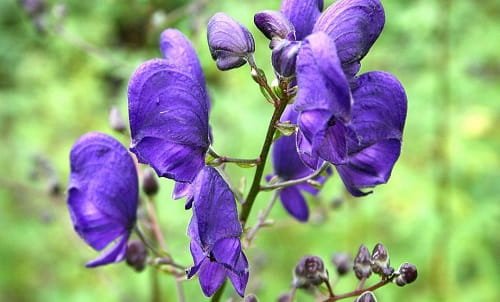
Monkshood (Aconitum napellus) is arguably the world’s most dangerous garden flower — and one of the most toxic plants on Earth. Its primary toxin, aconitine, is so potent that it can be absorbed through intact skin, causing immediate tingling, numbness, and progressing to respiratory paralysis and cardiac arrhythmia within hours. There is no specific antidote; treatment is purely supportive.
Historically, aconite was known as “queen of poisons” and was used in assassination attempts, including a 2009 case in the UK where a gardener died from skin contact after pruning Monkshood without gloves. Several murders involving aconite poisoning have been documented in the UK and India in the past decade.
- Absorbed through skin — gloves provide only partial protection (use nitrile, not latex)
- 2009 UK case: gardener died from skin contact while pruning — no intentional ingestion
2. Deadly Nightshade (Atropa belladonna)
Deadly Nightshade has one of the most storied toxic histories in botany. Its toxins — atropine, hyoscine (scopolamine), and hyoscyamine — cause dilated pupils, racing heart, hallucinations, convulsions, and death. The name “belladonna” (beautiful woman) refers to its historical use by Italian women to dilate pupils as a cosmetic.
Children are particularly at risk from the sweet-tasting black berries — 2-5 berries can kill a child, while 10-20 can kill an adult. The alkaloids also have medicinal applications — atropine is used in surgery and emergency cardiac care.
- 2-5 berries lethal to a child, 10-20 to an adult
- Atropine (derived from belladonna) is on the WHO Essential Medicines List — used in cardiac emergencies
3. White Snakeroot (Ageratina altissima)
White Snakeroot is responsible for one of the most historically significant plant poisoning events in North American history — “milk sickness,” which killed thousands of American settlers in the 18th and 19th centuries, including Nancy Hanks Lincoln (Abraham Lincoln’s mother), who died in 1818. The toxin tremetol passes from cows to their milk when cattle graze on the plant, then poisons whoever drinks the milk.
White Snakeroot is a wildflower found throughout eastern North America, featuring small white clustered flowers that appear innocent. Its danger was not understood until the 1830s when physician Anna Pierce Hobbs identified the plant as the cause.
- Killed Nancy Hanks Lincoln — Abraham Lincoln’s mother — in 1818
- Toxin (tremetol) passes through cow’s milk — “milk sickness” killed thousands of settlers
4. Oleander (Nerium oleander)
Oleander is one of the world’s most widely planted ornamental shrubs — found in gardens, highways, and parks across Mediterranean Europe, California, the Middle East, and South Asia — and is simultaneously one of the most dangerous. Every part of the plant contains cardiac glycosides (oleandrin and neriine) that disrupt heart rhythm. Ingestion of even a small amount can cause nausea, bradycardia, heart block, and death.
Cases have been documented where smoke from burning oleander branches, honey made from oleander nectar, and water in which oleander was placed have caused poisoning. In 2024, poison control centers in the US recorded over 400 oleander ingestion cases.
- Every part of the plant is toxic — flowers, leaves, bark, roots, nectar
- 400+ US poison control cases annually — one of the most common ornamental plant poisonings
5. Rosary Pea (Abrus precatorius)
The Rosary Pea produces striking red and black seeds commonly used in jewelry and crafts globally. But the seeds contain abrin — a toxin approximately 75 times more potent than ricin (the poison derived from castor beans). Even a single punctured seed can be lethal; intact seeds pass through the digestive system harmlessly, as the hard seed coat prevents abrin absorption.
The seeds are classified as a potential bioterrorism agent by the US CDC, alongside ricin. Jewelry makers who drill or sand rosary peas without protection are at risk of lethal abrin exposure.
- Abrin is ~75x more toxic than ricin (by weight)
- CDC Schedule 1 select agent — potential bioterrorism material
6. Angel’s Trumpets (Brugmansia species)
Brugmansia, native to South America and widely cultivated as an ornamental for its large, pendulous, fragrant trumpet-shaped flowers, contains scopolamine, atropine, and hyoscyamine — anticholinergic alkaloids that in low doses cause hallucinations and in higher doses cause delirium, hyperthermia, coma, and death. The plant is also associated with the infamous “burundanga” or “devil’s breath” criminal scopolamine cases in Colombia, where the purified alkaloid is used as an incapacitating agent.
All parts of Brugmansia are toxic, and deaths from recreational and accidental ingestion are regularly recorded in South America and Europe.
- Source of scopolamine — “devil’s breath” used in Colombian criminal poisoning cases
- All parts toxic — seeds most concentrated; deaths documented from tea made from leaves
7. Lily of the Valley (Convallaria majalis)
Lily of the Valley is a beloved garden plant with delicate, fragrant white bell-shaped flowers — and it is highly toxic from root to tip, including the red berries and even the water in which cut stems are placed. It contains over 30 cardiac glycosides (cardenolides) that disrupt the sodium-potassium pump in cardiac muscle cells, causing irregular heartbeat and potentially fatal arrhythmias.
In 2022, a family in Germany was poisoned by drinking the vase water after Lily of the Valley cut flowers were placed in it — demonstrating how insidious the danger is.
- Vase water becomes toxic — documented poisoning from drinking flower vase water
- Used as a motif in Kate Middleton’s wedding bouquet (2011) — most people are unaware of its toxicity
8. Foxglove (Digitalis purpurea)
Foxglove is both a beauty and a killer — its tall spikes of purple tubular flowers are garden favorites, yet the plant contains digitalis glycosides that in therapeutic doses treat heart failure (digoxin, derived from Foxglove, remains an important cardiac medication) and in toxic doses cause fatal heart arrhythmias. The margin between therapeutic and lethal dose is extremely narrow.
Children who eat Foxglove flowers, believing them harmless or attractive, are the most frequent victims. Even touching the plant extensively and then touching the face can cause skin and mucous membrane irritation.
- Source of digoxin — a still-essential cardiac medication
- Therapeutic and lethal dose are very close — narrow safety margin makes accidental overdose dangerous
9. Autumn Crocus (Colchicum autumnale)
The Autumn Crocus is a beautiful lilac-flowered plant that blooms in late summer and autumn in European meadows and gardens. It contains colchicine — a toxin that inhibits cell division by binding tubulin and disrupting microtubule formation. Poisoning causes a delayed multi-organ failure that progresses over 2-5 days: initially appearing as gastroenteritis, then causing bone marrow failure, cardiovascular collapse, and respiratory failure. There is no specific antidote.
The plant is frequently confused with wild garlic and wild leeks, leading to fatal foraging accidents in Europe annually.
- Colchicine poisoning: delayed multi-organ failure — symptoms begin 2-6 hours after ingestion
- Frequently confused with wild garlic — multiple foraging fatalities per year across Europe
10. Rhododendron / Azalea (Rhododendron species)
Rhododendrons and Azaleas contain grayanotoxins — a group of compounds found in all parts of the plant (flowers, leaves, pollen, nectar, and even honey made from rhododendron nectar). Grayanotoxin poisoning, known historically as “mad honey” poisoning, causes salivation, vomiting, low blood pressure, slow heart rate, and in severe cases, loss of consciousness and cardiac failure. “Mad honey” — honey produced by bees that forage on rhododendrons — remains a documented hazard in Turkey and Nepal.
- Mad honey (grayanotoxin) still sold and consumed in Turkey for its purported medicinal effects
- Rhodora (wild azalea) responsible for livestock deaths across North America and Europe
Frequently Asked Questions (FAQs)
Q1. Which flower is the most poisonous in the world?
Monkshood (Aconitum) is generally considered the most acutely dangerous flower due to its ability to cause lethal poisoning through skin absorption alone, with no specific antidote available. Rosary Pea seeds contain abrin, which is more potent by weight, but intact seeds are not immediately dangerous unless the coat is broken.
Q2. Are Lily of the Valley and Foxglove safe to handle?
Both should be handled with caution. Wearing gloves when handling either plant is advisable, particularly for prolonged contact. Wash hands thoroughly after handling either plant, and keep children and pets away from both. The primary danger from both is ingestion, not skin contact — but mucous membrane and eye contact can cause irritation.
Q3. What should I do if someone ingests a toxic flower?
Call your national Poison Control Center immediately (in the US: 1-800-222-1222; in the UK: 111). Do not induce vomiting unless specifically directed to do so by medical professionals, as this can cause further harm with some toxins. If the person loses consciousness or stops breathing, call emergency services (911/999/112) immediately.
Q4. Is it safe to have Oleander or Monkshood in a garden with children?
Most horticulturalists advise against growing highly toxic plants like Oleander, Monkshood, or Deadly Nightshade in gardens where young children have unsupervised access. However, with appropriate garden design (raised beds, barriers, labeling), adult supervision, and age-appropriate education about plant safety, risk can be managed. Many toxic plants are grown safely in botanical gardens worldwide with appropriate protocols.
Q5. What is “mad honey” and is it still a problem in 2026?
Mad honey is honey produced by bees that forage predominantly on Rhododendron flowers containing grayanotoxins. It remains most prevalent in the Black Sea region of Turkey (Karadeniz), where it is traditionally consumed in small amounts for its claimed medicinal properties. Cases of mad honey poisoning requiring medical treatment continue to be documented annually in Turkey, Nepal, and increasingly, in imported honey from these regions sold internationally.
Conclusion
The world’s most dangerous flowers are a compelling reminder that nature’s beauty can conceal extraordinary danger. From the skin-penetrating toxins of Monkshood to the heart-stopping glycosides of Lily of the Valley, these plants have shaped human history, medicine, and folklore for millennia. In 2026, with urban gardening surging in popularity and foraging for wild plants increasingly trendy, botanical literacy has become a genuine safety skill. Understanding which plants to admire from a distance — and which to handle with extreme caution — could one day save a life.

Brandon is the cheif editor and writer at WorldUnfolds.com. With a passion for storytelling and a keen editorial eye, he crafts engaging content that captivates and enlightens readers worldwide.