Dinosaurs ruled the Earth for approximately 165 million years — a span of time so vast that the T. Rex and the Stegosaurus are separated by more time than the T. Rex and modern humans. In that extraordinary span, evolution produced predators of a scale, power, and diversity that exceeds anything alive today. In 2026, paleontology is advancing rapidly — new fossil discoveries, biomechanical modeling, and CT scanning are continuously reshaping our understanding of how these magnificent creatures actually lived, moved, and killed.
This list ranks the 10 most dangerous dinosaurs based on current paleontological evidence, considering size, bite force, weaponry (claws, horns, armor), predatory behavior, and ecological dominance. Rankings draw on research published through 2026 in journals including Nature, PLOS ONE, and the Journal of Vertebrate Paleontology.
| Rank | Name | Key Trait | Danger Level |
| 1 | Tyrannosaurus Rex | Highest bite force of any land animal | Apex Predator |
| 2 | Spinosaurus | Largest carnivorous dinosaur — semi-aquatic | Apex Predator |
| 3 | Giganotosaurus | Larger skull than T. Rex | Apex Predator |
| 4 | Velociraptor (true size) | Pack hunting & sickle claw | Very Dangerous |
| 5 | Carnotaurus | Speed + bull horns | Very Dangerous |
| 6 | Ankylosaurus | Armored — tail club destroys bone | Defensive Extreme |
| 7 | Triceratops | 3 horns, charging capability | Defensive/Offensive |
| 8 | Allosaurus | Hatchet-like upper jaw attack | Very High |
| 9 | Therizinosaurus | 3-foot claws — largest of any known animal | High |
| 10 | Pachycephalosaurus | Dome skull — 25G impact force | High (impact) |
1. Tyrannosaurus Rex
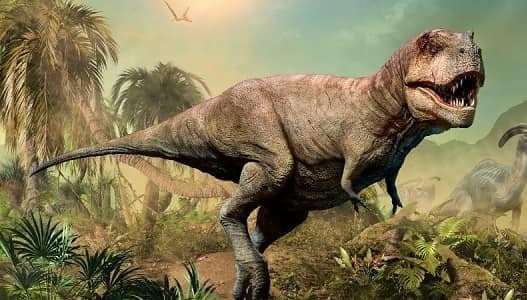
Rex remains the undisputed icon of prehistoric predatory power. A 2023 study published in Nature confirmed T. Rex’s bite force at approximately 3.5-8 tons of force — by far the highest of any known land animal in Earth’s history. Its skull, measuring up to 1.5 meters in length, housed 50+ banana-sized teeth designed not just to cut but to crush bone, allowing it to extract maximum nutritional value from prey.
Recent 2024-2025 research has refined our understanding of T. Rex’s sensory capability, suggesting it had a complex lip structure covering its teeth (rather than the exposed-tooth Jurassic Park model), forward-facing eyes providing stereoscopic vision, and potentially the ability to sense seismic vibrations. Evidence of T. Rex pack behavior remains debated but is supported by some fossilized trackway evidence from Canada.
- Bite force: 3.5-8 tons — highest of any known land animal
- 2024 research suggests T. Rex had lips, like lizards, not exposed teeth as commonly depicted
2. Spinosaurus (Spinosaurus aegyptiacus)
Spinosaurus is now accepted as the largest carnivorous dinosaur ever discovered — larger than T. Rex — with adult length estimates of 14-18 meters and weight estimates of 7-20+ tonnes (the range reflects uncertainty from incomplete fossil records). A 2020 Nature paper confirmed Spinosaurus was semi-aquatic, with dense bones for buoyancy control and limb proportions suited to swimming, likely hunting large fish like Coelacanths and prehistoric sharks.
As the only dinosaur known to exploit aquatic as well as terrestrial environments as a large predator, Spinosaurus occupied an ecological niche with essentially no competition. A 2022 fossil find in Morocco added further detail to its tail structure, revealing fish-tail-like adaptations for aquatic propulsion.
- Length: 14-18 meters — longest carnivorous dinosaur known
- 2022 Morocco fossil: tail showed fish-like adaptations for powerful aquatic swimming
3. Giganotosaurus (Giganotosaurus carolinii)
Discovered in Patagonia, Argentina in 1993, Giganotosaurus had a skull approximately 1.8 meters long — larger than T. Rex — and hunted the enormous titanosaur sauropods of South America, including Argentinosaurus (potentially the largest animal ever to walk the Earth). Unlike T. Rex’s bone-crushing approach, Giganotosaurus likely used a slashing attack with its serrated teeth to inflict blood loss on its massive prey over time.
- Skull: ~1.8 m — larger than T. Rex
- Preyed on Argentinosaurus — potentially the largest land animal in Earth’s history
4. Velociraptor mongoliensis (actual size)
The Velociraptor of Jurassic Park is cinematic fiction. The actual Velociraptor was approximately the size of a turkey — about 2 meters long and 0.5 meters tall, weighing 15-20 kg. It was feathered (confirmed by quill knobs on arm fossils), and its famous sickle claw (up to 6.5 cm) was likely used to pin prey, not to slash. The “raptors” in Jurassic Park are more accurately modeled on Deinonychus or Utahraptor.
However, even at turkey size, Velociraptor was a formidable pack hunter with intelligence exceeding most contemporaries (relative brain size among highest of known dinosaurs).
- Actual size: turkey-sized (~2 m long, 15-20 kg)
- Quill knobs confirmed on forearm fossils — definitely feathered
5. Carnotaurus (Carnotaurus sastrei)
Carnotaurus — “meat-eating bull” — was one of the most unusual large theropods, featuring two short horns above its eyes (unique among large carnivorous dinosaurs) and an extremely short, deep skull with a powerful bite. Crucially, footprint trackway analysis suggests Carnotaurus was one of the fastest large predatory dinosaurs, potentially reaching speeds of 48-56 km/h in short bursts.
Found in Patagonia, it was also one of the best-preserved large theropods, with exceptional skin impressions showing bumpy, crocodile-like scales.
- Estimated top speed: 48-56 km/h — among the fastest large carnivorous dinosaurs
- Best-preserved large theropod skin impressions ever found
6. Ankylosaurus (Ankylosaurus magniventris)
Ankylosaurus was the ultimate defensive dinosaur — covered in osteoderm armor fused to the skin, with a massive tail club (knob of fused bone) at the end of a stiff tail. Biomechanical studies suggest the tail club could swing at sufficient speed to shatter the leg bones of a T. Rex or comparable predator. Essentially invulnerable to attack from above or the sides, Ankylosaurus’s only vulnerability was its softer underbelly.
- Tail club swing force sufficient to fracture the bones of a T. Rex
- Armor (osteoderms) were embedded in the skin — effectively a natural coat of mail
7. Triceratops (Triceratops horridus)
Triceratops was one of the last and largest horned dinosaurs — up to 9 meters long, weighing 6-12 tonnes, with three horns (two brow horns up to 1 meter each and a nasal horn) and a massive neck frill. Evidence from multiple specimens shows healed bite marks from T. Rex on Triceratops frills and bones — confirming these were genuine combatants. CT scans of frills show vascular channels suggesting the frill may have been flushed with blood for display.
- Horns up to 1 meter long — confirmed used in combat against T. Rex
- Healed T. Rex bite marks found on multiple Triceratops specimens
8. Allosaurus (Allosaurus fragilis)
Allosaurus was the apex predator of the Late Jurassic, 80 million years before T. Rex dominated the Cretaceous. It used a distinctive “hatchet attack” bite strategy — opening its massive jaws and driving the upper jaw downward into prey with its neck muscles rather than a clamping bite. This allowed it to tackle prey far larger than itself, including large sauropods.
- Hatchet bite strategy — drove upper jaw into prey with neck muscles
- Apex predator for ~80 million years before T. Rex evolved
9. Therizinosaurus (Therizinosaurus cheloniformis)
Therizinosaurus possessed the longest claws of any known animal — each curved forearm claw measuring up to 1 meter in length. Paradoxically, despite its terrifying armaments, Therizinosaurus was a herbivore — using its claws to pull down tree branches. However, an animal with 1-meter hooked claws capable of swinging them in defense presents a unique danger profile that places it on any “most dangerous” list regardless of intent.
- Claws: up to 1 meter each — longest of any known animal
- Despite terrifying appearance, it was a herbivore — used claws to gather vegetation
10. Pachycephalosaurus (Pachycephalosaurus wyomingensis)
Pachycephalosaurus had a dome-shaped skull up to 25 cm thick — far beyond structural necessity for brain protection. Biomechanical studies published in 2023 confirm the dome was used for head-butting combat, both between members of the same species and potentially in defense against predators. A head-butt from a large Pachycephalosaurus, modeled at 25G of impact force, would be sufficient to break bones on impact.
- Skull dome: up to 25 cm thick — confirmed used in intraspecific combat
- 2023 study: impact force modeled at 25G — sufficient to fracture large bones
Frequently Asked Questions (FAQs)
Q1. Was T. Rex really the most dangerous dinosaur?
Ans: Rex was likely the most dangerous large predator in its specific ecosystem and time period (Late Cretaceous North America). But Spinosaurus was larger, Giganotosaurus had a bigger skull, and Velociraptor (and related dromaeosaurids like Deinonychus) arguably had more sophisticated hunting intelligence. “Most dangerous” depends on the metric — bite force, size, speed, intelligence, or ecological dominance.
Q2. Were Velociraptors really as smart as Jurassic Park shows?
Ans: Real Velociraptors were definitely intelligent relative to other dinosaurs — their encephalization quotient (brain-to-body ratio) was among the highest of known non-avian dinosaurs. However, the Jurassic Park velociraptors are modeled on Deinonychus or Utahraptor (much larger) and depicted with intelligence approaching primate level, which is not supported by current evidence. They were smart predators, not puzzle-solvers.
Q3. What is the newest dangerous dinosaur discovered?
Ans: Several significant predatory dinosaur discoveries have occurred in 2023-2025. Meraxes gigas (Argentina, 2022) was a massive carnivore with a large skull like Giganotosaurus. Spectrovenator ragei (Brazil, 2023) revealed new information about early predatory dinosaur evolution. Ongoing excavations in Patagonia continue to yield large carnivorous dinosaur finds regularly.
Q4. How do we know dinosaur bite force?
Ans: Bite force is estimated through biomechanical modeling — scientists measure the attachment points and estimated mass of jaw muscles based on skull fossil anatomy, then use engineering software to model the forces generated. For T. Rex, the bone-crushing evidence (shattered bones with the teeth marks embedded) also provides direct empirical confirmation that its bite was powerful enough to compress bone.
Q5. What is the largest dinosaur ever found?
Ans: The largest dinosaur by size was almost certainly a titanosaur sauropod (plant-eater), not a predator. Patagotitan mayorum (discovered in Argentina, 2017) is currently the leading candidate for the largest dinosaur known, with estimates of 69-77 tonnes and 37 meters in length — roughly the weight of 10 African elephants. Argentinosaurus may have been even larger, but fossil material is too fragmentary for definitive comparison.
Conclusion
The most dangerous dinosaurs represent evolution’s most extraordinary experiments in predatory power, defensive armament, and ecological dominance. In 2026, paleontology continues to reveal new details that challenge and enrich our understanding of these ancient giants — from T. Rex’s lips to Spinosaurus’s tail. Each new discovery reminds us that the story of Earth’s most dangerous prehistoric animals is still being written, one fossil at a time, in the rocks of Patagonia, the Gobi Desert, and the badlands of Montana.

Brandon is the cheif editor and writer at WorldUnfolds.com. With a passion for storytelling and a keen editorial eye, he crafts engaging content that captivates and enlightens readers worldwide.