Not all airports are created equal. While modern aviation is statistically the safest form of long-distance travel, certain airports around the world present exceptional challenges that push pilots, aircraft, and passengers to their limits. Short runways perched on cliff edges, constant crosswinds in narrow mountain valleys, fog-shrouded approaches over hostile terrain, and active conflict zones all make some airports genuinely perilous to operate.
This list is compiled from aviation safety databases, pilot accounts, ICAO (International Civil Aviation Organization) data, and incident reports as of 2025-2026. These airports are still operational — a testament to the skill of the aviators who serve them — but they demand extraordinary precision, experience, and respect.
| Rank | Name | Key Trait | Danger Level |
| 1 | Lukla Airport, Nepal | Cliff-edge runway, no go-around | Extremely High |
| 2 | Paro Airport, Bhutan | Mountain valley approach | Very High |
| 3 | Toncontin Intl, Honduras | Steep descent in urban valley | Very High |
| 4 | Princess Juliana, St Maarten | Beach-level threshold crossing | High |
| 5 | Gibraltar Airport | Road crosses active runway | High |
| 6 | Narsarsuaq, Greenland | Glacier winds & fog approaches | High |
| 7 | Courchevel Airport, France | Uphill slope runway in Alps | High |
| 8 | Kabul Intl Airport, Afghanistan | Active conflict zone | Extremely High |
| 9 | Barra Airport, Scotland | Beach runway, tide-dependent | Moderate-High |
| 10 | McMurdo Station, Antarctica | Ice runway, extreme conditions | Moderate-High |
1. Lukla Airport (Tenzing-Hillary Airport), Nepal
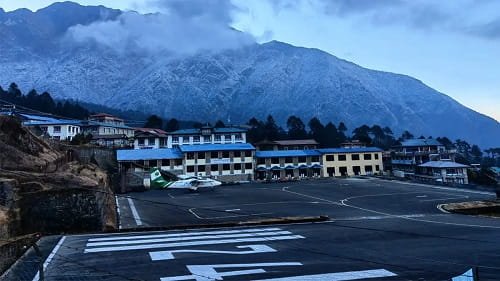
Widely regarded as the world’s most dangerous airport, Lukla serves as the gateway to the Everest region and sits at 9,383 feet above sea level in the Khumbu Valley. Its runway is just 527 meters long, ends at a sheer cliff drop, and begins against a mountain wall — meaning there is no go-around option on landing. Pilots must get the approach right the first time.
Cloud cover and fog can roll in within minutes, trapping aircraft, and strong Himalayan thermals create unpredictable turbulence. Several accidents have occurred here, most recently with smaller propeller aircraft and helicopters.
- Runway length: 527 m (one of the world’s shortest commercial runways)
- Altitude: 9,383 ft — only certified pilots with special training may land here
2. Paro Airport, Bhutan
Paro is located in a deep Himalayan valley surrounded by peaks exceeding 18,000 feet. Approaches require sharp turns at low altitude through mountain corridors, and only a handful of specially certified pilots in the world are authorized to land there. As of 2026, only 24 pilots are cleared to operate commercial landings at Paro.
Wind shifts, altitude, and the visual-only approach (no instrument landing system) make this one of the most technically demanding commercial airports on Earth.
- Only ~24 pilots globally certified for Paro approaches
- No ILS — purely visual approach required
3. Toncontin International Airport, Honduras
Located in the capital Tegucigalpa, Toncontin is surrounded by hills on all sides and sits in a narrow valley with an urban environment crowded around the runway. Pilots must execute a sharp turn at extremely low altitude — essentially a 45-degree bank — just seconds before touchdown.
A 2008 crash and numerous near-misses have led to ongoing debates about whether to relocate the airport, but it remains operational as of 2026.
- One of the shortest international runways in Latin America at ~2,163 m
- 45-degree banking turn required at less than 500 ft altitude
4. Princess Juliana International Airport, St Maarten
Princess Juliana is famous for its beach-threshold approach — aircraft must pass within 20-30 meters of beach sunbathers over a fence before touching down. While technically manageable for trained pilots, the shallow approach, potential for jet blast accidents on the beach, and crosswinds make it a frequently cited dangerous airport.
A tourist was killed by jet blast in 2017, and the airport was heavily damaged by Hurricane Irma, reopening in phases afterward.
- Aircraft pass within ~20 m of Maho Beach on approach
- Jet blast from departing aircraft has caused serious tourist injuries
5. Gibraltar Airport
Gibraltar Airport has one of the most unusual danger profiles of any civilian airport: Winston Churchill Avenue — a main road through the territory — crosses the active runway perpendicularly. Traffic is stopped by barriers and red lights when aircraft are landing or departing.
Strong “Levanter” winds that funnel through the Strait of Gibraltar create significant crosswind challenges for pilots.
- A public road literally crosses the runway
- Levanter winds create challenging crosswind conditions regularly
6. Narsarsuaq Airport, Greenland
In southern Greenland, Narsarsuaq serves as a key airport but faces extreme challenges including dense fog, katabatic glacier winds, and one of the trickiest fjord approaches in aviation. Pilots must navigate through a fjord flanked by mountains with minimal instrument support.
- Katabatic winds can surge unexpectedly
- Surrounded by glaciers with limited emergency landing options
7. Courchevel Airport, France
Nestled in the French Alps at 6,588 feet, Courchevel’s runway is famously short (537 meters) and slopes uphill at 18.5% — the steepest runway gradient of any public airport in the world. Aircraft must touch down before a ridge and stop before a wall. Only specially licensed pilots may operate here.
- Runway gradient: 18.5% — steepest of any public airport globally
- Popularized by the James Bond film “The World Is Not Enough”
8. Kabul International Airport, Afghanistan
Since the Taliban takeover in August 2021, Kabul’s main airport has operated in a deeply precarious environment. International airlines largely suspended service after chaotic evacuation scenes. Limited international flights resumed under UAE-led management by 2023, but security threats — including ISIS-K bombings at the airport perimeter — remain a persistent concern through 2025-2026.
- ISIS-K bombed the airport gate in August 2021, killing 170+ civilians
- Limited international commercial flights operating as of 2026 under strict security
9. Barra Airport, Scotland
Barra Airport in the Outer Hebrides, Scotland, is the world’s only scheduled service airport that uses a beach as its runway. The Cockle Strand beach doubles as the runway, meaning flight schedules are dictated by tide timetables. Landings can only occur during low tide, and the runway disappears underwater twice a day.
- The only commercial airport in the world with a tidal beach runway
- Flight schedules are published in alignment with tide tables
10. McMurdo Station Airfields, Antarctica
Antarctica’s McMurdo Station operates two primary airfields — one on ice shelf and one on a compacted gravel surface. Extreme cold, whiteout conditions, and crevasse risks make operations here among the most challenging in the world. Emergency landing options essentially do not exist. Aircraft must be specially configured for Antarctic operations.
- Temperature can drop to -50°C (-58°F) affecting all aircraft systems
- No alternate divert airports within range — McMurdo is the only option
Frequently Asked Questions (FAQs)
Q1. Which is statistically the most dangerous airport in the world?
Ans: Lukla Airport in Nepal (Tenzing-Hillary Airport) is most consistently cited by aviation experts as the world’s most dangerous due to its extreme terrain, short cliff-edge runway, unpredictable Himalayan weather, and absence of go-around options.
Q2. Are dangerous airports still safe to fly into?
Ans: Generally, yes — but with significant caveats. These airports employ stringent pilot certification requirements, weather minimums, and safety protocols. When operated within these parameters, they function safely. The danger comes from system failures, weather deviations, or procedural non-compliance.
Q3. Why doesn’t Gibraltar close its road during aircraft operations?
Ans: The road closure IS part of the procedure — barriers and signals stop traffic automatically when aircraft are on approach or departure. The system has functioned for decades without a road-runway collision, though it remains an unusual arrangement by global aviation standards.
Q4. Which airports have been closed due to safety concerns?
Ans: Kai Tak Airport in Hong Kong (closed 1998) is one of the most famous historical examples. Toncontin in Honduras has faced closure debates. Several Antarctic airfields operate seasonally and are closed during extreme winter conditions.
Q5. How do pilots get certified for extreme airports like Paro or Lukla?
Ans: Certification for extreme airports typically involves extensive simulator training for the specific approach profiles, multiple supervised flights with senior-certified captains, and regulatory approval from the civil aviation authority of both the airline’s country and the airport’s country. These certifications must be renewed periodically.
Conclusion
The world’s most dangerous airports are simultaneously testaments to human engineering ambition and to the extraordinary skill of the pilots who serve them. In 2026, aviation technology continues to improve approach systems, weather forecasting, and emergency response — making even these extreme environments incrementally safer. But the fundamental physical challenges of terrain, weather, and conflict that make these airports dangerous cannot be engineered away entirely. For adventurous travelers, understanding these risks adds a layer of appreciation for every safe landing.

Brandon is the cheif editor and writer at WorldUnfolds.com. With a passion for storytelling and a keen editorial eye, he crafts engaging content that captivates and enlightens readers worldwide.